
Sandbach Flashes: birds and wildlife

About the Atlas
During the three breeding seasons 2004–06 and three winters 2004/05–2006/07, Cheshire and Wirral Ornithological Society (CAWOS) organised more than 350 volunteers to survey all of the county, trying to find every species of bird that was breeding or wintering
Meadow Pipit Anthus pratensis
Breeding
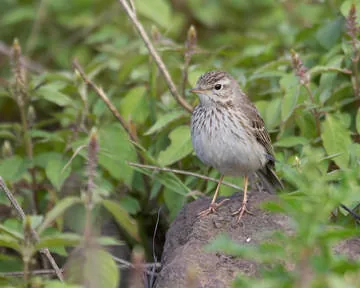
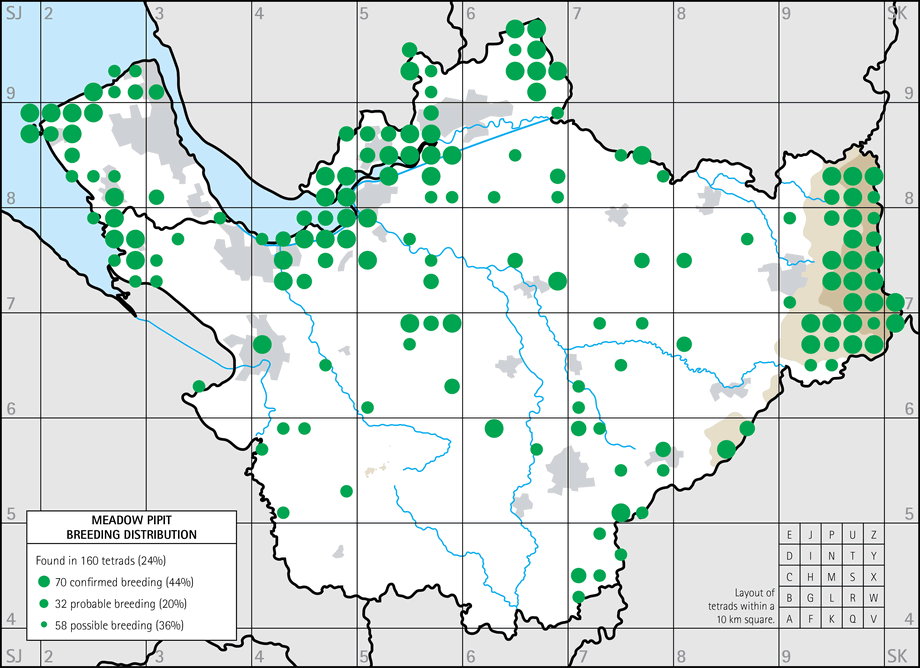
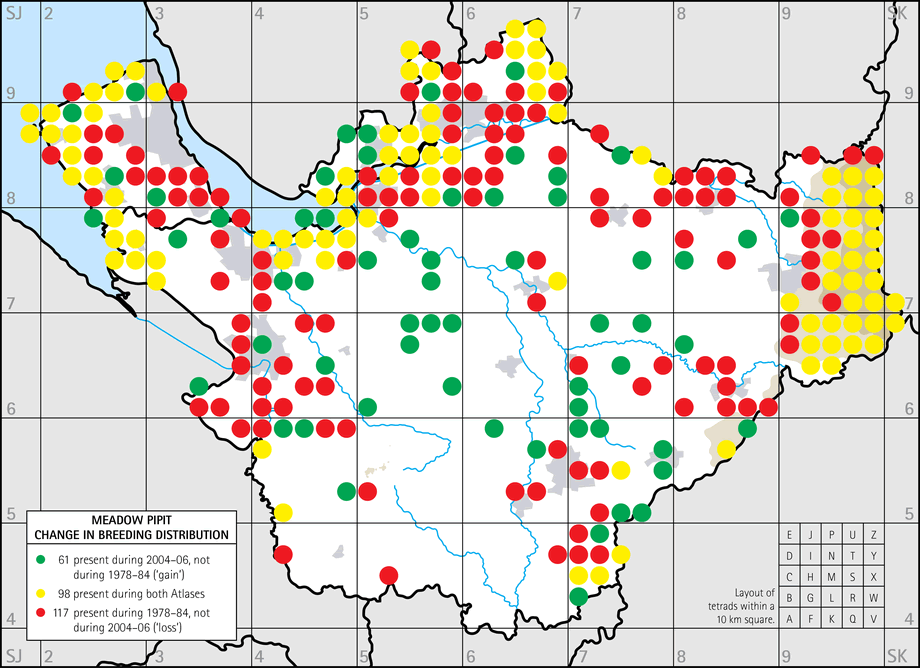
This is the commonest bird, and the most obvious, in the eastern hills, but is equally at home in low-lying areas near the coast and on rough land in some sites inland. They seem to favour some post-industrial land, including brownfield sites in peri-urban areas and the edges of sand quarries. Meadow Pipits avoid mature trees and are mainly birds of rough grassland or moorland, but the submitted habitat codes for all birds do not show that, with 102 farmland, 43 semi-natural grassland, 22 on estuarine saltmarsh and 11 heathland and bog. A truer picture is obtained for the tetrads with confirmed breeding only: 24 farmland (11 of which were unimproved grassland, with 9 improved grassland), 22 semi-natural grassland, 15 estuarine saltmarsh and 7 heathland and bog.
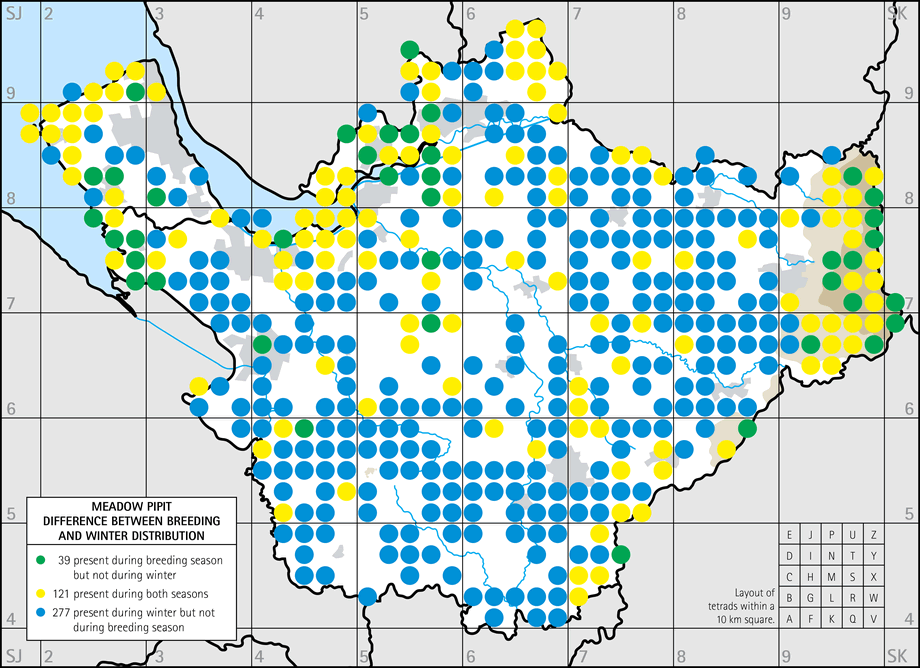
The map exaggerates the species’ apparent presence during the breeding season. Many of the small dots are probably attributable to passage birds. Spring passage, of birds returning from as far as Iberia and Morocco, is noticeable through March and into April, and birds may be found in apparently suitable breeding habitat for a day or two, males sometimes singing, but they do not stay to breed. Further, half (17 out of 32) of the ‘probable’ breeding record codes are ‘D’ – display – and some observers have allotted this code to the characteristic ‘parachuting’ song flight of a single bird.
Most birds in the lowlands are paired on territory during April, although they are later at higher altitudes. The 119 broods that I have ringed at Frodsham Marsh, 1981 to 2007, have hatching dates from 7 May, with the peak of first broods hatching on 18 May. Most females lay five eggs and raise an average of 4 chicks, and many pairs have a second brood in July, averaging 3 chicks. They betray the presence of chicks with their anxious ‘pit-pit’ calls, but the nests can be challenging to find, and only 9 tetrads recorded NY or NE, with a further 3 FS codes as adults sometimes carry their chicks’ faecal sacs one hundred metres or more before dropping them. Meadow Pipits eat, and feed their chicks on, a variety of flies that they find on the ground. They mostly take the flying forms rather than larvae, especially favouring the seasonally abundant craneflies and mayflies. Adults are obvious when carrying beak-loads of invertebrates for their chicks, and 44 of the 67 confirmed breeding codes were FY. Chicks leave their nests before they can fly properly, and 11 tetrads furnished RF records of chicks fluttering weakly.
The BTO analysis of 2004-05 BBS data puts the breeding population of Cheshire and Wirral as 5,300 birds (with wide confidence limits of 190 to 10,410). As shown by the abundance map, most of these are in the eastern hills, with the moorland areas holding as many as 68 birds per tetrad. The best habitats can hold local concentrations up to perhaps 1 pair per hectare (Simms 1992), a density equivalent to 400 pairs per tetrad.
Atlas account sponsored by Jane Turner
Winter
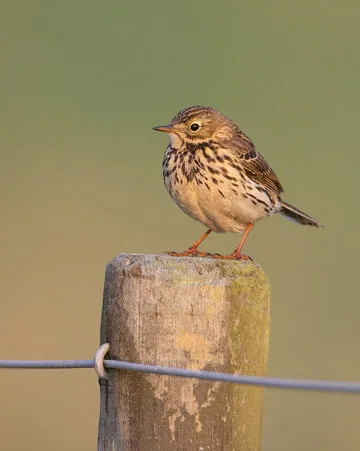
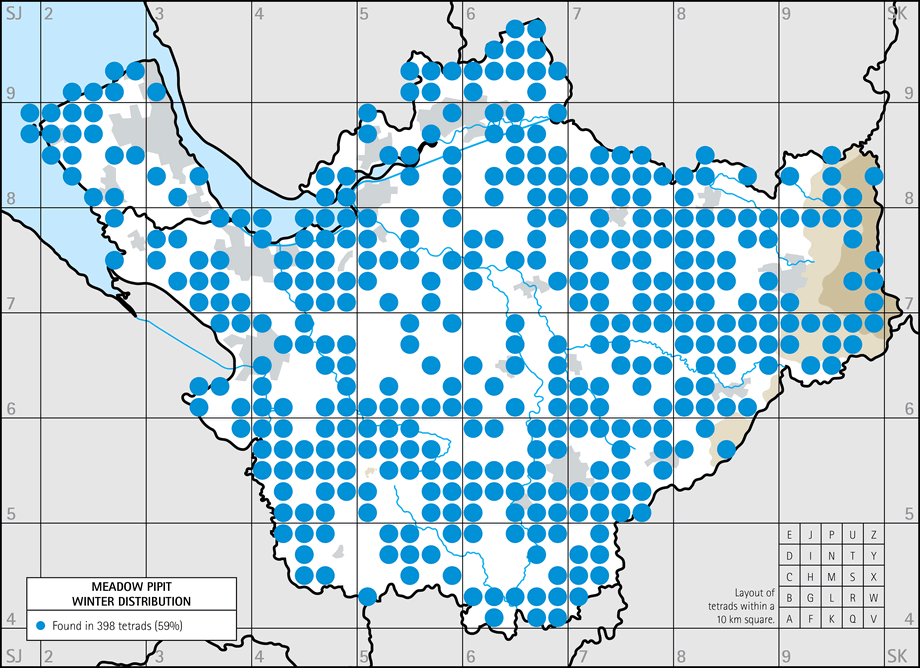
The Atlas map shows that wintering Meadow Pipits are distributed throughout the county, and they must be much more widespread now than they used to be. Older ornithologists wrote mainly about their status in freezing conditions. Coward and Oldham (1900) said that in hard winters the moorlands are deserted but a correspondent saw Meadow Pipits on the hills near the Cat and Fiddle in mild weather on 5 January 1899. It is also absent in winter from many parts of the plain, but on the Dee marshes and in the water meadows bordering the larger rivers it may be found all the year round. Coward (1910) added that hard weather drives the birds to the marshes, where, in severe frost they are very abundant. Boyd (1946) commented on a Meadow Pipit in January 1945 which lived for five days at the bottom of a ditch, ‘usually walking in the shallow water like a tiny wader; an odd choice for a bird which often leaves these islands for Portugal and southern Spain in winter’. Bell (1962) copied Coward’s description of the species’ seasonal status.
In winter Meadow Pipits seek out invertebrates, especially in sites such as sewage works, farmland slurry pits and the damp corners of fields, but otherwise eat almost any type of small seeds. Their ecology seems similar to that of Pied Wagtails, but pipits are much less likely to use human sites, and the map shows that few of the county’s urban tetrads had records of Meadow Pipits. Birds were present in about half of the upland breeding tetrads, some of them noted as returning early in spring, but others found in midwinter, although far fewer than during the breeding season.
With their substantial southward autumn movement, Meadow Pipit is one of the most obvious species for those watching visible migration, and the northern half of Britain – where most Meadow Pipits breed – is only sparsely occupied in winter (BTO Winter Atlas). The species’ traditional wintering grounds lie as far south as the Mediterranean but the destination of Cheshire and Wirral breeders is not known in our changing climate: as a partial migrant, the proportion staying in Britain is likely to have increased with the milder weather of the last two decades.
The winter habitat codes were scattered thinly across a wide range, but the vast majority (83%) were of farmland, with 7% semi-natural grassland and marsh. Cheshire farmland may be inhospitable for them in the breeding season, but in winter it is able to support Meadow Pipits. 41% of the total were improved grassland and 12% unimproved grassland, with 9% stubble. This is the small passerine with the highest number of records in unimproved grassland.
From the counts submitted by surveyors for this Atlas, the median flock size is ten birds, so the county wintering population of Meadow Pipits is at least 5,000 birds. By chance, this is much the same as the breeding population, but most of the birds are different individuals.
Atlas account sponsored by Jane Turner