
Sandbach Flashes: birds and wildlife
About the Atlas
During the three breeding seasons 2004–06 and three winters 2004/05–2006/07, Cheshire and Wirral Ornithological Society (CAWOS) organised more than 350 volunteers to survey all of the county, trying to find every species of bird that was breeding or wintering
Mediterranean Gull Larus melanocephalus
Breeding
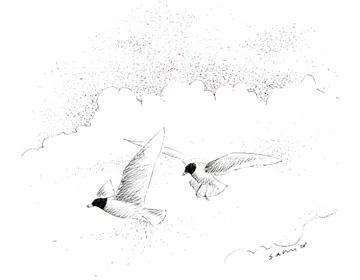
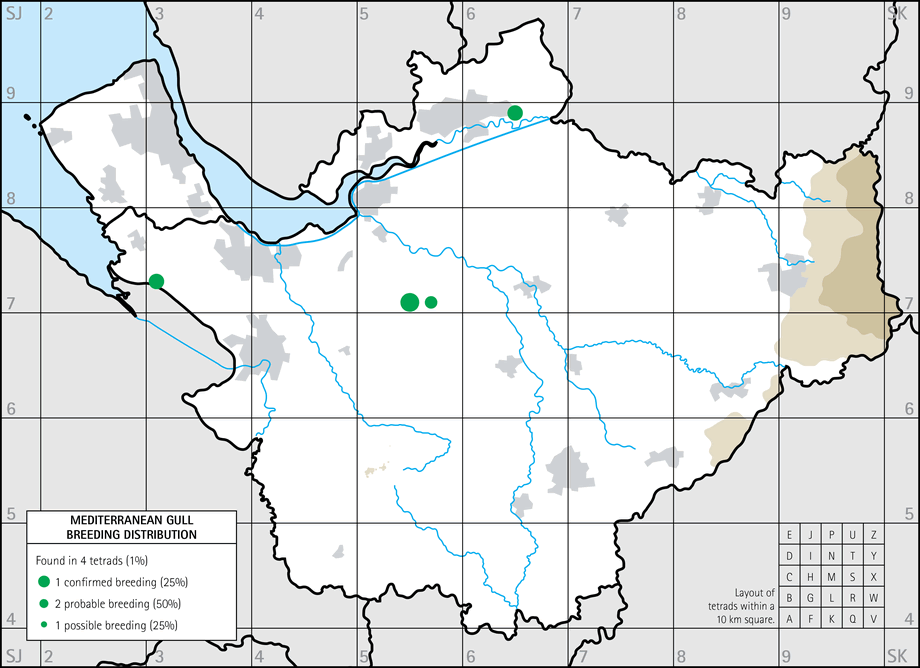
Mediterranean Gulls marked the start of this Atlas in 2004 with their first breeding in the county; not, as many expected, at Woolston (SJ68P) or Inner Marsh Farm (SJ37B), where birds had displayed to Black-headed Gulls for years, or paired with immature conspecifics, but in the Black-headed Gull colony at Blakemere Moss (SJ57K) in Delamere Forest.
They first bred in Britain, in Hampshire, in 1968 and 1969, but the initial colonisation was slow because most of the pioneering birds were males and few female Mediterranean Gulls reached Britain. Many early pairings were with female Black-headed Gulls, sometimes producing hybrid offspring although none of them seems to have been fertile. They next produced chicks in Hampshire in 1976, then in Kent in 1979 but it was the 1990s before they spread, with successful breeding in eight counties during that decade (Brown & Grice 2005). The northward expansion included breeding in Lancashire from 1997 and in Greater Manchester in 2003. By 2004 there were 183-241 pairs breeding at 26 sites in 15 counties (Holling et al 2007).
Mediterranean Gulls do not normally breed until three years of age, although some two-year-olds try to do so, and they spend much of their time in Black-headed Gull colonies. The build-up to Mediterranean Gulls’ breeding in Cheshire and Wirral, as in most counties, is clouded by the behaviour of two-year-old birds and interactions with Black-headed Gulls. In most years from 1995 to 2004 pairings including immature birds and mixed-species displayed and sometimes built nests, at Inner Marsh Farm, Frodsham Marsh or Woolston (CWBRs). Breeding finally occurred in 2004 when several adult Mediterranean Gulls visited the county’s largest Black-headed Gull colony at Blakemere (SJ57K) – the first time that they had been recorded there – and at least two pairs raised young. Three pairs nested at Blakemere in 2005 and six birds were seen on nests in 2006. It seems that, given the initial stimulus, most of the county’s birds with breeding intent now gather at the one site, as there were fewer records at Inner Marsh Farm or Woolston in 2005 and 2006 than for the previous decade.
Most Mediterranean Gull colonies are in tidal lagoons but they seem equally at home on the county’s freshwater sites. Their diet should place no restriction on their distribution because their main food during the breeding season appears to be terrestrial invertebrates, especially earthworms, and insects (Mitchell et al 2004).
Atlas account sponsored by Peter F. Twist
Winter
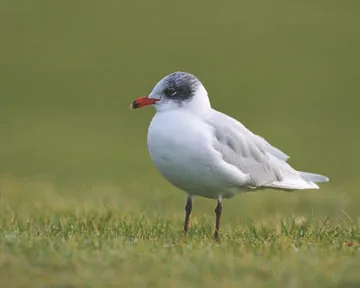
The rise in numbers of this species in Britain has been remarkable. Until 1940 only four or five had ever been recorded, and it remained so rare that records were considered by the British Birds Rarities Committee until 1962. The first in Cheshire and Wirral was identified in 1967 and the species has been recorded every year since. Until about 1994 most records were from the Wirral coast, including the Mersey Narrows, but since then birds have been widespread across the county.
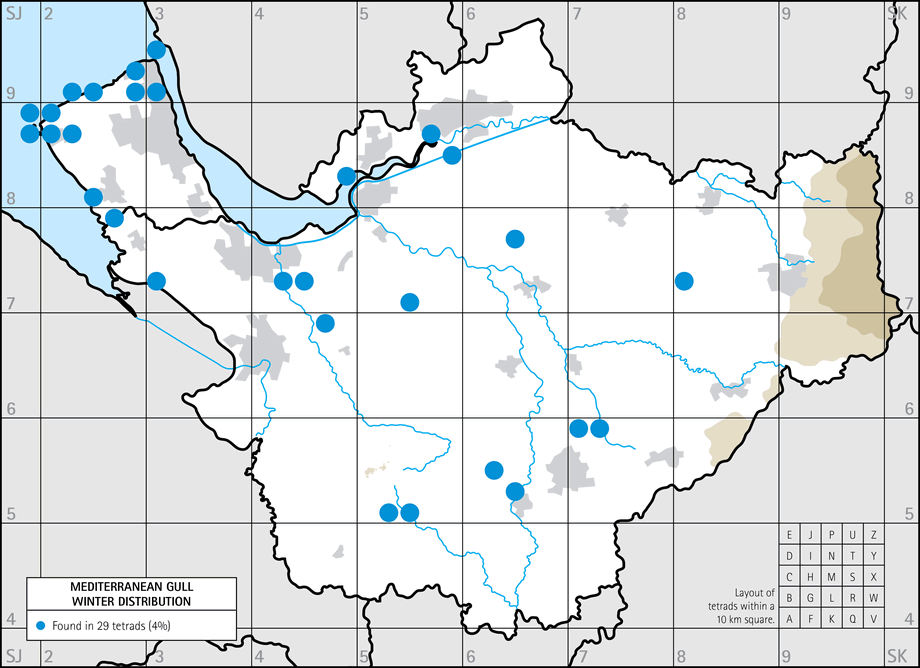
During this Atlas birds were recorded in 29 tetrads, with about a dozen birds each winter of this survey. This is typical of any year in the last ten, since the Cheshire and Wirral Bird Report for 1998 noted that wintering numbers appear to be relatively constant. There is a mixture of site-fidelity and nomadism, with some individuals regularly appearing for several years in succession, and others newly arriving and visiting new sites. Several birds have been noted wearing rings indicating that they were hatched in colonies on the north coast of France or Belgium. In Lancashire, where some observers have carefully observed and reported rings, there are also records of birds from eastern Europe – Poland, Czech Republic, Slovakia, Hungary and the Ukraine, showing that some of the Mediterranean Gulls have come from as far as the Black Sea, the heart of the species’ distribution (White et al 2008).
The submitted habitat codes indicate the breadth of areas exploited by Mediterranean Gulls, with 10 records of marine habitats (4 open sea/ shore, 6 estuarine), 11 freshwater (2 small waterbody, 8 lake/ reservoir/ sandpit, 1 river) and four farmland (3 grassland, 1 stubble). Their winter food is similarly varied, marine fish and molluscs, terrestrial invertebrates and anything edible discarded by man. The only record of two birds together during this Atlas survey was at Meols (SJ29F) where Richard Smith saw them ‘feeding on scraps next to a mobile chippy, just over the sea wall from the shore’.
Atlas account sponsored by Peter F. Twist