
Sandbach Flashes: birds and wildlife

About the Atlas
During the three breeding seasons 2004–06 and three winters 2004/05–2006/07, Cheshire and Wirral Ornithological Society (CAWOS) organised more than 350 volunteers to survey all of the county, trying to find every species of bird that was breeding or wintering
Merlin Falco columbarius
Breeding
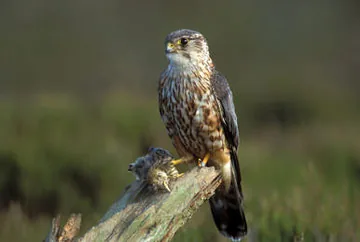
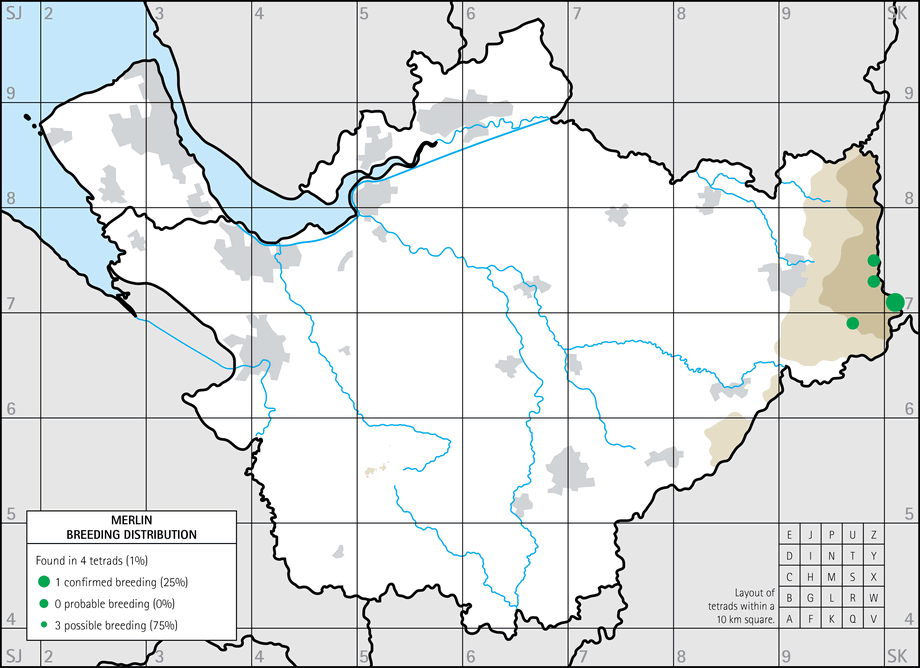
The Merlin is one of a group of predatory birds – with Hen Harrier and Short-eared Owl – that breeds on the fringe of Cheshire and might or might not actually nest in the county. During this Atlas survey, one was seen carrying food to chicks in 2004, the first confirmed breeding within the existing county boundaries for at least seventy years.
It is not at all clear when breeding last took place. Bell (1967) noted a nest in 1951 and 1952 in Longdendale, not now part of Cheshire, and Bell (1962) said that ‘during the last 25 years there is no evidence of it having bred in the hills’, implying that it did so before then, but giving no further substantiation. Coward and Oldham (1910) wrote that ‘possibly an odd pair of Merlins may succeed in rearing their brood on the moors east of Macclesfield, as they undoubtedly do just beyond the Staffordshire border’.
The Merlins of the south Peak District, of which Cheshire forms a small part, have been well studied for the last half-century. A population of 45 pairs in the 1950s suffered a catastrophic decline to near-extinction by 1980, after which the number of occupied nesting areas in the south Pennines increased from 2 (in 1980) to 66 (in 1992) (Newton et al 1981, Brown & Stillman 1998). Their decline had probably been caused – as has been well documented for another bird-eating falcon, the Peregrine – by accumulation of organochlorine pesticides. Merlins feed almost exclusively on small passerines, especially Meadow Pipits which can make up half of their diet. The population recovery followed the gradual cessation of use of these pesticides, aided by a reduction in persecution and egg-collecting.
The records published in Cheshire and Wirral annual bird reports track the recovery. There were odd records in suitable habitat in 1970, 1987, 1989, 1990, 1991, 1993, 1994, 1995, 1996, 1997, 2000 and 2001, and a pair was seen in three years, 1966, 1972 and 2003; breeding is difficult to prove in casual visits, however. Their favoured habitat is moorland with scattered shrubs. The Peak District birds nest mostly on gently sloping ground in heather, less commonly in old Crow nests in trees, avoiding areas of high recreational pressure.
Atlas account sponsored by John and Debbie Bannon
Winter
Merlins have always been much more common in Cheshire and Wirral in winter. Coward (1900) quoted Brockholes (1874) saying that a few birds remained through the winter in the Dee marshes, where they sometimes prey upon the feral pigeons which feed there. In Coward’s time the bird was occasionally encountered in winter in the marshes of the Mersey estuary, near Thornton and Ince, and less commonly on the plain. Boyd (1951) knew the Merlin as an infrequent winter visitor, seen one at a time, to areas around his Frandley home.
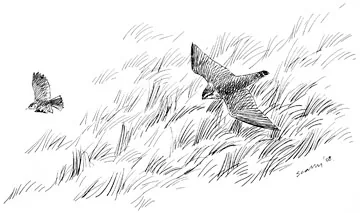
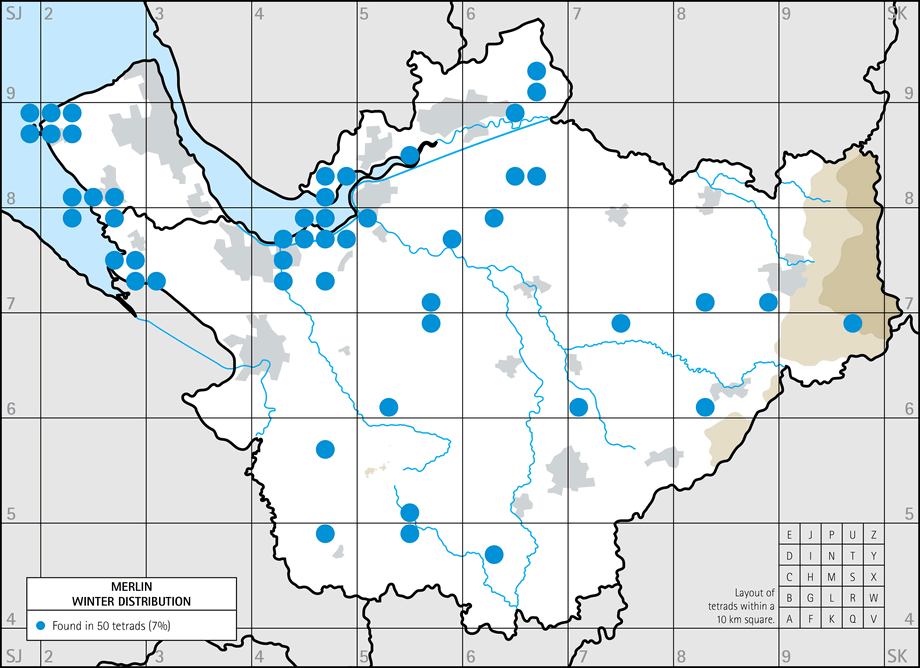
This Atlas map bears out that same general description today. The main concentrations are along the estuarine edges but an odd bird can be found almost anywhere in the lowlands. One bird showed an early return to the eastern hills. Compared to Hen Harriers and Short-eared Owl, there are proportionately more in the rough grassland around the Mersey than along the Dee saltmarshes, which may reflect the Merlins’ dependence on small passerines rather than mammals and larger birds. Merlins mainly hunt for passerines in winter but also take small waders up to the size of Redshank, usually skimming low over the ground and surprising their prey. They sometimes appear to cooperate with another Merlin or a different raptor, especially a Hen Harrier, in flushing prey. The submitted winter habitat codes reflect their use of open areas. 47% of records were of farmland, mostly grassland with 5% of stubble – birds presumably trying to surprise a feeding passerine – with 25% on grazing marsh or saltmarsh and 15% in estuaries.
The majority of British Merlins remain within Britain all year, with a median distance of 99 km between the breeding season and winter and movements being generally southerly and to lower altitudes. One ringed as a nestling in North Yorkshire was found dead near Warrington in its second winter in 1998. Most Icelandic birds winter in Ireland and western Britain so surely some of our wintering Merlins are of the Icelandic race Falco columbarius subaesalon. They are slightly larger and somewhat darker in plumage, but usually not safely distinguishable in the field, not least because northern British Merlins, from Shetland, Orkney and northern Scotland, are mainly within the Icelandic size range (Migration Atlas).
There were records submitted of 20, 28 and 26 Merlins in the three winters of this Atlas project.
Atlas account sponsored by xxxxxxxx