
Sandbach Flashes: birds and wildlife

About the Atlas
During the three breeding seasons 2004–06 and three winters 2004/05–2006/07, Cheshire and Wirral Ornithological Society (CAWOS) organised more than 350 volunteers to survey all of the county, trying to find every species of bird that was breeding or wintering
Moorhen Gallinula chloropus
Breeding
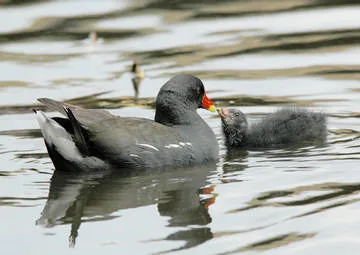
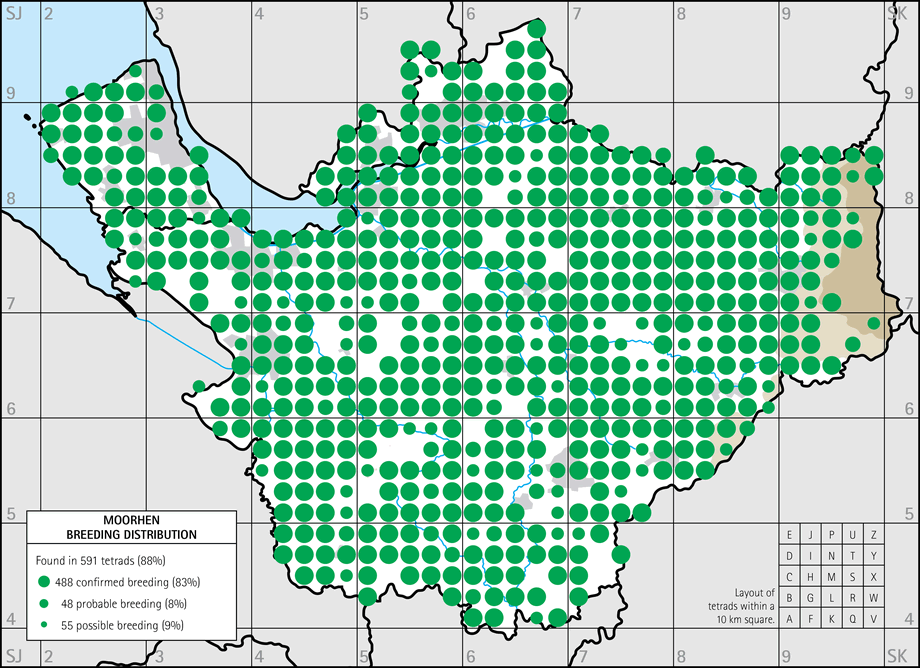
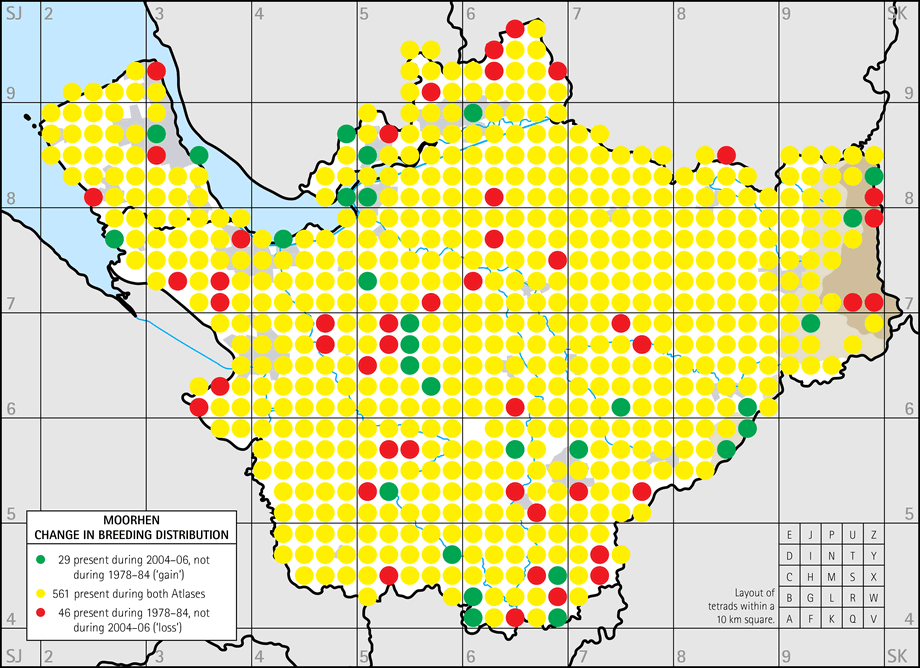
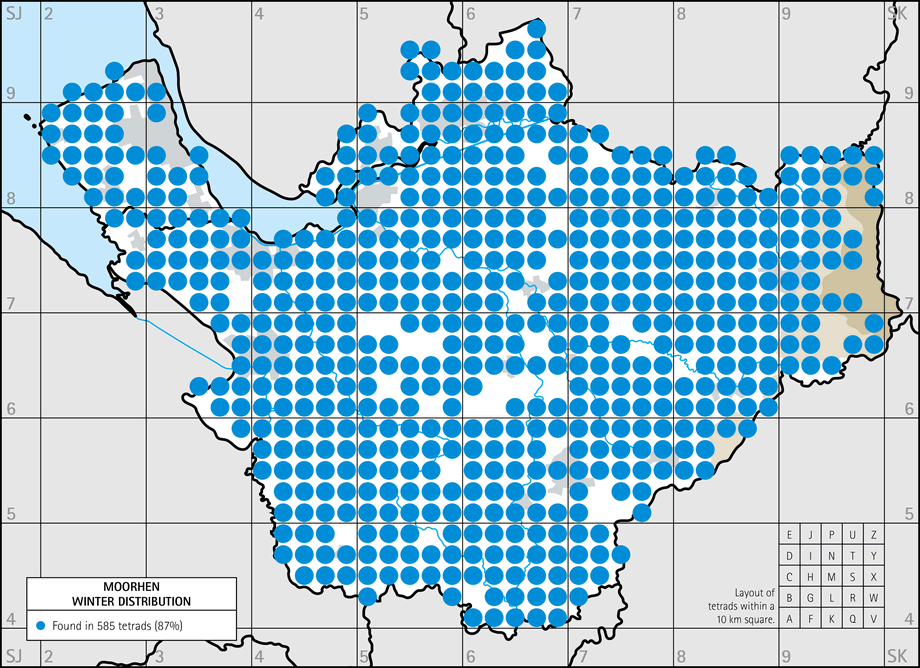
Moorhens are present in the breeding season almost everywhere in Cheshire and Wirral up to an altitude of about 250 m in the eastern hills. This is our second most widespread breeding waterbird, headed only by Mallard. There has been a small net loss of 17 tetrads relative to our First Atlas, possibly from an element of under-recording, but perhaps birds have been displaced from some areas by the move of many Coots to smaller waters. Richard Elphick and Mike Scott, however, recorded Moorhens ‘nesting amicably in a small pool with nesting Coots’ near Alderley Edge (SJ87T). This species needs waters with some fringing vegetation, and readily suffers from unsympathetic riparian management.
They build their nest from the broad leaves of aquatic plants, the female laying an average of six eggs and sharing the three weeks of incubation with the male. They sometimes surprise observers by nesting in trees, using an old nest of a corvid or other species. Proof of breeding was obtained in 83% of the tetrads in which they were recorded, mostly (426 out of 488) from observers seeing chicks during an extended season lasting from mid-April on, often into September. The adults often build one or more ‘brood platforms’, rudimentary nest-like structures on which the chicks can rest, wait for food to be brought to them, roost overnight and perhaps escape predation from pike. Mink are a big problem for them, however, as can be cats when they spread out onto waterside meadows and lawns. Moorhens usually raise two broods of chicks, sometimes even three, and adopt an unusual breeding strategy in which the first-brood chicks help to feed their younger siblings from the second nest, thus helping to relieve the burden on their parents and giving themselves some practice for their own breeding attempts in the next year. Some nests hold more than the normal size of clutch, either from egg-dumping by neighbouring females, or because of cooperative nesting when two, three or four females were paired to the same male (BTO Second Atlas). In cooperative nesting, the females share the parental duties along with the male; where studied in detail, the females have been shown to be mother and daughter.
Moorhens were frequently noted nesting on ponds in gardens, farms and on golf courses. The recorded habitats show 35% on ponds and 33% on small waterbodies, with only 15% using the larger meres, lakes and reservoirs; 17% of breeding Moorhens were on linear watercourses, mostly canals, where they seem content to co-exist with traffic from holidaying narrowboats. A count in 1996 found seven nests along a 6 km stretch of the Bridgewater Canal near Warrington and in 1998 ten pairs were reported in 4.3 km of the Shropshire Union in south Cheshire (CWBR).
The BTO analysis of the Cheshire and Wirral BBS data shows that the breeding population in 2004-05 was 7,940 birds (5,420-10,460), corresponding to an average of about 7 pairs per tetrad with confirmed or probable breeding. This is one of the few species where this survey gives a population figure significantly lower than the estimate from our First Atlas, which was 6,000 pairs. It is not known if this represents a real drop or an over-estimate of the 1984 total. Nationally, the breeding population of Moorhen has been fairly stable, dropping in years following extra mortality in hard winters. Reductions in the number and quality of farmland ponds, and the spread of mink along watercourses, have been suggested as possible causes of decline.
Nevertheless, 7,940 birds is more than 2.2% of the British population, showing that the county is disproportionately important for the species.
Atlas account sponsored by Patrick King
Winter
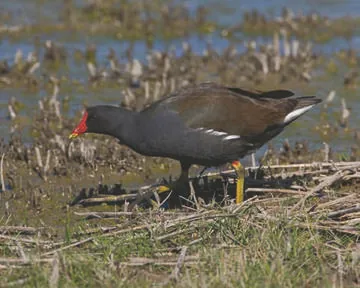
British Moorhens are highly sedentary, but are joined in winter by migrants from continental Europe, especially the Netherlands, Germany and Denmark (Migration Atlas). A bird ringed at Woolston in February 2007 was found in Denmark in October 2007.
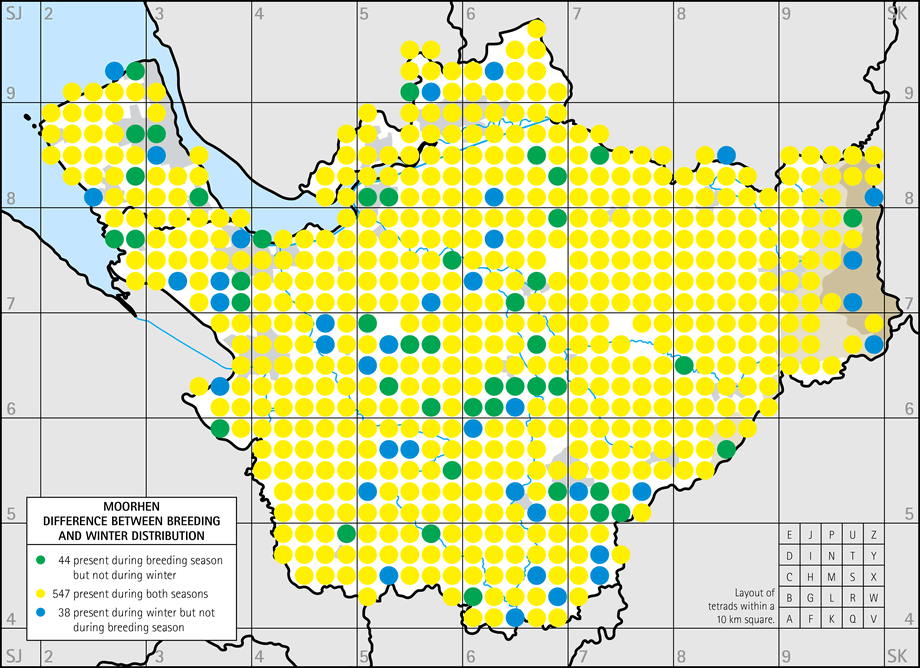
As expected for a sedentary species, there was little difference between the breeding and wintering distribution. They were recorded in both seasons in 547 tetrads, in 38 in winter only, and in 44 only in the breeding season, half of these in a relatively small area in the centre of the county: the apparent absence in winter in parts of SJ56 and SJ66 merits further investigation. Moorhens normally avoid the highest ground (BTO Winter Atlas) but, oddly, birds were found in four tetrads in the highest eastern hills where they did not breed. An interesting comment on its behaviour in one upland tetrad, near Oakgrove (SJ96J), where the species does breed, came from Steve and Gill Barber: ‘on a cold morning after a heavy frost we watched this bird as it grazed an area of short (sheep-grazed) grass high on a gorsey hillside’.
Moorhens eat a variety of plant and insect food, collected from in or near water, including seeds, fruit, pondweeds, worms, fish and carrion. More than one-third of records came from the smallest ponds, and in winter they stay on the small ponds but tend to retreat from other standing waterbodies, perhaps because of competition from flocks of waterfowl. The proportion on linear watercourses (G6 to G10) from 17% in the breeding season to 24% in winter, spread evenly across ditches, streams, rivers and canals. A century ago, Coward (1910) noted that ‘in winter, when the ponds are frozen, it resorts to running water’ and evidently some birds shift habitat even in the warmer climes of today. Moorhens quite frequently venture out of water, especially in damp grassy areas, and observers in 55 tetrads recorded them on agricultural grassland; they scamper back to the safety of water when alarmed, sometimes submerging with just the tip of the bill showing.
This bird is mostly a creature of freshwater, although a few gather on the Dee saltmarsh, 25 being flushed by high tide in winter 2006/ 07 at Gayton Sands (SJ27U). They seldom gather in large flocks and it is estimated that waters covered by WeBS counts hold only 1% of the British population (Brown & Grice 2005). In this Atlas, more than half of counts were of just one or two birds, and 90% of them were of ten birds or fewer. The largest flock was 71 at Gilroy Road Nature Reserve, West Kirby (SJ28I), counted by Chris Butterworth, double the next highest counts, 35 by Mary Prince and Susan Bastin on the Shropshire Union Canal at Christleton (SJ46M) and the same total by Alan Booth at Redes Mere (SJ87L).
Atlas account sponsored by Patrick King