
Sandbach Flashes: birds and wildlife
About the Atlas
During the three breeding seasons 2004–06 and three winters 2004/05–2006/07, Cheshire and Wirral Ornithological Society (CAWOS) organised more than 350 volunteers to survey all of the county, trying to find every species of bird that was breeding or wintering
Mute Swan Cygnus olor
Breeding
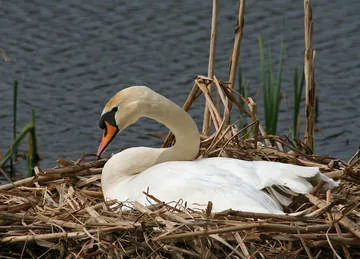
It is difficult now to recall that, twenty years ago, Mute Swan was among the scarcest birds of Cheshire, with a special census in 1985 finding only 13 breeding pairs, and none in Wirral (Elphick 1985). The cause was simple to diagnose, and easy to remedy. Swans need gravel in their gizzard to grind their vegetable food, and amongst the small stones they were ingesting lead weights carelessly discarded, or lost, by anglers. The resulting poisoning killed many swans. Responsible fishermen voluntarily changed to non-toxic weights, and legislation banning the use of lead became effective on 1 January 1987. The Cheshire Swan Study Group (CSSG) was formed in 1988 and monitored the recovery of the population, topping 100 pairs in the county in 1996, and by the year 2000 the local numbers had outstripped the capacity of CSSG to cover the whole county (Cookson 1993, CWBRs).
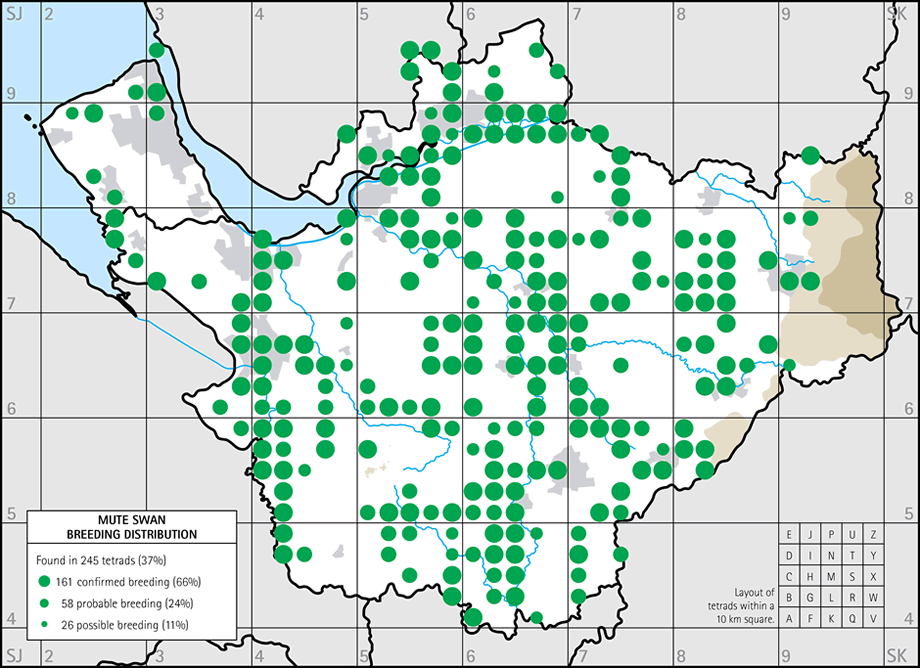
Even uninterested people find it hard to ignore Britain’s heaviest bird, and the Atlas map must be accurate. However, only 66% of occupied tetrads furnished proof of breeding, and about one-quarter of pairs—usually birds in their first year together—do not nest in any one year. Most swans first breed at three or four years old; a few females start at the age of two; but, especially when population levels are high and there is fierce competition for territories, some adults may never breed (Birkhead & Perrins 1986). Pairs normally stay together for life, with divorce being rare, but bereaved swans do find another mate, contrary to the romantic myth.
Their population is probably limited only by the availability of suitable nesting sites. They have few natural predators, the size and fearless nature of the birds being sufficient to deter almost any attack, and their only significant threat is vandalism by hooligans throwing stones at the nest, destroying eggs and occasionally killing an adult. The habitat codes reported in this survey showed that 67% of our swan records are on standing waterbodies (G1–5), with 10% on flowing water (G6–8), 21% on canals (G9–10) and 1% on coastal water on the Dee. They are mostly on larger waters, as would be expected, but swans will nest on small ponds and narrow streams and ditches. Mute Swans eat almost any type of aquatic vegetation (to a metre deep), especially crowfoot, pondweeds and soft grasses. They will also graze on land, and occasionally take insects, molluscs and small amphibians, although it is not known if those are by choice or just because they were caught up in the submerged vegetation. If there is insufficient food for the chicks, adults will lead them, walking overland if necessary, to suitable water sometimes up to a kilometre distant, possibly into an adjacent tetrad.
Mute Swans are now to be found breeding everywhere in the county where there is suitable water with submerged vegetation. Thus, they are absent from the higher ground in the east of Cheshire—they avoid the dystrophic hill reservoirs—and the Sandstone Ridge, and they are scarce on Wirral. The BTO analysis of Cheshire and Wirral BBS data (2004–05) gave a county population of 1,470 birds (470–2,460) in the breeding season. This survey did not distinguish between territorial pairs and non-breeding flocks. Most tetrads hold only one pair, although some have more, and the present population is likely to be around 200–250 pairs breeding, with around 1,000 non-breeding birds. Boyd (1946), never one to shrink from making value judgments on birds, wrote in his newspaper column in 1939 that ‘in my opinion they are becoming far too plentiful, and usurp the territory and food of other and more interesting
fowl’. What would he think now?
Atlas account sponsored by Cheshire Swan Study Group
Winter
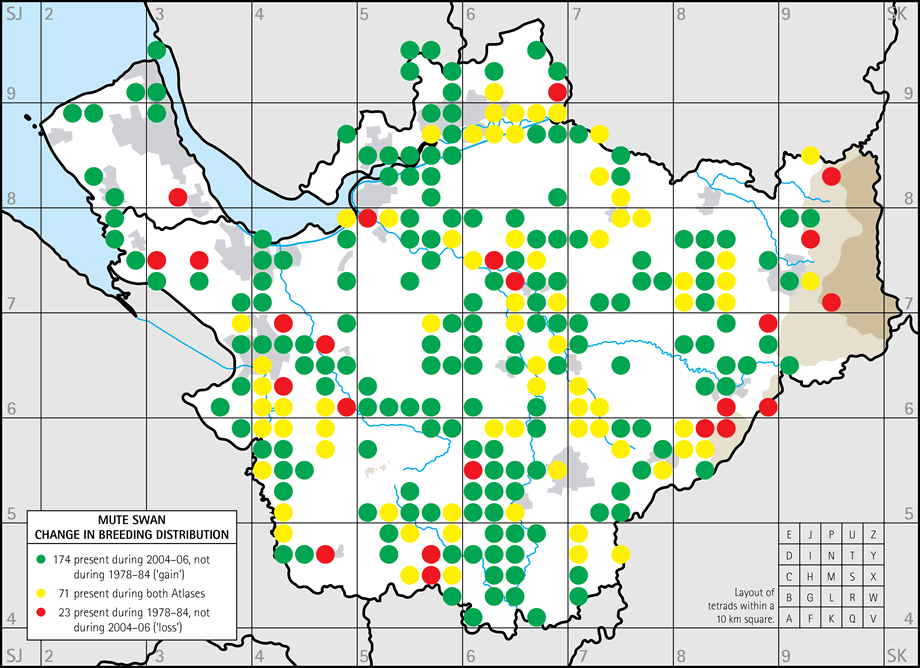
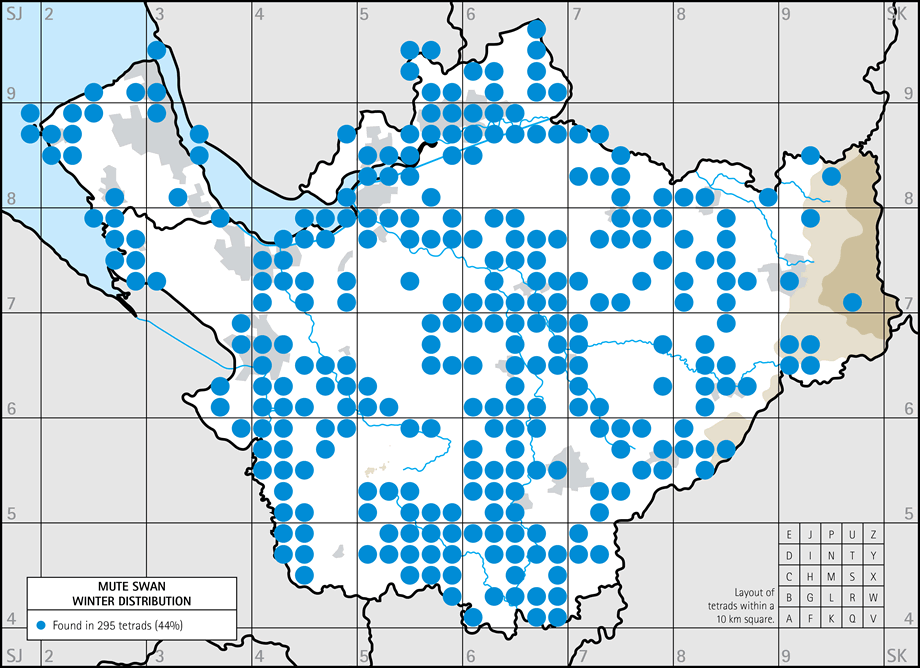
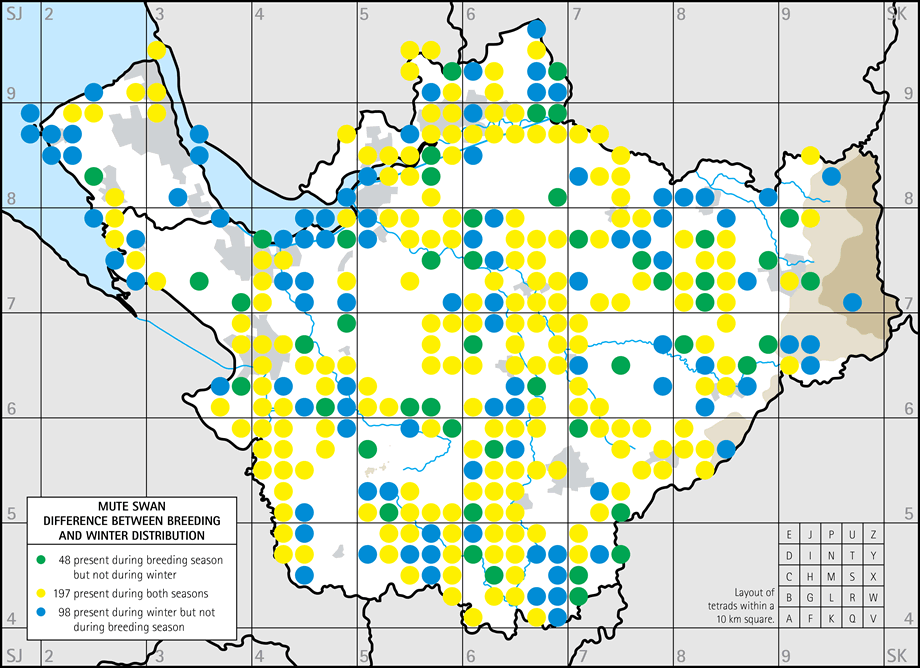
Many Mute Swans maintain their territories throughout the year, so it is surprising that the winter map shows 48 tetrads occupied in the breeding season but vacated in winter. It would be interesting to study what distinguishes those tetrads from those used all year round. In addition, there are 98 extra tetrads with wintering birds. There are many more records on the Dee and Mersey estuaries, and some seasonally flooded fields. The extensive and long-running programme of ringing Mute Swans has shown that there can be significant wanderings, up to around 100 km from their natal site, with exceptional movements to Scotland, Ireland and Gloucestershire, but most Cheshire birds live their lives within the county. There is no immigration from continental Europe.
The other main difference from the breeding season is the large flocks, mostly comprising birds below breeding age. Birds at some sites are often fed by people whose traditional response to any wild creature is to offer bread. The size of these flocks has apparently increased in the last twenty years. The BTO Winter Atlas (1981/82–1983/84) mapped only four 10 km squares in Cheshire with counts of 24 or more birds, whereas fieldworkers for this Atlas reported 33 flocks of that size, in twelve 10 km squares. Four of them exceeded 50 birds, all in 2005/06, with flocks of 56 on the Mersey salt-marsh (SJ47P), 52 on the Manchester Ship Canal (SJ58C), 52 on farmland near Hack Green (SJ64N) and 70 on Redes Mere (SJ87K). Almost half of all counts were of two birds, though, emphasizing the adults’ maintenance of their pair-bond, and probably the territory.
Most (79%) of the winter habitat codes were fresh water, with 4% estuarine, 5% semi-natural grassland and marsh, and 9% farmland. More than half were on standing water, with 7% on ponds, 20% small waterbodies and 26% lakes, reservoirs and sand quarries. Linear waterways comprised 26%, equally split between rivers, small canals and larger canals.
Coward and Oldham (1900) dismissed all Mute Swans as ‘semi-domesticated’. They noted that they ‘may sometimes be seen feeding on the sandbanks and ooze of the Dee estuary, but there is no reason whatsoever to suppose that any of those, shot from time to time on the Dee or elsewhere, are really wild birds’. Boyd (1951) gave no information on the species in winter, and Bell (1962) noted just two counts, of a flock of 90 on the Weaver estuary in hard weather, and another flock of 30 on Sandbach flashes. It is difficult to know whether the lack of information reflects a continuation of Coward’s disdain for the species, but the inference is that their population is much higher nowadays, and that winter flocks in the county have become a feature only in the past fifty years.
Atlas account sponsored by Cheshire Swan Study Group