
Sandbach Flashes: birds and wildlife

About the Atlas
During the three breeding seasons 2004–06 and three winters 2004/05–2006/07, Cheshire and Wirral Ornithological Society (CAWOS) organised more than 350 volunteers to survey all of the county, trying to find every species of bird that was breeding or wintering
Oystercatcher Haematopus ostralegus
Breeding
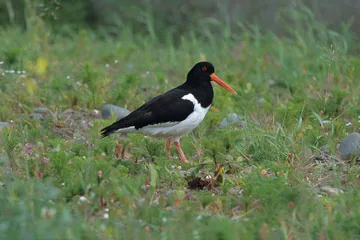
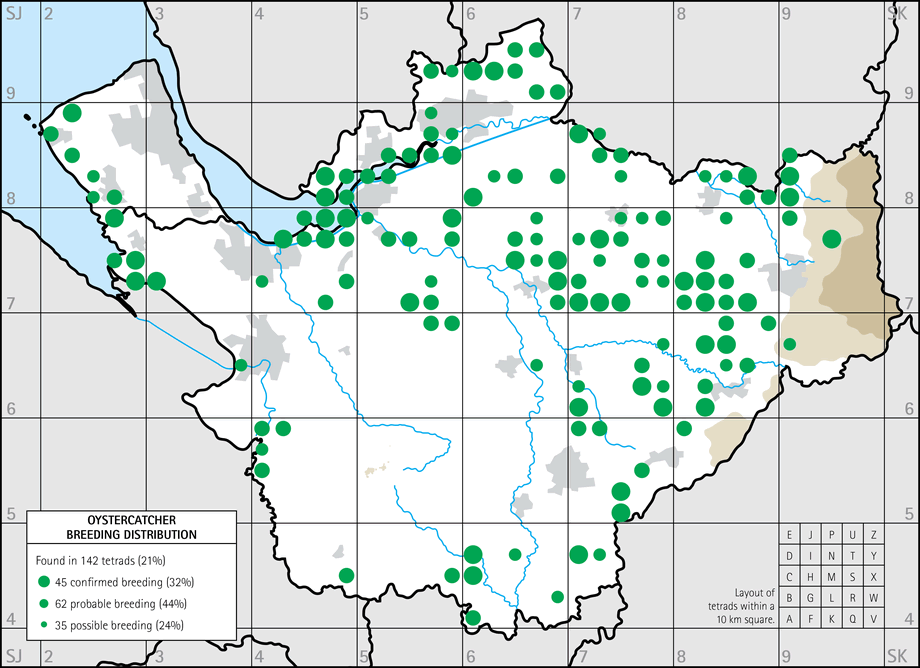
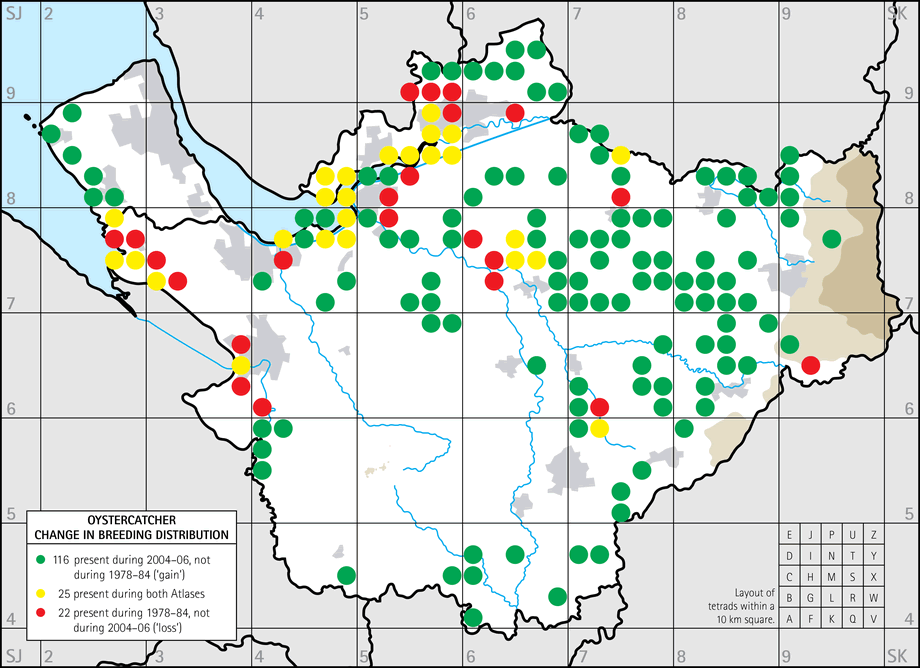
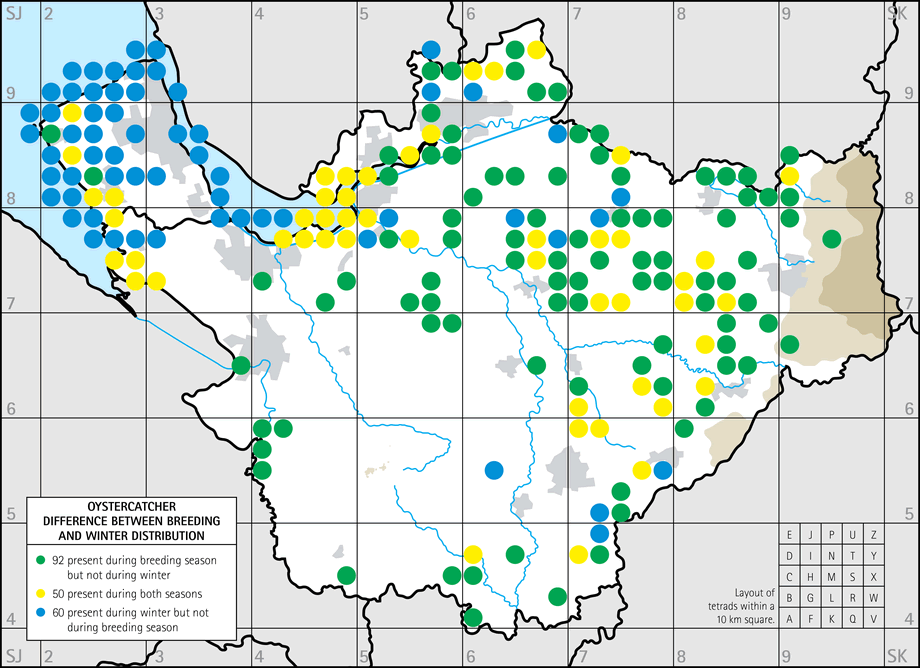
Breeding Oystercatchers have undergone dramatic changes in the last twenty years. There were only 25 tetrads where Oystercatchers were present in the breeding season during our First Atlas and this Atlas, with 116 newly occupied and the species lost from 22. The ‘change’ map shows a major expansion of range inland, especially in the eastern half of Cheshire, and in the south of the county, around Delamere, along the river Dee south of Chester and along the west coast of Wirral. At the same time there are obvious losses especially along the lower reaches of our two main rivers, the Dee and the Mersey. The spread inland parallels what has happened in the rest of northwest England. They started breeding inland on gravel banks in rivers early in the 20th century, colonising the Eden in Cumbria in 1920, the Lune in north Lancashire in 1928, the Ribble in 1934 and the remainder of the Lancashire rivers during the 1950s and 1960s, then, from the 1970s, moved onto agrarian habitats. Birds breeding in farmland have so many advantages that it is easy to see how the habit rapidly spreads: they nest a month earlier than on the coast, suffer lower predation and fledge twice as many young per pair than coastal or riparian breeders (Briggs 1984).
Their normal nest is on the ground, amongst shingle or rubble, and often on bare earth in the middle of fields inland, with three eggs incubated for nearly four weeks. In Scotland some birds nest in the tops of rotting fence-posts and a similar habit has taken hold amongst Oystercatchers alongside the Manchester Ship Canal at Frodsham Marsh (SJ47T/ Z) where up to four pairs now nest in the tops of wooden jetties, surrounded by, and a metre or more above, the water of the canal. This is the only British wader where the adults feed their chicks, mostly on earthworms for the inland breeders. Most habitat codes (76) were from farmland (33 improved grassland, 8 unimproved grassland, 22 mixed grass/ tilled land and 13 tilled land), with 62 alongside freshwater bodies and 12 on damp semi-natural grassland including six on estuarine saltmarsh.
Oystercatchers are long-lived birds, with some known to have reached the age of thirty, and females do not breed until at least three years of age, with males delaying until five or older. There seem to be few immature birds in the county during the breeding season and it must be supposed that they spend the summer elsewhere, probably on their wintering grounds in France and Iberia (Brown & Grice 2005).
The Oystercatcher breeding population of Cheshire and Wirral in 2004-05 was large enough to be sampled on Breeding Bird Survey transects, and is estimated at 510 birds (with a confidence range from zero to 1,220), at least a tenfold increase on the figure of 20 pairs suggested in our First Atlas.
Atlas account sponsored by Dee Estuary Voluntary Wardens
Winter
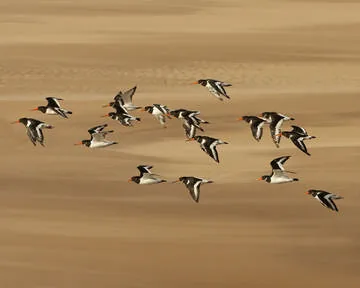
The winter influx of Oystercatchers comes from the north, Scotland and northern England, the Faeroes (whose national bird it is), Iceland and Norway. They come here to feed on the abundant shellfish, especially cockles and mussels, with macoma as a backup. No other wader is capable of opening the bivalves, and Oystercatchers have evolved two specialised methods, with appropriately different types of bill. Some have short, blunt bills and hammer their prey through the shell, while others have longer, pointed bills and prise the two shells apart.
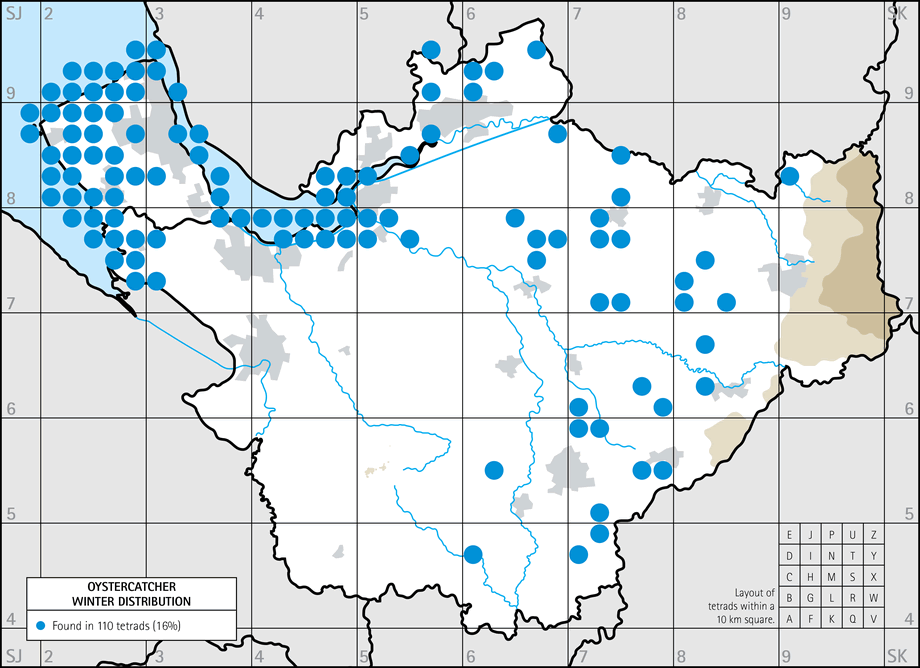
Although the winter map shows birds in almost every tetrad in both estuaries, and inland across parts of eastern Cheshire and much of Wirral, the key area is the Dee estuary, which is internationally important for the species and ranks third amongst British sites on the basis of WeBS counts (Musgrove et al 2007). The five-year peak mean total is nearly 25,000 birds, more than 10% of the winter population of Britain, although sometimes half of the Dee birds are in Wales rather than in Cheshire and Wirral. The Irish Sea is the key area for wintering Oystercatchers, with four of the top five sites: Morecambe Bay, Solway Estuary, Dee Estuary and the Ribble Estuary.
Coward (1910) noted that, although most abundant as a bird of passage in spring and autumn, ‘considerable numbers of Oystercatchers remain in the Dee and Mersey as winter residents’. At all seasons it was more plentiful near the mouth of the Dee than higher up the estuary. Some quantitative information came from Hardy (1941), that winter flocks at Hilbre may reach from 300 to 1,000, and from Bell (1962) that several thousand winter at the mouth of the Dee, but it was not until the start of the Birds of Estuaries Enquiry started that hard figures were obtained, with sample figures of 11,208 in December 1972, 22,489 in January 1976, 30,360 in December 1983 and 35,775 on 18 November 1990. From then onwards, Oystercatcher numbers declined quite rapidly, reaching 12,506 in 1999/ 00 against a background of stable regional and national populations, and puzzling as adult birds are normally site faithful, although immature birds move to new areas (BTO Winter Atlas).
This decline caused concern, including amongst the secretariat that administers the Ramsar Convention for internationally important wetlands which included the Dee estuary in the ‘Montreux Record’, the subset of Ramsar sites in need of priority conservation attention. Harvesting of cockles was one of the site impacts listed, and the Environment Agency imposed Britain's first cockling ban on the Dee estuary beds in 1997, lifted for a few days in most years since. The Dee estuary cockles are particularly valuable commercially, said to contain more meat than those from any other fishery, and the Environment Agency is seeking new by-laws to restrict the number of cocklers and the methods they use. The decline in Oystercatcher numbers is not directly linked to the cockle fishery, but the population has recovered to around 25,000 birds wintering across the whole site.
Some large flocks were recorded during this Atlas but half of the 160 records with a count were of ten birds or fewer. There were 33 four-figure flocks and two five-figure counts, 10,000 birds off West Kirby (SJ28C) in 2004/ 05 and 12,000 off Heswall (SJ28K) in 2005/ 06. Occasionally some significant gatherings feed inland on fields, such as the 285 birds counted by Roy Palmer on 12 January 2006 between Heswall and Barnston (SJ28R). Numbers are small away from the Dee. Although Coward (1910) mentioned the Mersey in the same sentence as the Dee, he gave no further information and there are no documented records of the Mersey ever having been important for the species; the largest count in the Mersey during this Atlas was 210 birds near Stanlow Point (SJ47I). Inland, no more than five birds were reported from any site in the eastern half of the county. Indeed, many of the Oystercatchers in inland areas were seen as pairs, and in ten inland tetrads, observers specifically commented that the birds recorded in the Atlas ‘winter’ period were early-returning breeders, usually around mid-February. All previous authors had emphasised its scarcity inland – Boyd (1951) knew just two winter records in the 25 years from 1926 to 1950 in the Great Budworth area – and Oystercatchers are probably more often seen inland nowadays than ever before.
Most Oystercatchers were reported in estuarine (31 tetrads) or open shore (9) habitats in winter, but elsewhere they were found in a range of habitats including various types of freshwater (28), agricultural land (35), mostly grassland and semi-natural grassland (19), mostly saltmarsh or grazing marsh.
Atlas account sponsored by Dee Estuary Voluntary Wardens