
Sandbach Flashes: birds and wildlife
About the Atlas
During the three breeding seasons 2004–06 and three winters 2004/05–2006/07, Cheshire and Wirral Ornithological Society (CAWOS) organised more than 350 volunteers to survey all of the county, trying to find every species of bird that was breeding or wintering
Peregrine Falco peregrinus
Breeding
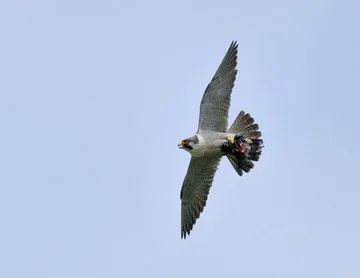
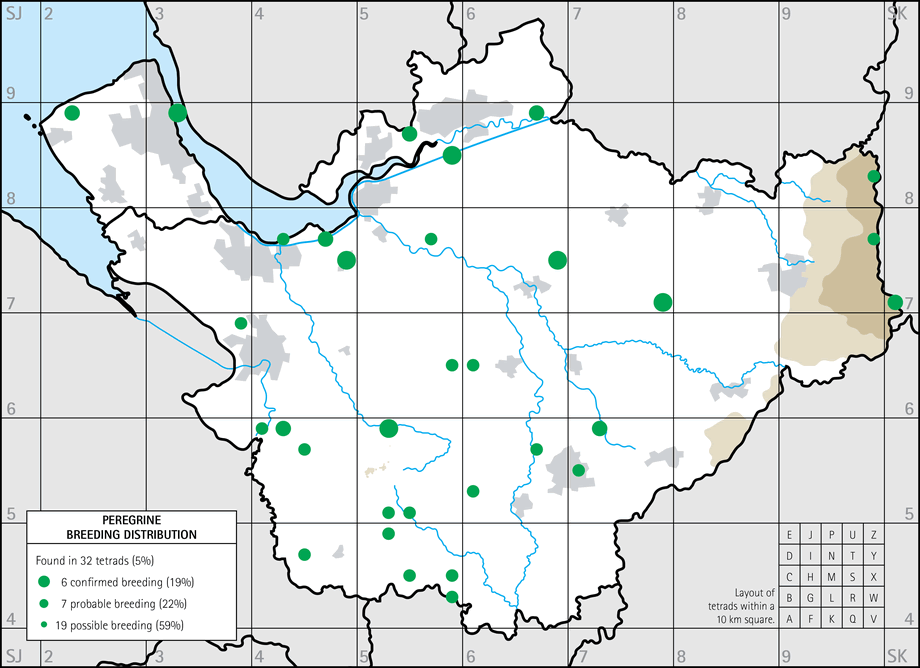
The Peregrine has been a welcome addition to the county’s breeding avifauna since our First Atlas, and it is probably only a shortage of nesting sites that inhibits its further expansion. The first breeding in Cheshire was in 1989, after several years of display, on the sandstone cliff of Beeston Castle (SJ55J), followed in 1993 by the county’s other major natural site at Helsby (SJ47X). Since then Peregrines have also used a range of industrial structures – oil refinery, railway bridges, power station, a tower on an urban station and a chemical works. The latter site is next to a conveyor belt loading 1,200 tonnes a day of limestone into the plant, with the concomitant noise and dust all day and night. It was singled out for comment in the BTO’s 2002 national Peregrine survey (Crick et al 2003) – “Is this the most unusual / inhospitable site for a nesting Peregrine?” – but it has been occupied every year from 1997 onwards. Some other sites have been used for several years then not again.
The spread into Cheshire and Wirral has been part of the rise of the national Peregrine population, which is now probably larger than it ever has been. The number of UK breeding pairs recorded in the decennial census has grown as follows: 1961 – 385 pairs; 1971 – 489 pairs; 1981 – 728 pairs; 1991 – 1,283 pairs; 2002 – 1,402 pairs (Ratcliffe 1993, Banks et al. 2003). The species has largely recovered from the detrimental effects of organochlorine pesticides in the 1950s and 1960s, which manifested themselves especially in thin eggs that broke before hatching. Unhatched eggs from Cheshire nests have been taken, under licence, for analysis and show just ‘background’ levels of these chemicals, with shells of normal thickness (Norman & Lythgoe 1997).
Most Peregrines return to the breeding area during winter, certainly by February. Adults may well pair for life, but the attachment is to the nest-site rather than to each other. The nest in the chemical works mentioned above has been known to have been used by the same female – a distinctively-plumaged brown bird – from at least 2000 to 2007, and she has raised 27 chicks during that time, a very high average. The birds’ usual breeding cycle is to lay four eggs in late March, with the female laying every other day then incubating for about 32 days so that eggs hatch in early May. The male (tiercel) provides most of the food during this time, as he does for the first ten days or so after the chicks hatch, during which time they cannot regulate their own body temperature and are brooded by their mother. After about ten days of age the chicks (eyasses) grow their second coat of down and the female leaves the nest-ledge to share hunting duties with her mate, returning to feed the chicks, and brood them during rain and overnight. Chicks fledge 5 to 6 weeks after hatching, in mid-June, followed by two or three months of decreasing dependence on their parents as they learn the skills needed to catch their own food. At this time chicks can be found in unusual situations, including gardens occasionally.
Recorded Peregrine prey from British eyries includes almost every species of bird from Shelduck to Goldcrest (Ratcliffe 1993). Food items found at Cheshire nests are mainly feral pigeons, but Starlings and waders feature regularly, and the remains of a Swift – a rarely-recorded prey species – were identified once. They often share nesting sites with potential prey items but appear to declare a truce with their near-neighbours, although sometimes chasing them in ‘low-intensity’ pursuit where it seems that the Peregrine has no intention of killing the target (Ratcliffe 1993).
There are normally five pairs of Peregrine breeding in the county. First-year birds disperse widely, and they do not breed until at least two years of age, so there are likely to be immature birds anywhere in the county during the breeding season; one of the county’s breeding birds had been ringed as a chick in North Yorkshire and moved over 100 km to settle here. There also appear to be several ‘spare’ adults or pairs, as illustrated in 2001 when the female of the resident pair at Beeston died with a tumour in her intestine. Even before she died, but must have been ailing, another female was present, who then immediately moved in with the widowed male. The shortage of suitable nest-sites is probably limiting their numbers; an imaginative programme of placing nest-boxes on tall buildings and utility structures would surely benefit Cheshire Peregrines.
Atlas account sponsored by Roy Bircumshaw
Winter
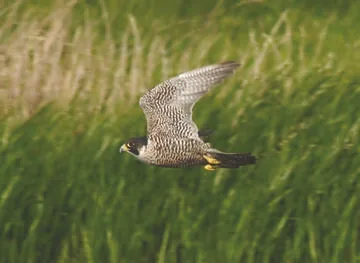
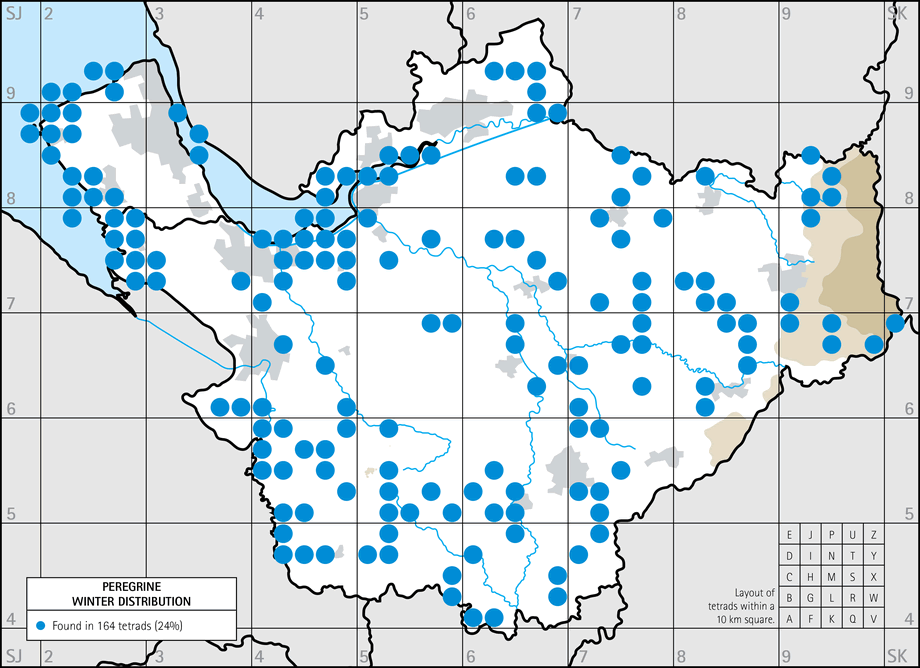
There are more Peregrines in the county now than have ever been recorded before, with birds found in winter in almost one quarter of tetrads. Coward (1910) wrote that one or two annually frequent the Dee estuary, often pursuing the wildfowl and pigeons crossing the water. They were also found in the southwest of the county, apparently feeding on Redwings. Most of the birds known to Coward were shot, and in the hill country ‘scarcely a winter passes without one or more being killed on the grouse moors’. Boyd (1951) knew it as an occasional winter visitor to mid-Cheshire.
Peregrines could now potentially be found almost anywhere in the county in winter. Large concentrations of waterfowl obviously attract them, with the Dee and Mersey estuaries and the Dee floods showing on the Atlas map with clusters of occupied tetrads, but they can find food anywhere. Winter Atlas surveyors reported them using a wide range of habitats. Farmland (47% of records) was most common, followed by semi-natural grassland and marsh, mostly saltmarsh, with 13% and human sites on 12%, mostly suburban. Water habitats comprised 9% freshwater and 10% marine, with even woodland and scrub recorded for 7% of tetrads. They take a wide range of prey, almost entirely birds and especially those species that flock, including Woodpigeons, gulls, ducks, waders, gamebirds and Fieldfares. Moorhens must be particularly unlucky as they often feature in lists of Peregrine diet although they do not seem to fit the normal profile of their prey. Urban Peregrines may well subsist almost entirely on feral pigeons and Starlings. Many birds are killed by the spectacular stoop, the Peregrine diving from on high and using its advantage of height and speed to knock its prey to the ground, but they also catch birds by flying after them almost in the manner of a Sparrowhawk, or flushing prey as a harrier does. Some birds are taken on the ground as well (Ratcliffe 1993). As with all falcons, the female is bigger than the male, half as heavy again, and she is more likely to take heavier prey. Peregrines occasionally dispossess another raptor of its prey, but Neil Friswell saw the tables turned at Tattenhall (SJ45Z) on 26 January 2005 when a male was chased off its kill by a Raven.
Breeding birds mostly stay in their territories, although a pair may temporarily split up and cover a larger area between them, but young birds disperse in the autumn and the winter birds in the county could have a range of origins. The median distance of movement is 45 km, but some ringed birds have been found more than 200 km from their natal site, although few Scandinavian Peregrines reach the west of Britain (Migration Atlas).
The winter population of the UK was estimated as 4,000 birds in the early 1980s (BTO Winter Atlas), since when the breeding population has doubled. In the three winters of this Atlas, fieldworkers recorded 95 birds in 74 tetrads in 2004/ 05, 85 birds in 66 tetrads in 2005/ 06, and 97 birds in 78 tetrads in 2006/ 07. Most individuals will range over several tetrads, and there will obviously be much double-counting, but fewer than half of the county’s tetrads were visited each winter, and there may well be between as many as 50 Peregrines in the county during winter.
Atlas account sponsored by Roy Bircumshaw