
Sandbach Flashes: birds and wildlife

About the Atlas
During the three breeding seasons 2004–06 and three winters 2004/05–2006/07, Cheshire and Wirral Ornithological Society (CAWOS) organised more than 350 volunteers to survey all of the county, trying to find every species of bird that was breeding or wintering
Pheasant Phasianus colchicus
Breeding
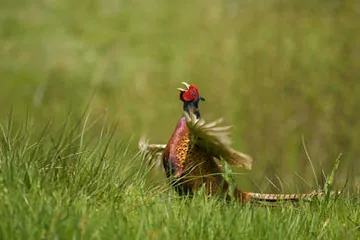
Largely ignored by most birdwatchers, and once voted the most hated bird in Britain, there is a strong argument for saying that Pheasant is in fact England’s most important bird as its requirements have shaped much of the English countryside (Marchington 1984). Many wooded areas and hedgerows exist mainly to provide cover for this species. Lest the foregoing be taken as suggesting that the introduction and rearing of Pheasants has had a benign or positive influence on the countryside, however, it should be noted that some authors report potentially negative effects of high Pheasant densities on native UK birds. These include the structure of the undergrowth and woodland field layer and the spread of disease and parasites (Fuller et al. 2005). Interspecific competition for food could be an issue as well: at around 1kg, rather more for males and less for females, the biomass of Pheasants exceeds that of any other British bird.
There are some self-sustaining populations of wild birds but the species’ numbers are determined principally by releases of reared birds for shooting: the Game & Wildlife Conservation Trust estimated in the early 1990s that some 20–22 million birds were released in the UK each autumn. This figure has increased four-fold since the mid 1960s (Tapper 1999), and nowadays may well be higher still. About one-in-ten of the released birds are expected to survive until spring, when they must form the major part of the breeding population. The corresponding figures for Cheshire and Wirral are not known but the BTO BBS analysis shows that the breeding population of the county in 2004-05 was 9,420 birds (5,810-13,030). Most of those detected on BBS transects were males, which are much more vocal with their far-carrying ‘kor-kok’ calls, and more visible as the brightly-plumaged birds strut about their territories whilst the camouflaged females are hidden on their nests. However, each year roughly half of all males are not breeding because many dominant birds gather a harem of several females and mate with each of them, leaving a surplus of unmated, mostly one-year-old, males, although some birds do nest as conventional pairs.
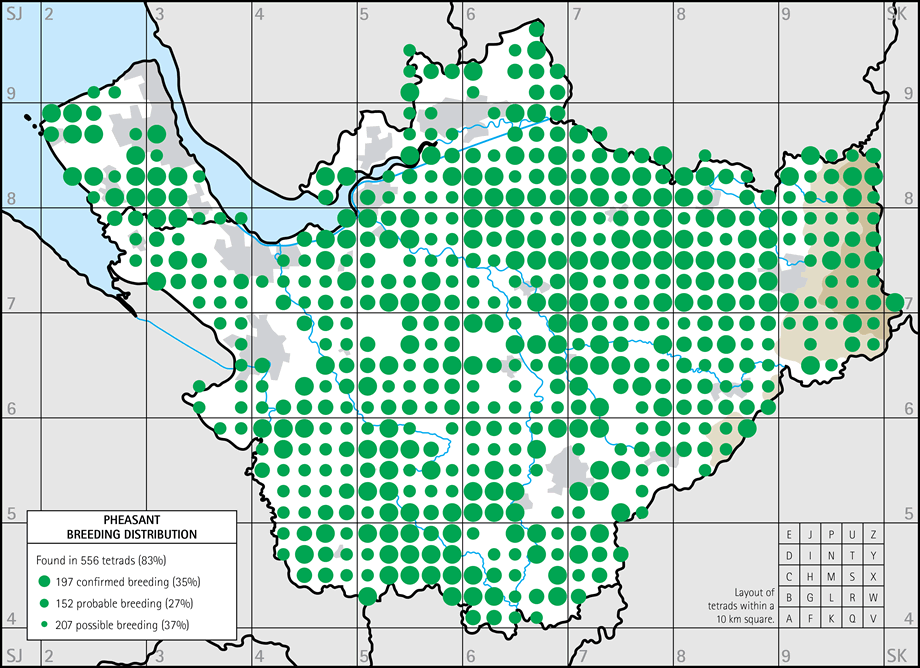
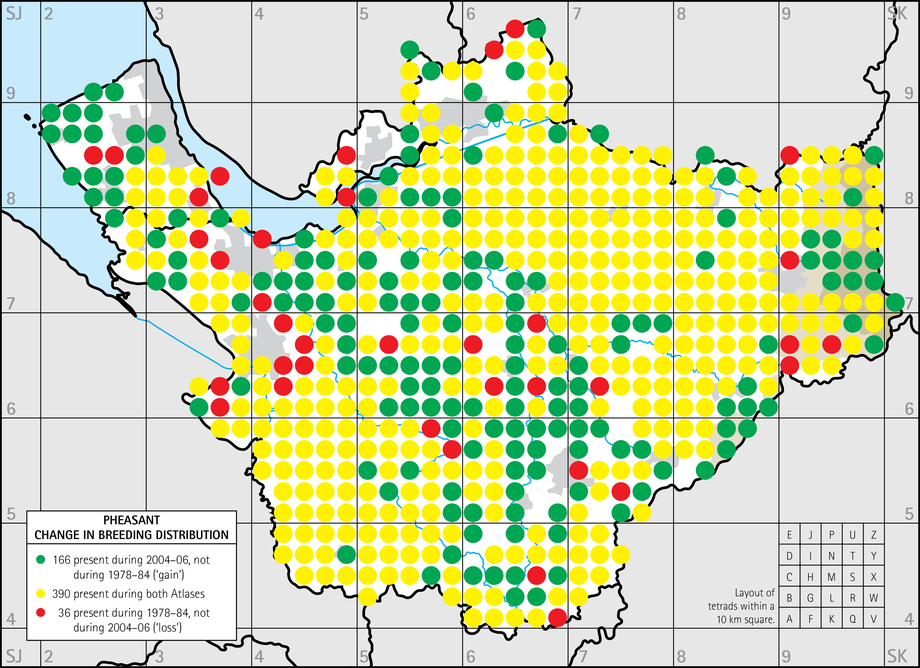
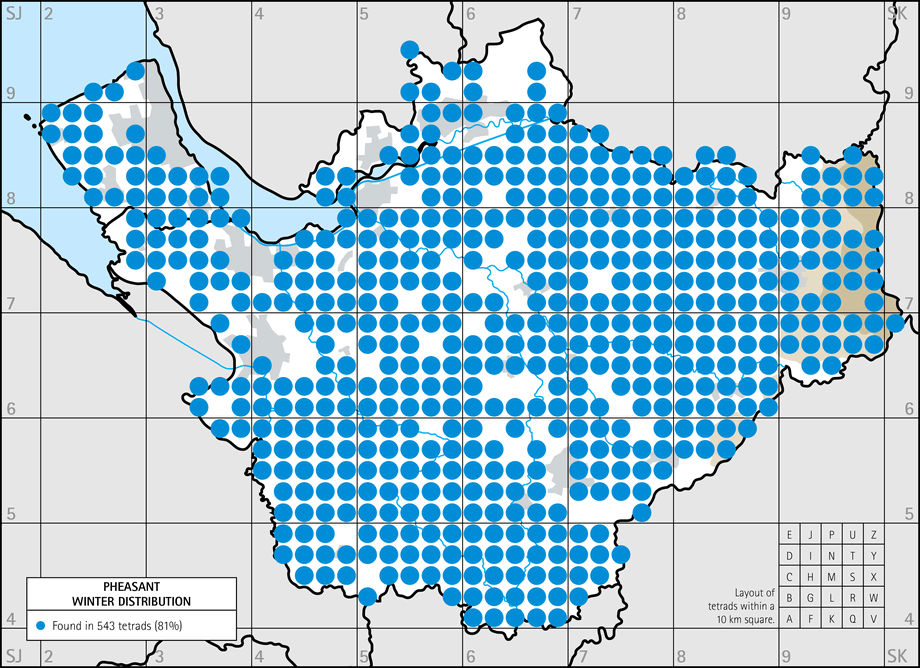
The maps show that Pheasants have spread considerably since our First Atlas, with a net gain of 130 tetrads, and they are now found almost everywhere apart from urban areas. The most noticeable increases have been in north and west Wirral, east of Macclesfield, and a broad swathe through the centre of Cheshire, roughly following the lines of the rivers Weaver and Gowy. The national population index rose by 57% from 1984 to 2004 and the county population has probably risen substantially from the First Atlas estimate of ‘from two to five pairs per occupied tetrad’; the current figure corresponds to an average of about 17 birds per tetrad in which the species was recorded. It seems inappropriate to use ‘pairs’ for a species with such a flexible mating system. Most of the records of confirmed breeding came from observations of one or more adults with a brood of chicks (159 tetrads), but surveyors in 25 tetrads found nests, in various stages of occupation.
Pheasants can be found in almost any habitat: two-thirds of the records for this Atlas were farmland, of all types, with woodland (19%), scrub (6%) and semi-natural grassland (4%). They feed in the open, often in field margins, yet remain close to shelter. Favoured areas for cover are protected from wind and weather, and provide suitable nesting areas: most nests are near to the edge of a wood or its internal rides.
Atlas account sponsored by Robin Hart
Winter
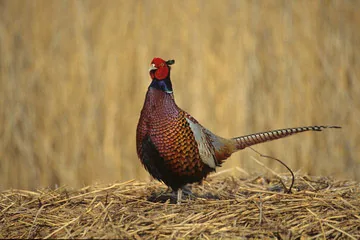
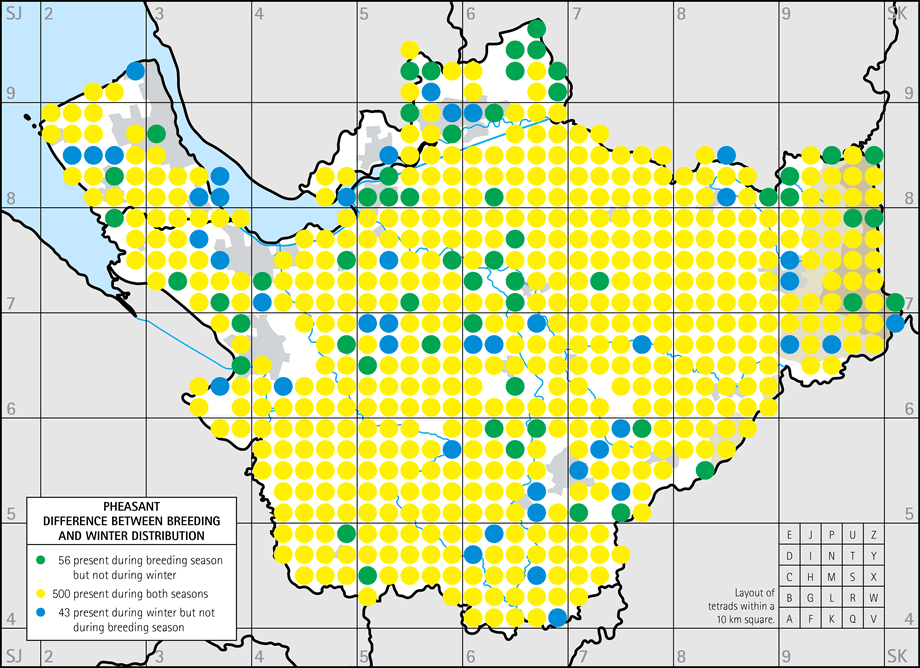
The maps of winter and breeding season distribution are almost identical; Pheasants were found wintering in 43 tetrads where they were not recorded in the breeding season, and were missing in winter from 56 with breeding presence. These differences are most likely to be due to observer effects, perhaps unluckily visiting a location when the resident Pheasant was silent. The females gather into flocks of tens of birds, or more, but even during winter, males are quite aggressive and weaker males, especially the first-year birds, are forced out into suboptimal habitat. Radio-tracking has shown that adult cocks that have previously held a territory move an average of only 80 metres to their winter area, compared to about 300 metres for birds establishing a territory for the first time (Robertson 1997). This work also showed that they especially favour small woods, seldom moving more than 30 metres in from the edge of woodland. They are not fussy about the tree species provided that there is reasonable shelter provided by a good shrub layer. Their use of habitats in this winter Atlas was almost identical to that of the breeding season, with a few birds spreading into human sites and odd records on saltmarsh, although Pheasants do not often go far from cover. They are occasionally found in marshland and reedbeds, often said – wrongly – to be the preferred habitat in their ancestral Chinese homeland from where they have been introduced around the world (Robertson 1997).
In winter Pheasants feed mostly on seeds, often provided for them in woodland grain-hoppers, but also gleaning the remains of cereal crops, and this is one of the few species to be found in maize stubble. Away from woodland, increasing numbers of farms are planting strips of mixed seed-bearing crops intermixed with dense crops such as kale, often known as game cover. Pheasants usually carry substantial reserves of fat and can starve for several days if need be, such as when feeding areas are covered by deep snow; only in prolonged hard weather, such as has not been experienced in the county for twenty years or more, do many birds die from starvation.
One notable feature of Pheasant behaviour in winter is their use of communal roosts. They usually choose a dense tree, walking towards it then noisily flying steeply up into the branches until they reach a height where they feel safe from ground predators, especially foxes. Such roosts are widespread although fieldworkers in only six tetrads recorded them, with the largest estimated to contain 50 and 60 birds. It seems that at least one of the birds is always awake, keeping watch for threats to the whole party.
Many of the comments made by previous chroniclers of the county’s birds could equally apply today. Coward (1910) wrote that, except in those parts of the hills east of Macclesfield where there is no suitable cover, the Pheasant is extensively preserved and exists everywhere in a semi-domestic condition. Hand-reared birds are turned down in thousands in woods and coverts, which are maintained and often planted solely for their benefit. Boyd (1951) summed up the traditional birdwatchers’ view in saying that it was difficult to think of them as really wild birds, but they are found throughout the area in a perfectly wild state. Bell (1962) linked the fortunes of the Pheasant in the county almost entirely to the birds keepered on large estates, but also noted that, even during the Second World War when there was little or no gamekeeping, a stock of wild birds did manage to hold their own despite severe poaching.
Atlas account sponsored by Robin Hart