
Sandbach Flashes: birds and wildlife
About the Atlas
During the three breeding seasons 2004–06 and three winters 2004/05–2006/07, Cheshire and Wirral Ornithological Society (CAWOS) organised more than 350 volunteers to survey all of the county, trying to find every species of bird that was breeding or wintering
Pintail Anas acuta
Breeding
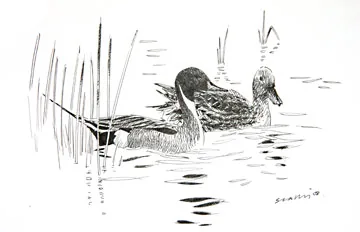
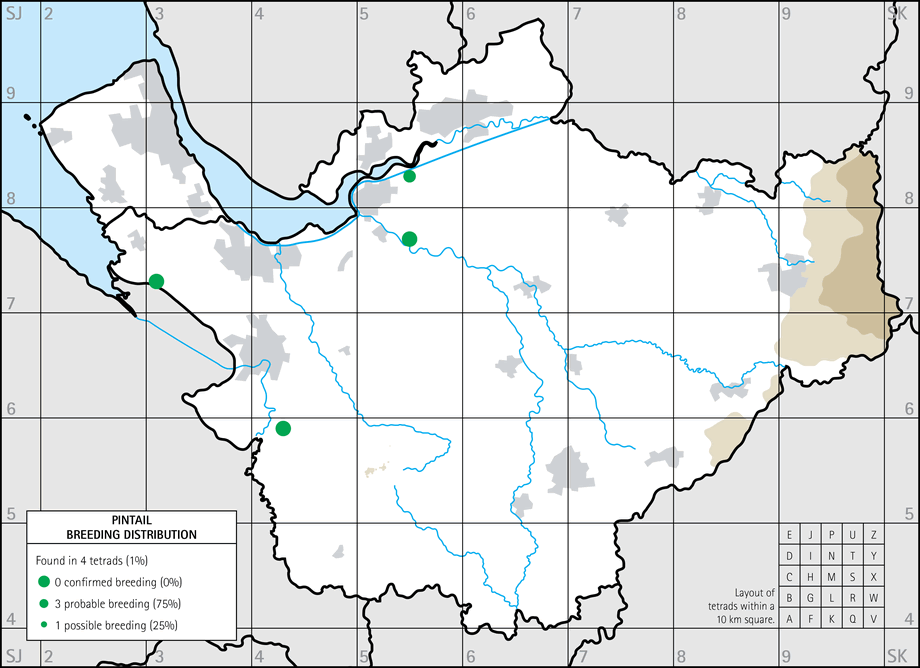
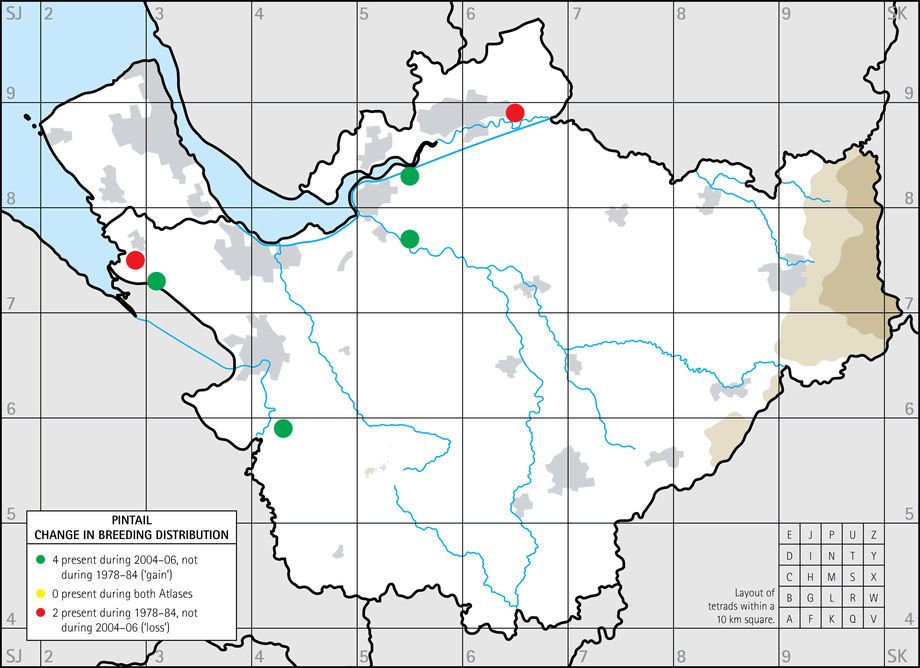
The records submitted for this Atlas were typical of any of the last 35 years. Pintails have not been found breeding in the county since a female seen with young at Frodsham Marsh in 1969. In many years pairs are present, sometimes displaying, as during this Atlas period. There were no records in 2004. In 2005 a pair was found near the river Weaver at Aston (SJ57N); the male went into eclipse plumage in July. In 2006, three pairs displayed at Inner Marsh Farm (SJ37B), another pair was present at Aldford (SJ45J), and a single female summered in Runcorn Town Park Lake (SJ58L).
Their few breeding sites in Britain are mostly open grassy areas adjacent to shallow eutrophic freshwater or brackish coastal pools, with a copious supply of invertebrates, especially small mud-snails. The national total of breeding birds was only 12-22 pairs in 2004 (Holling et al 2007).
Atlas account sponsored by www.deeestuary.co.uk
Winter
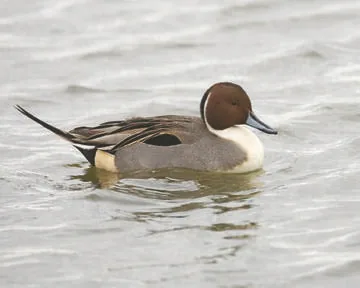
Our two estuaries have been of paramount importance for Pintail for much of the last century, but have experienced contrasting fortunes. The Dee is currently the premier site in the country, internationally important with a five-year peak mean of around 5,800, almost 10% of the international flyway population; virtually all of these birds are in Cheshire and Wirral. Establishment of the RSPB Gayton Sands reserve at the south end of the Dee has been crucial to them.
The Mersey used to be the supreme site for Pintails: from 1973 to 1984, counts exceeded 10,000 in most winters, and the maximum of 18,450 in November 1980 represented over three-quarters of the British total. But from 1985 onwards, numbers have fallen steadily and in 2004/ 05 the five-year peak mean fell to as few as 240 birds, below even the 279 necessary for registration as of national importance. The reasons for this are not understood but are clearly related to the site rather than the species as there has been little change over the years in the total visiting Britain. More than half of the British wintering Pintails are on the Irish Sea estuaries of the Dee, Solway, Ribble and Morecambe Bay, and indeed this is the most important region for them in northwest Europe (Brown & Grice 2005).
Going farther back in time, the numbers on the estuaries have clearly varied over the years. Coward (1910) knew the Pintail as a ‘fairly plentiful’ winter visitor to the Dee estuary, with increasing numbers on the Mersey especially using Hale Duck Decoy as a safe retreat in daytime. Up to about 1940 flocks on the Dee estuary varied from 500 to 1,000 but by 1957 the figures were 1,000 to 3,000, with the estuary holding the largest numbers in the British Isles, between half and three-quarters of the national wintering total. Far fewer birds visited the Mersey, with notable counts of 150 and 195 in March 1954 and 1956 (Bell 1962). During the 1960s birds apparently shifted from the Dee to the Mersey, with peak counts in 1965/ 66 of 1,200 on the Mersey but only 300 on the Dee. Up to 600 were on the Dee floods at Aldford at the same time (Bell 1967).
Pintails can be extremely mobile during the winter, taking advantage of habitats which are only temporarily available through flooding, and the Dee flood meadows above Chester also qualify as internationally important with mean counts of 600-700, peaking at 900 birds in winter 2006/ 07 near Worthenbury (SJ44I), with 250 at Aldford (SJ45E) in 2004/ 05. The only other three-figure flocks at non-estuarine sites were 250 on a small lake at Frodsham Marsh (SJ47Z) in 2004/ 05, and up to 180 at Inner Marsh Farm (SJ37B).
Although this species is said usually to be found in large flocks, in fact half of the 117 counts submitted over the three winters were of groups comprising fewer than ten birds. The habitat codes show that almost all of the county’s Pintails were on medium to large standing freshwater bodies, or saltmarsh/ estuarine areas. Despite their long necks, this species prefers to feed mainly in shallow water, dabbling and upending to take invertebrates and seeds. On the estuaries, they depend largely on small Hydrobia snails, but on inland grazing marshes seeds are by far the most important food (Owen et al 1986). One examined in studies following the August 1989 Mersey oil spill had been eating blackberries, presumably overhanging or fallen into an inland feeding site.
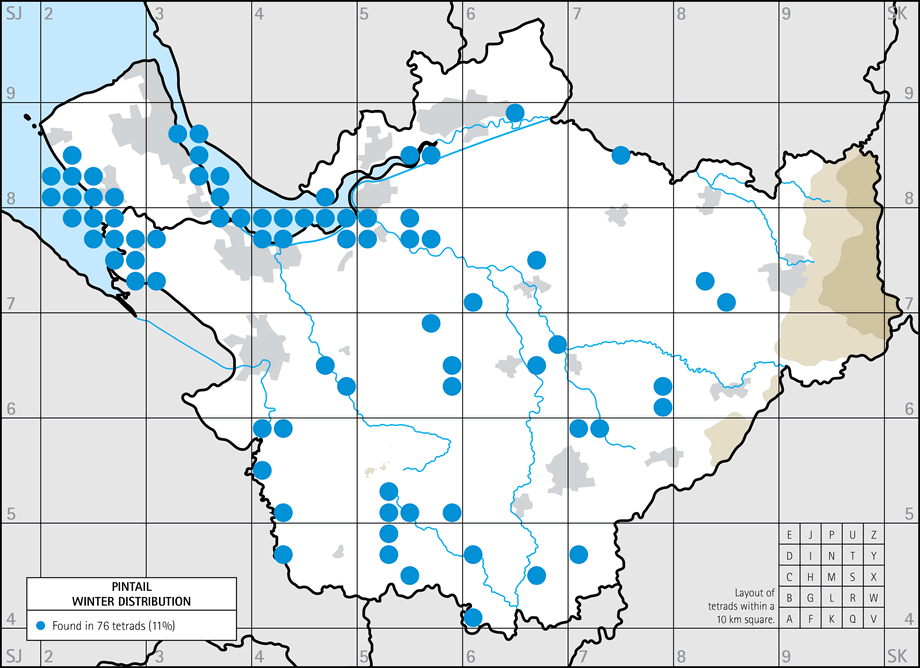
The winter distribution map has probably not changed much over the last thirty or forty years. Small numbers are present at most of the meres and lowland waters, but they avoid the uplands.
Pintail come here for the winter from breeding areas in Siberia, Fennoscandia, the Baltic States and Iceland. A bird ringed as a chick in Estonia in 1972 was shot that winter by a wildfowler on the Dee.
Atlas account sponsored by www.deeestuary.co.uk