
Sandbach Flashes: birds and wildlife

About the Atlas
During the three breeding seasons 2004–06 and three winters 2004/05–2006/07, Cheshire and Wirral Ornithological Society (CAWOS) organised more than 350 volunteers to survey all of the county, trying to find every species of bird that was breeding or wintering
Pochard Aythya ferina
Breeding
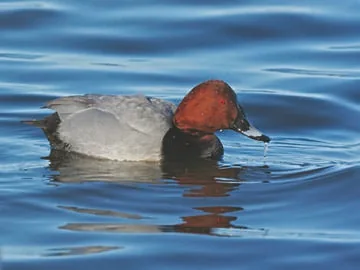
Pochard is such a scarce breeder nationally that its numbers have been monitored by the Rare Breeding Birds Panel since 1986. Their latest report shows that, in 2004, the Cheshire and Wirral population was 15 pairs out of a national total of 482 pairs (Holling et al 2007). There are only seven counties with more breeding birds. It is misleading, however, to use the word ‘county’ here, because all of our regularly breeding birds are at just one site, Woolston Eyes, as they have been for more than twenty years. As was commented in our First Atlas, the Pochard’s breeding status in Cheshire depends mainly on the state of the Woolston sludge-beds, and the citation for the SSSI status of Woolston was amended in March 2004 to recognise the site’s value for nationally important numbers of breeding Pochard. There were at least 15 broods there in 2004, 22 broods in 2005 and 13-16 broods in 2006.
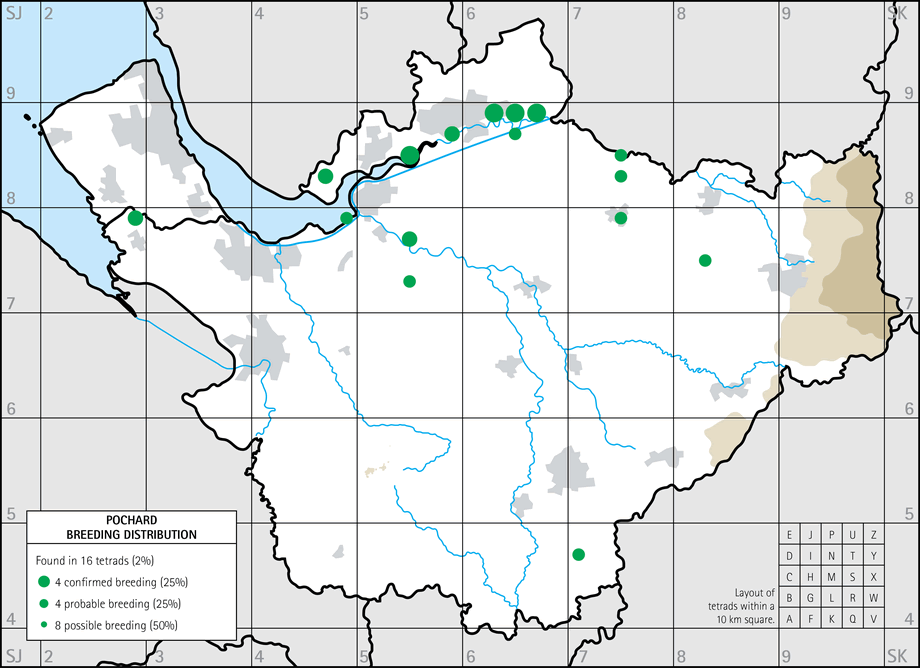
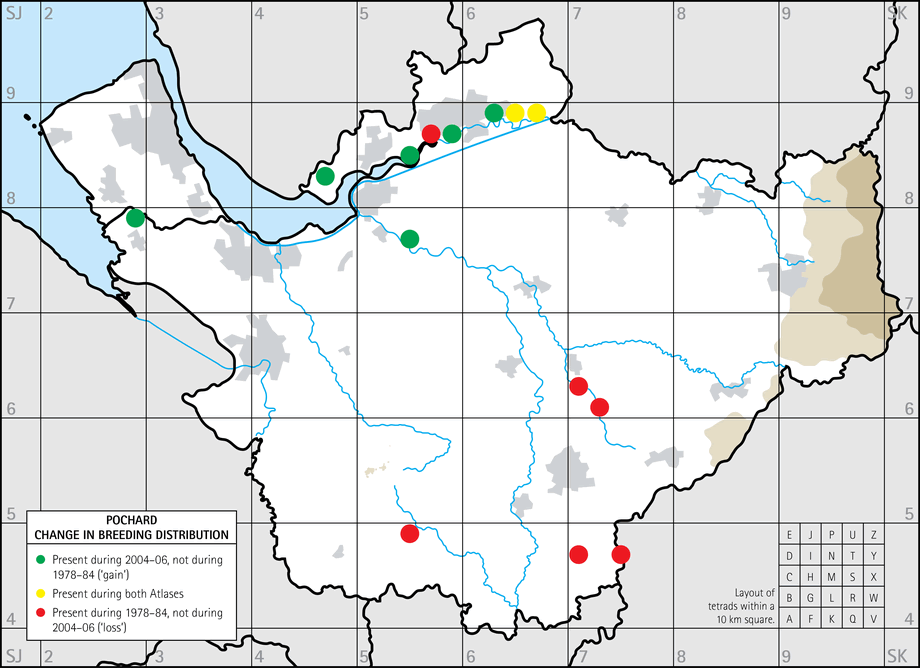
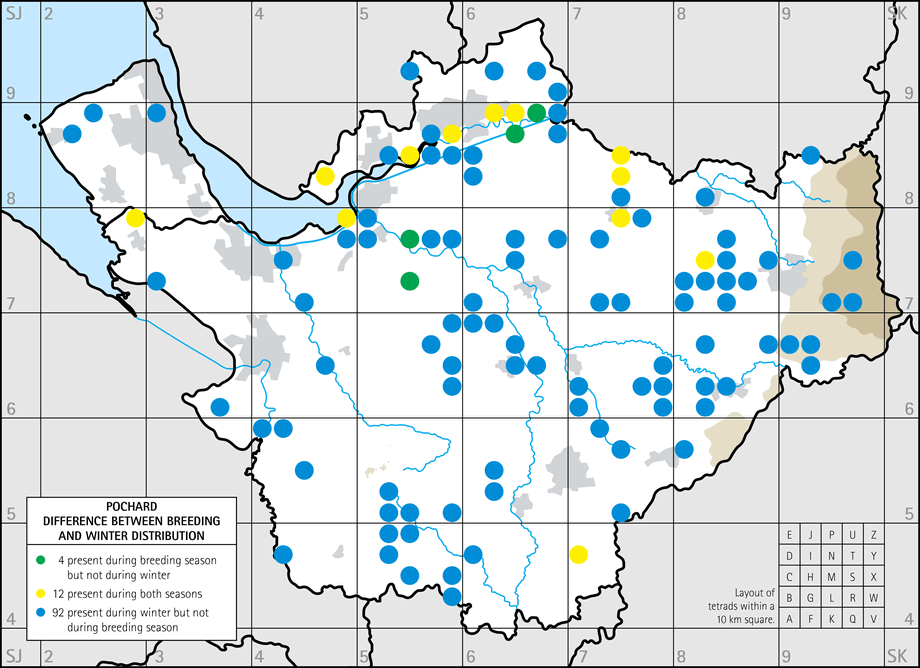
Their stronghold is clearly along the Mersey valley. In our First Atlas they were proved breeding only at Woolston and Doddington (SJ74D); now, twenty years on, breeding was confirmed only at Woolston (annually, in three tetrads) and Fiddlers Ferry (in 2006), with pairs of Pochards found in a further four tetrads. The Atlas map shows that there were single birds at a further eight sites but clearly few sites in the county provide their needs: Pochards are primarily vegetarian, diving for their food in shallow water with abundant plant-life, although they do take some small invertebrates. All of the birds were on standing water, and they can use quite small waterbodies; of the eight probable or confirmed records, one was on a pond less than 50 m2 (G1) and three on small waters up to 450 m2 (G2).
Pochards are fairly obvious when pairing, but females then withdraw to nest in dense emergent vegetation, and single males should be carefully watched. The earliest birds at Woolston start nesting in mid-April. Laying the typical clutch of 8-10 eggs, followed by 25 days incubation, leads to hatching in late May, with new broods from later birds emerging into July.
Atlas account sponsored by Tony and Margaret Hayter
Winter
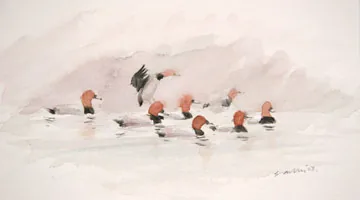
The UK breeding total is around 500 pairs but the British wintering total is currently estimated at 59,500 birds as large numbers arrive here from breeding grounds far to the east, reaching as far as 60ºE in Russia. Their long movements are explicable because the shallow, eutrophic waters that they favour are likely to be the first to freeze. The numbers reaching Britain have, however, dropped considerably in recent years as the warming climate allows more lakes and rivers in Eastern Europe and Russia to remain ice-free, so Pochards do not need to move as far.
There is strong differential migration with females moving farther south, probably because of aggression from the earlier-migrating males. However, where both sexes share a site, the females can hold their own and do not lose out on feeding opportunities. Across Britain as a whole, the wintering population is about 70% males and 30% females, a more imbalanced sex ratio than any other wintering duck, but it varies with latitude from about 8:1 in the north of Scotland to 3:2 in southern England (Migration Atlas). The preponderance of males in the county was commented upon by Bell (1962), although by 1967, Bell’s own records show that it had declined. He gave no figures, however, and quantification of the sex ratio in the wintering Pochard flocks in Cheshire and Wirral would be an interesting subject for study.
Their distribution is obviously determined largely by the availability of suitable food. Pochards sometimes upend like dabbling ducks, but mostly feed by diving, to an average depth of about a metre, where they take especially spores of algae and the seeds from pondweed. For several years in the late 1980s Salford Docks was discovered to be an important night-time feeding site for Pochards, and flocks were seen leaving Rostherne and Woolston to fly there at dusk, returning at dawn.
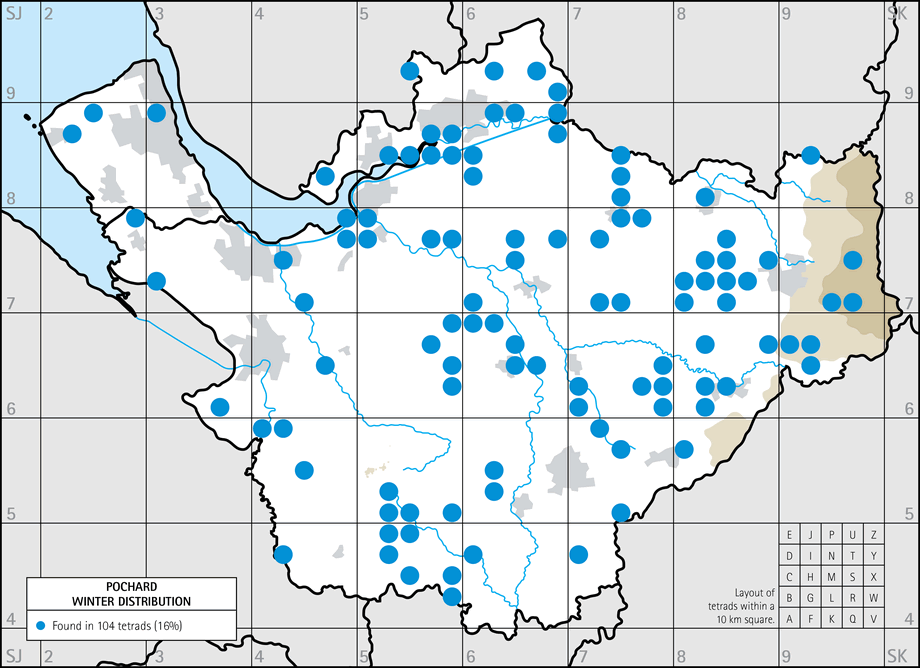
The map shows a striking absence from our estuaries: throughout its range, Pochard is largely an inland species. In the mid-20th century, Pochard were said to frequent most of the major meres, with flocks usually between 100 and 200 at Rostherne (Bell 1962). They are mainly birds of the larger waters: almost three-quarters of the winter habitat codes were G3 or G5, lakes, reservoirs and sand pits.
Currently Woolston is the most important site in the county, and the only one ranking as a site of national importance for wintering Pochard, holding (on average over 5 years) more than 1% of the UK population – 595 birds. Rostherne Mere (SJ78M) has now dropped out of the list of sites of national importance for the species, but has been an especially important refuge in times of hard weather, when its deep water remained largely ice-free. In January 1997, cold weather concentrated many Pochards there, and the WeBS count totalled 2,616, by far the largest flock on record in the county; counts in January 2002 and 2003 were close to 900 and 1,000 respectively, but annual peaks since then have not exceeded 200.
During this Atlas period, other favoured sites within the county included Frodsham Marsh (SJ47Z), with a peak count of 150, a count of 53 at Doddington (SJ74D), the meres at Cholmondeley (SJ55K) with up to 52, and an unusually high total of 50 on Astbury Mere, Congleton (86L). However, despite these sizeable flocks gathering at a few sites, the majority of Pochards wintering in Cheshire and Wirral are found in small numbers, up to twenty at most, dispersed widely across the county.
Atlas account sponsored by Tony and Margaret Hayter