
Sandbach Flashes: birds and wildlife
About the Atlas
During the three breeding seasons 2004–06 and three winters 2004/05–2006/07, Cheshire and Wirral Ornithological Society (CAWOS) organised more than 350 volunteers to survey all of the county, trying to find every species of bird that was breeding or wintering
Red-legged Partridge Alectoris rufa
Breeding
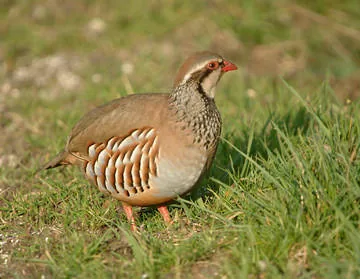
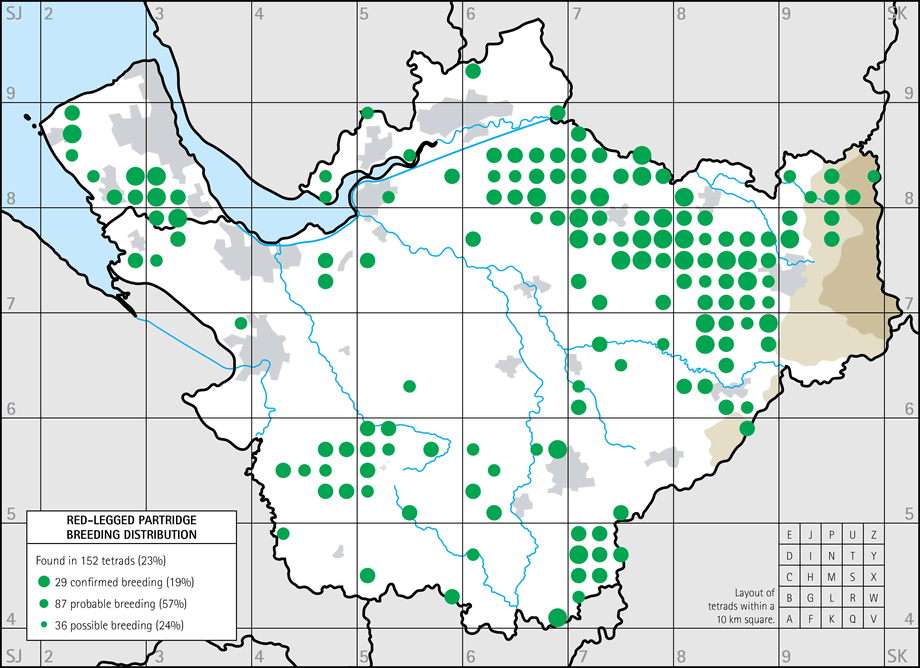
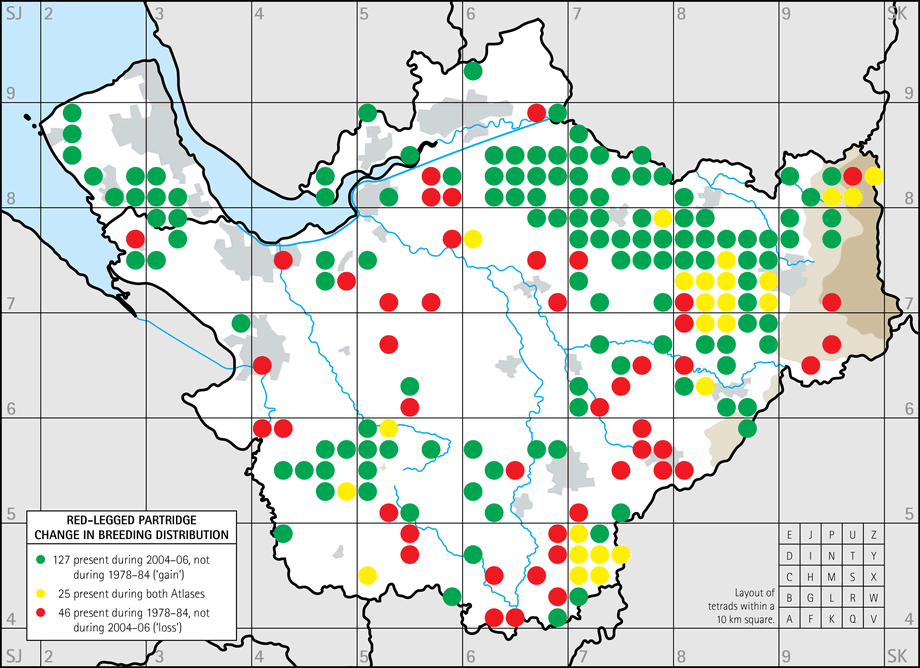
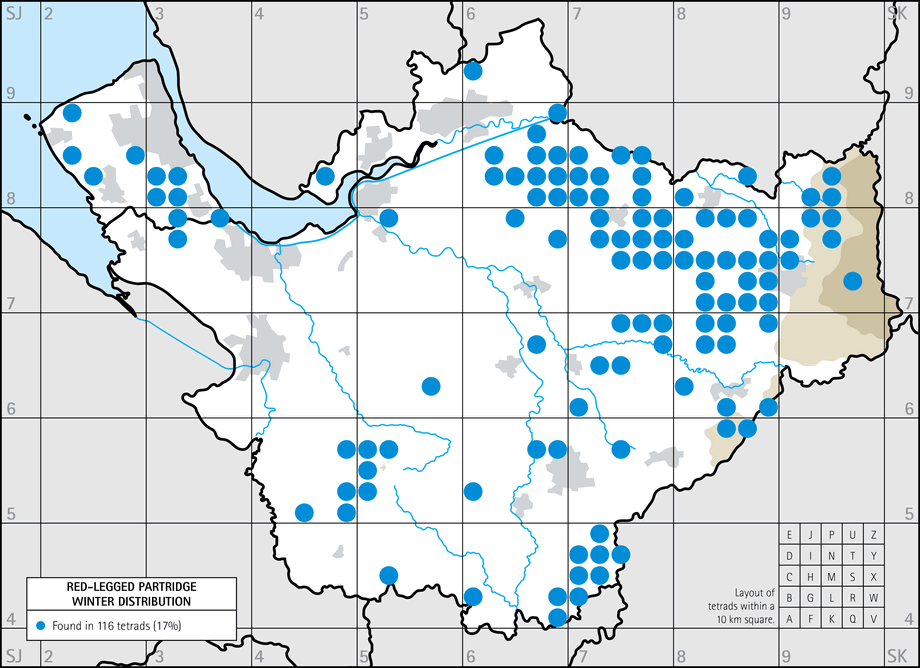
This partridge is essentially a south-easterly bird in Britain with Cheshire on the edge of its range, so it is interesting that this survey shows it now to be widespread in several parts of Cheshire, and to have established itself widely in Wirral as well. An indication of its range is well illustrated by the figures for the atlases of nearby counties: 70% of tetrads in Shropshire (1985-1990), 17% in Lancashire and North Merseyside (1997-2000) and 3% in Cumbria (1997-2001). Red-legged Partridges are usually reported to favour warm and dry areas, and lowland Cheshire fits within the 870mm annual isohyet and the 19ºC isotherm for average maximum July temperature that define their normal climatic requirements. Perhaps their spread in the county, with presence in 127 new tetrads and 46 losses since our First Atlas, has been encouraged by the warming climate.
This species was introduced to England in the 18th century from its native southern Europe and numerous sporadic attempts to import birds into Cheshire failed to establish a self-sustaining population here. Now, the county map appears to show four main clumps of population, and it is tempting to think that they have spread out from the sites where there have been large-scale releases of birds. The First Atlas mentioned releases in the 1970s and 1980s at Betley (SJ74), Withington (SJ87) and Dibbinsdale (SJ38), and more recently others have been ‘put down’ at Bolesworth and Tilston (SJ45).
All gamebirds suffer high rates of nesting failure. Their open nests, on the ground, are vulnerable to predation throughout their relatively long periods of egg-laying and incubation. Red-legged Partridges attempt to counter this by their unusual habit of double-clutching. Females frequently lay eggs in one nest, leave them unincubated and lay a further set in a second nest. She then incubates the second clutch whilst the male returns to the first nest and incubates them. The two broods, if they survive, are raised separately. This strategy is only partially successful, however, because the first clutch is left unattended for about three weeks and is at greater risk of predation. [They also tend to leave their eggs uncovered during laying, while Grey Partridges cover theirs with grass or leaves.] Perhaps the low productivity was suggested in this survey by only 29 tetrads having records of confirmed breeding; half of the records were of pairs seen, and others were located by their loud calls, said to resemble small steam-engines.
Analysis of the BTO BBS transects shows that the breeding population of Cheshire and Wirral in 2004-05 was 2,880 birds (820-4,950), an average of 25 birds per tetrad with confirmed or probable breeding: the Red-legged Partridge now exceeds the Grey Partridge, in abundance and in distribution. There is no evidence of any direct interaction, however: Grey Partridges dominate Red-legged in any disputes, and Red-legged are more susceptible to predation. However, newly-hatched Red-legged Partridge chicks can feed on weed and grass seeds, as well as insects, and it may be that they are less vulnerable to the indirect effects of pesticides than Grey Partridge chicks (Green 1984): this could be a reason why Red-legged survive in areas where Grey Partridges do not.
92% of habitat codes were farmland, with 32% improved grassland, 12% unimproved grassland, 12% tilled land and 26% mixed grassland and tilled land. Elsewhere in Britain, Red-legged Partridges are said to be much more tolerant of wooded landscapes than the Grey, yet more restricted to areas of arable crops (BTO Second Atlas) but there is no evidence of either of these traits in Cheshire.
Atlas account sponsored by Jim Bell
Winter
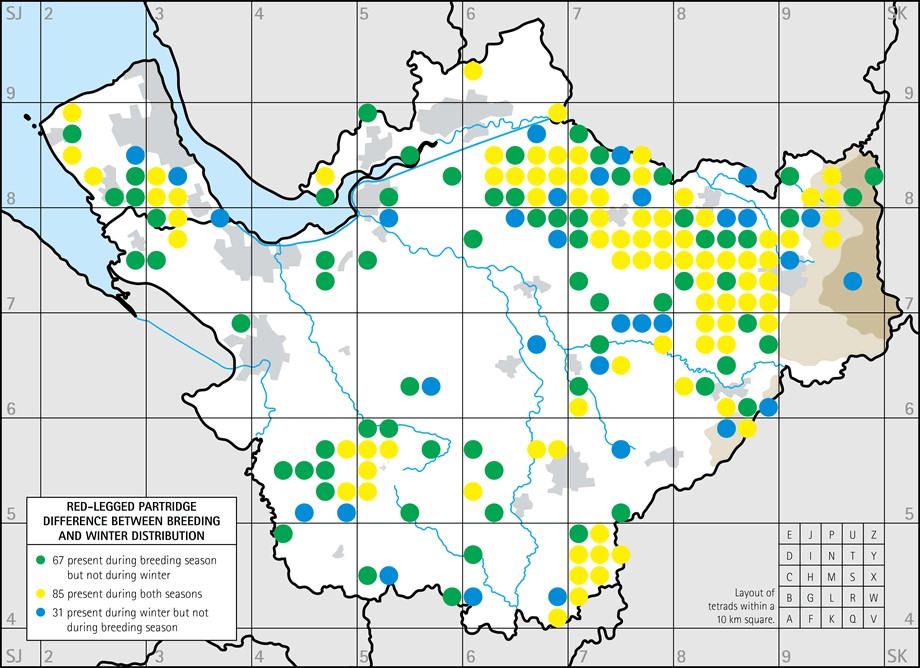
For such a sedentary species, there would be expected to be little difference between the breeding and wintering distribution maps, but 67 tetrads held Red-legged Partridges in the breeding season only, and 31 in winter only. This could be explained by birds gathering into flocks for the winter, but they normally stay together as family groups, typically two to five adults and their young (Brown & Grice 2005). This species differs from the Grey Partridge in that young males stay with the family party and it is the young females that disperse to avoid inbreeding: only about one quarter of young males move more than 0.5 km, while about three-quarters of yearling females do so (Migration Atlas). The ‘difference’ map shows that almost all of the tetrads occupied in winter only were adjacent to one with breeding season presence, and only three tetrads were more than 5 km away. The loss of birds from some of the more isolated breeding sites is difficult to explain, however.
91% of winter habitat records were on farmland, with similar proportions to the breeding season, 34% improved grassland, 7% unimproved grassland, 13% tilled land and 13% mixed grassland and tilled land. The hedge categories make up much of the remainder, but 7% of records were on stubble. Their winter diet is much the same as that of Grey Partridge, mainly seeds of grain and weeds, especially Polygonum, but birds increasingly turn to green food as seed becomes scarcer through the winter, particularly the shoots of winter-sown cereals.
Half of the submitted counts were of four birds or fewer, with 21 records of ten birds or more. The largest was 35 birds High Legh (SJ78B), with 28 near Marton in SJ86J, both in 2005/ 06. The same winter, twenty birds walked casually through Alan Straw’s rural garden near Mow Cop (SJ85U).
Atlas account sponsored by Jim Bell