
Sandbach Flashes: birds and wildlife
About the Atlas
During the three breeding seasons 2004–06 and three winters 2004/05–2006/07, Cheshire and Wirral Ornithological Society (CAWOS) organised more than 350 volunteers to survey all of the county, trying to find every species of bird that was breeding or wintering
Redshank Tringa totanus
Breeding
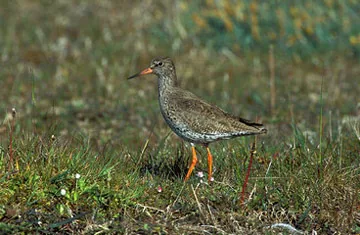
Land managed in a way that Redshanks like is in short supply these days, and their breeding distribution has contracted considerably since our First Atlas, with them being proven to breed now in only seven tetrads. Their key requirements are a high water-table with local soil saturation, open landscapes with look-out posts, moderately dense tussock vegetation (preferably grass or sedge) of intermediate height, and nearby wetlands for feeding (Tucker and Heath 1994). In saline areas they mostly eat small crustaceans, molluscs and polychaete worms, and inland breeders take earthworms and tipulids (cranefly larvae).
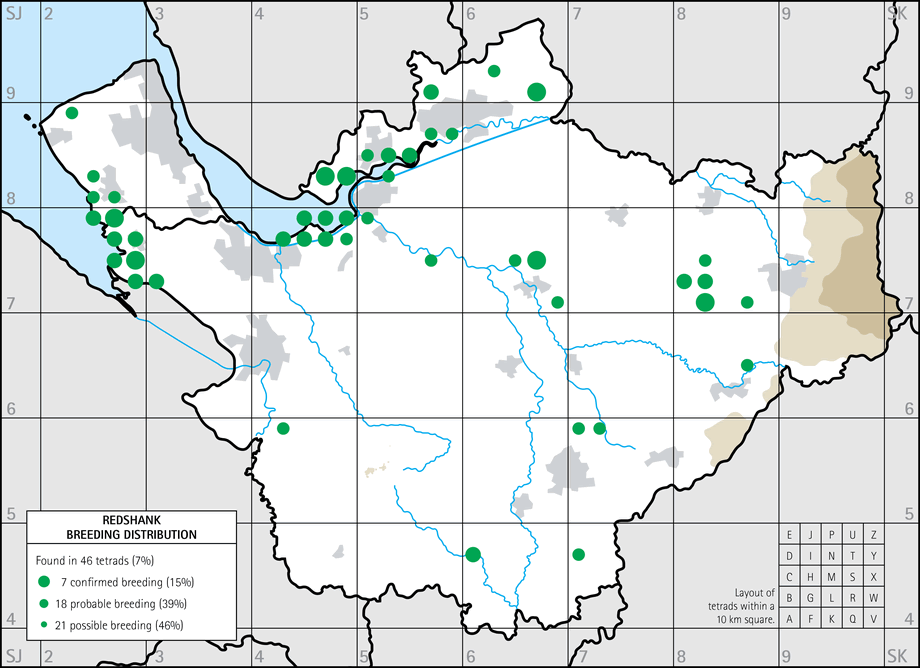
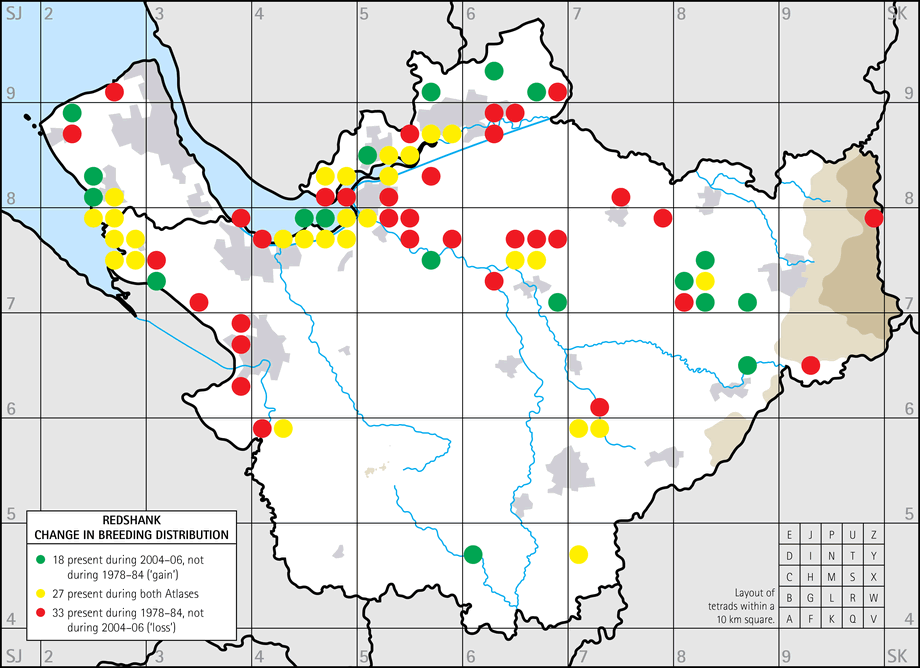
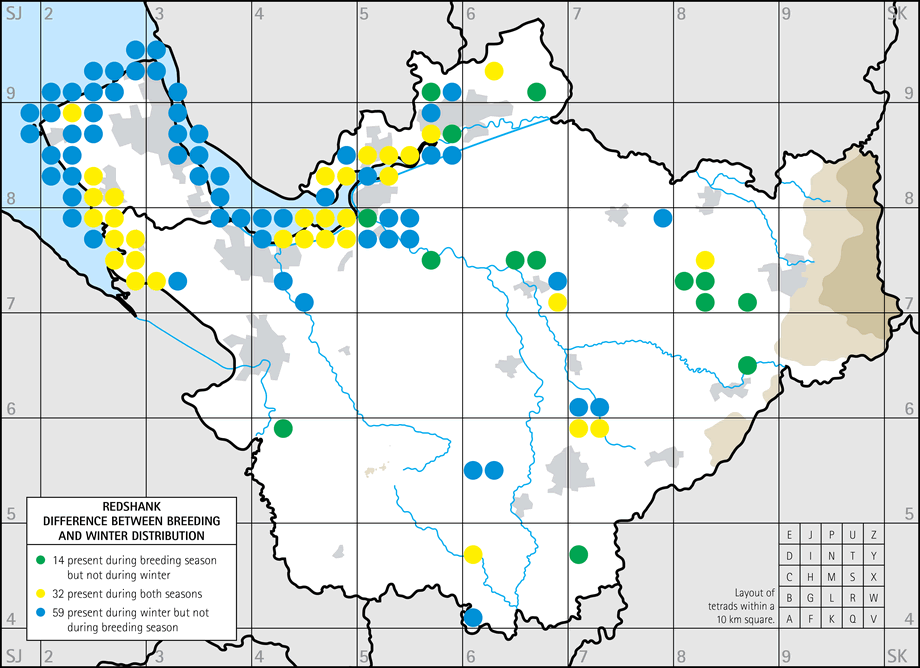
Redshanks have occupied three types of site in the county during our First Atlas or since: saltmarsh, primarily along the Dee estuary, with a few birds in the Mersey; riverside flooded meadows; and other sites, especially alongside sand quarries or flooded agricultural grassland. However, Redshanks breeding in the second have now disappeared in Cheshire, whereas twenty years ago they were proven to breed in two tetrads along the lower River Weaver, with possible breeding alongside the non-tidal section of the River Dee, from where there were no records at all in this survey. Thirteen of the 25 tetrads with confirmed or probable breeding were estuarine saltmarsh, with the other birds in a variety of habitats, most on the edges of large waterbodies, sand quarries or the Frodsham Marsh deposit grounds, or in water-meadows/ grazing marshes.
The seven tetrads with confirmed breeding came from observers seeing adults with chicks in five cases, with an occupied nest observed on the Dee saltmarsh and birds performing their distraction display, trying to lure the observer away from their nesting area, in a Mersey tetrad. The 18 instances of probable breeding arose from seven observations of agitated behaviour (A), seven of display (D), and four sightings of pairs of birds.
With the expected ‘coastal squeeze’ from sea-level rise and development close to the sea, the areas of saltmarsh and coastal grasslands will reduce, and Redshank has been taken as an indicator species for research (Smart & Gill 2003). Saltmarsh supports the most breeding Redshanks, followed by coastal grassland, then inland grassland; but on saltmarsh and coastal grassland, few young survive because of predation and tidal flooding washing away nests, whereas on inland grasslands, half of the pairs in the East Anglian study areas produced at least one fledgling.
The county population, as in our First Atlas, depends crucially on estimates of the numbers on the Dee saltmarshes, with at most 10 or 15 pairs elsewhere. RSPB surveys of their land in SJ27 during 1996 and 2000 show that Redshanks vary greatly according to the intensity of grazing, with perhaps 100 pairs or more in the whole area. Redshanks are on the Amber List of species of conservation concern, partly because of their UK population decline. National surveys of waders breeding on wet lowland grasslands were conducted in 1982 and 2002, revealing a 29% drop in breeding Redshanks, and showing that nature reserves were by far the best sites for them, with cattle and sheep grazing and flooding managed to benefit breeding waders (Wilson et al 2005). Although no action targeted at their conservation is yet in place, there are national and local Biodiversity Action Plans for coastal and floodplain grazing marsh, that ought to benefit breeding Redshanks. The only local action on these habitats so far has been at the Gowy Meadows (SJ47H/ M), however, where the species has not been recorded for many years; at least fifty pairs nested there in 1907 and it would be good to see a return (Coward 1910).
Atlas account sponsored by www.deeestuary.co.uk
Winter
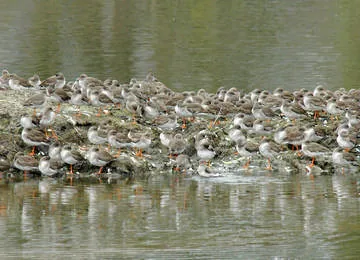
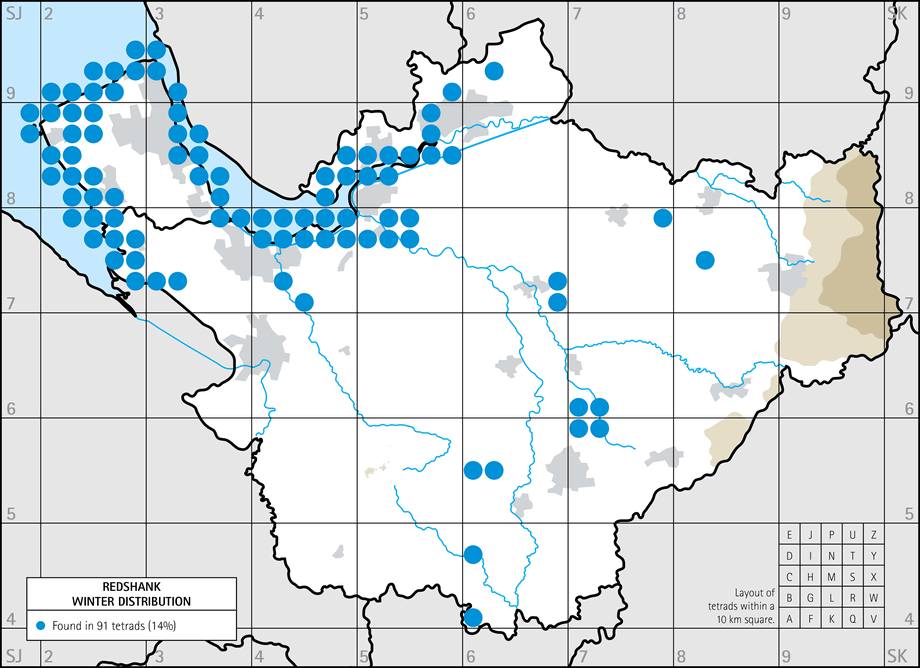
Cheshire and Wirral is the most important county in Britain for wintering Redshanks, with WeBS counts showing the Dee and Mersey estuaries both in the top five sites in the UK. The Dee figures include birds in Wales and inland at Inner Marsh Farm but our estuaries hold an annual average of around 10,000 birds between them. They both qualify as internationally important, exceeding the 2,800 threshold, and this is one of the species listed among their citations for European Special Protection Area and Ramsar status. Redshank is amongst the most frail of waders and is particularly susceptible to freezing conditions, so our relatively warm and sheltered west-coast estuaries may be of especial value for them (Norman & Coffey 1994).
The vast majority of these birds are of Icelandic stock, which have longer wings and shorter bills than British birds, typical adaptations for living in colder climates: work on the Mersey birds suggested that about 85% of the adult population were of the Icelandic-breeding race (Norman & Coffey 1994). Merseyside Ringing Group has records of nine birds that have been found in Iceland, including one unfortunate individual that apparently overshot and landed on a fishing boat between Iceland and Greenland, where Redshanks have never been known to breed. Some of our wintering birds are British breeders, including birds moving south from Scotland, but many British birds, especially the juvenile birds, move south to France.
Redshanks feed, singly or in small groups, on the mudflats and in the estuarine creeks, taking small molluscs and crustaceans, with the little marine shrimp corophium a favourite, and various worms. At high tides they flock to roost on the edge of the saltmarsh. As with all waders, Redshanks’ lives are dictated by the rise and fall of the tides rather than by daylight, and some birds occupy different areas at night, including some unusual sites where they would probably not feel safe by day. Edwin Samuels noted a night-time high-tide roost in a field at Bebington Oval sportscentre (SJ38H), with up to 200 birds present; in 1989 similar numbers of Redshanks roosted on the sides of a large pit within the Tranmere oil terminal complex.
The winter map shows Redshanks present at a few sites away from the estuaries, but only in small numbers. Apart from those roosting at Inner Marsh Farm, up to a maximum of 380 during this Atlas period, few Redshanks were found at any freshwater site, with 30 or more on flooded fields alongside the lower River Weaver at Aston (SJ57N) and 20 at Sandbach Flashes (SJ75J) the only double-figure counts.
From the publications of earlier Cheshire authors it is not possible to know whether there has been a change in status of wintering Redshanks. Coward (1910) wrote that ‘in December, January and February there are generally a few winter residents about the shores and marshes’, but followed that by adding that he had seen ‘very large flocks’ at the end of December on the Mersey sands near Eastham and Stanlow. Although by 1952 the famous photographer Eric Hosking knew Hilbre as the best place to film vast assemblages of waders, including Redshanks, Bell (1962 and 1967) does not even mention birds wintering on the estuaries, but over-emphasises the small numbers inland.
Atlas account sponsored by www.deeestuary.co.uk