
Sandbach Flashes: birds and wildlife

About the Atlas
During the three breeding seasons 2004–06 and three winters 2004/05–2006/07, Cheshire and Wirral Ornithological Society (CAWOS) organised more than 350 volunteers to survey all of the county, trying to find every species of bird that was breeding or wintering
Reed Bunting Emberiza schoeniclus
Breeding
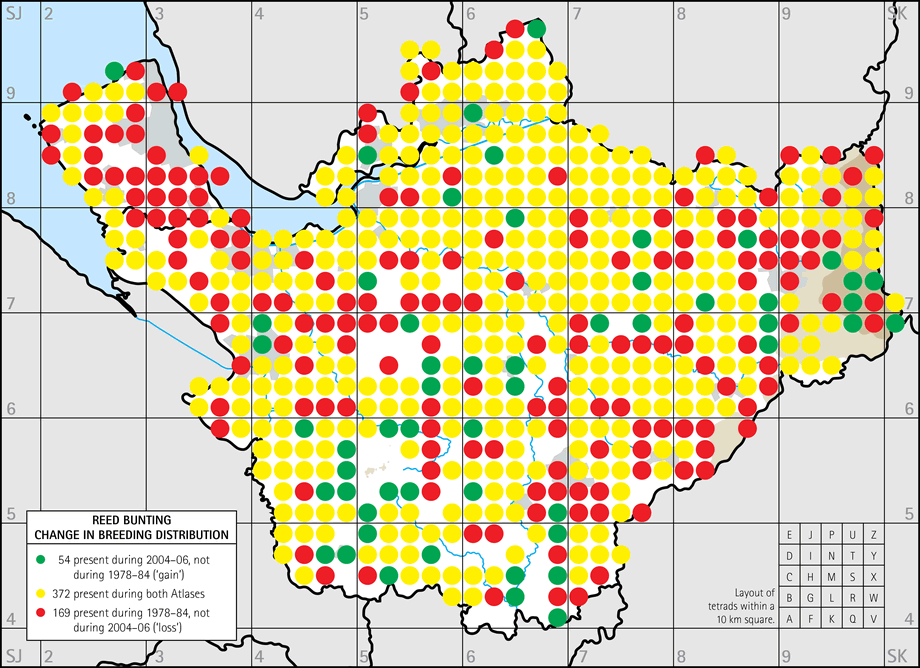
The rapid decline in breeding numbers has put Reed Bunting on the Red List of species of conservation concern, with a national and local BAP to support action for its recovery. The national population index for Reed Bunting crashed to reach a low point in 1984 that was 57% down on their peak just a decade earlier in 1975; the Cheshire and Wirral picture may have been worse, since the fall in northern Britain was greater than in southern areas (Peach et al 1999). Since then, the national index has fluctuated within quite a narrow range and the 2004 figure is little different from that of twenty years before. Thus, the population was falling throughout the period of our First Atlas, and the large decrease (169 lost, 54 gained) in occupied tetrads shown in the ‘change’ map is probably mainly in tetrads surveyed in the early years of our 1978-84 First Atlas survey. This drop is widespread and scattered throughout the county but includes a major loss from most of the Wirral peninsula. It is still, however, a common bird of the damp, scrubby areas in the Mersey valley, and Reed Bunting is perhaps the characteristic species of the marl pit ponds across much of agricultural Cheshire; the only areas showing more than the odd gains since our First Atlas are in the south-west of the county.
Demographic analyses suggest that the national decline was driven by decreasing over-winter survival rates, particularly for the inexperienced first-year birds, probably because of reduced availability of small seeds on farmland (Peach et al. 1999). The breeding decline was as severe along waterways as on farmland, and deterioration of the Reed Bunting’s characteristic wetland habitats may have had a serious effect, through loss of small ponds, unsympathetic river engineering and the encroachment of scrub and carr. In other parts of Britain, Reed Buntings have compensated by moving to breed into fields of this crop: farmland densities are four times higher in oilseed rape than in cereals or setaside (Gruar et al 2006). This is not likely to have had much effect in Cheshire and Wirral, however, with the relatively low area of this crop.
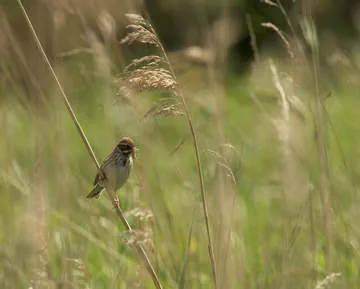
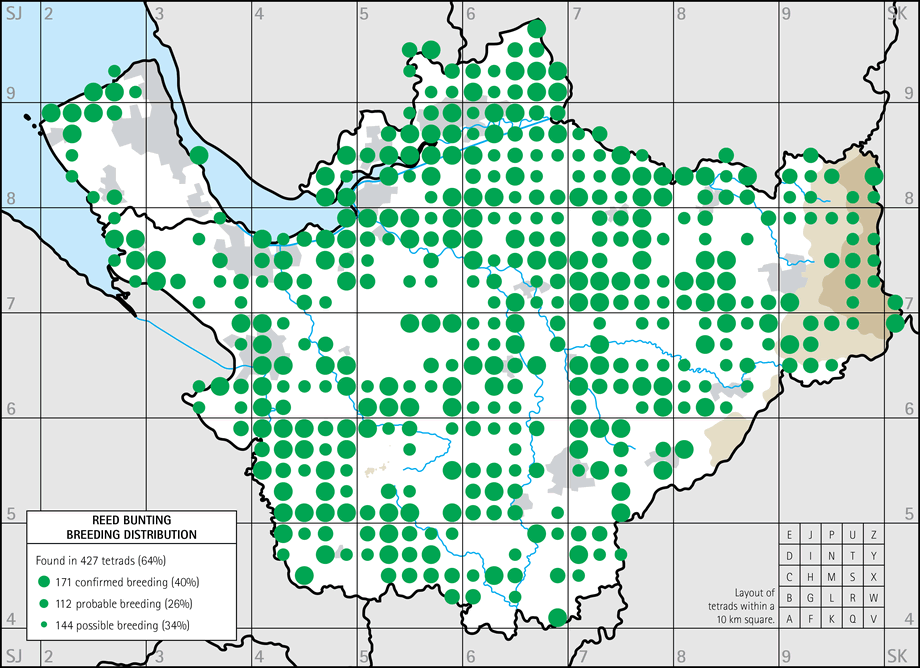
Breeding Reed Buntings occupied a very wide range of habitats. Most contained water or reedbed, but a significant fraction of birds belie the species’ name. During the middle of the 20th century the species had spread out to occupy some dry habitats, although these are probably sub-optimal and much of the population decline seems to have been in these drier areas. Even in apparently favourable habitat, however, there have been waning numbers. This species has been included in most years of the mid-May Woolston warbler census; counts have dropped dramatically from a mean of 103 singing males in the years 1983-89, to 78 males in 1994-97 and a mean of only 36 singing males during the three years of this Atlas. The unmanaged progression from open scrub towards a drier woodland has presumably been inimical to this species. It has also been noticeable across the county that the species has extended its breeding season, with some birds singing into August, probably driven by the poor success of early nests to prolong their season with further attempts. Fieldworkers confirmed breeding in 40% of the tetrads, mostly by seeing adults with a beak full of grubs, the observers’ attention probably being drawn by the birds’ insistent anxiety calls. Adults feed themselves on small seeds all year round, but have to find the protein-rich invertebrates for their chicks; it may be a reduction in insects that has cut Reed Bunting breeding numbers, especially in drier habitats.
The BTO analysis of 2004-05 BBS data puts the breeding population of Cheshire and Wirral as 4,410 birds (3,930-4,930), corresponding to an average of about 16 birds per tetrad with confirmed or probable breeding, or 10 birds per tetrad in which the species was recorded. The abundance map, although distorted for much of Wirral, shows that the main density of Reed Buntings is along the Mersey valley, where most of their ideal habitat is to be found.
Atlas account sponsored by Robin Hart
Winter
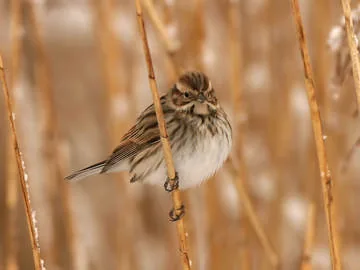
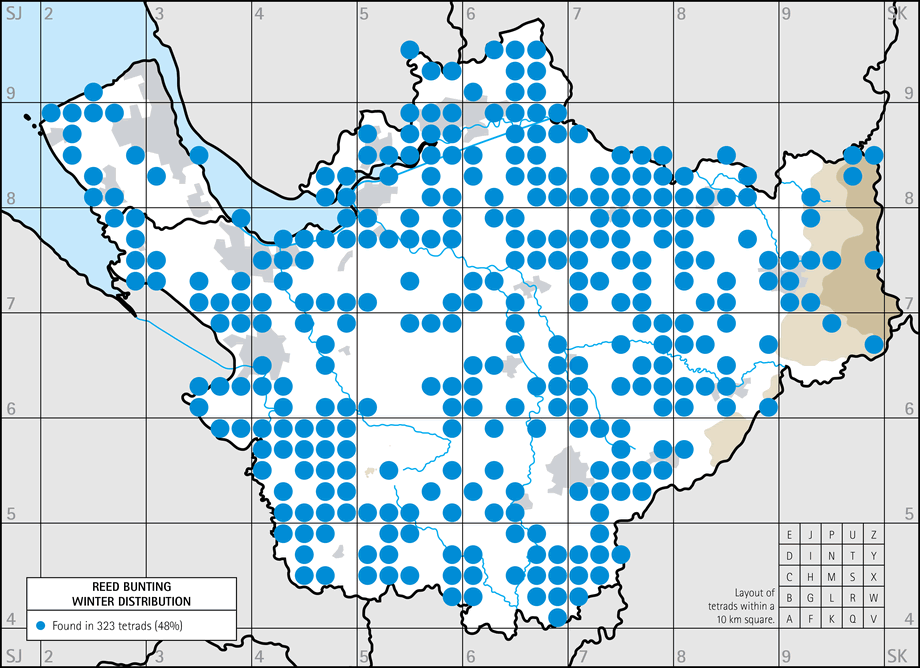
This winter Atlas map would come as a surprise to most 20th century ornithologists. Coward (1910) noted that ‘although a few odd birds, sometimes a male and female evidently a pair, frequently remain throughout the winter, the majority of Reed Buntings leave in the autumn’. They returned in mid-March as one of the earliest spring migrants. Boyd (1951) was used to only small numbers during winter in mid-Cheshire, where he acutely observed that they join the finch-Yellowhammer flocks in the hedgerows. Bell (1962) expanded on the description of their winter status by writing that few remain inland, and that in Wirral, birds from inland localities may make for the coast. During the mostly cold weather of the national winter Atlas, spanning 1981/ 82 to 1983/ 84, Reed Buntings were found in every 10-km square in the county, but only in any numbers along the Mersey valley and west Wirral, a statement that was echoed in the annual county bird report for 1986. From records submitted to the annual bird reports it is not clear when wintering birds became more widespread, but the Woolston report for 1992 noted that the recent run of relatively mild winters had changed their status and the county report for that year introduced one-line status statements for all species and, optimistically, declared the Reed Bunting a ‘common widespread resident’. There were noticeably fewer in the county in the colder winters of 1995/ 96 and 1996/ 97, when most birds were reported along the frost-free tide-lines and saltmarshes, but since then their wintering numbers have increased greatly.
Life in winter in Cheshire and Wirral is obviously finely balanced for Reed Buntings: the population comprises some residents and some partial migrants, and the equilibrium between them shifts from year to year. The smaller females especially are less able to withstand cold weather and move to the coast or fly south, or die. This is a much-ringed species and there are many records of migration, some as far as the south coasts of England and Wales: in 1990 a Woolston-bred female, for instance, moved to Devon for the winter and then back to Woolston in 1991. There appear to be fewer migratory birds these days, as climate change favours the sedentary individuals. Although the British Reed Bunting population is largely self-contained, there may also be some birds wintering here from continental Europe (Migration Atlas); ringed birds moving between Cheshire and Suffolk hint at such an origin.
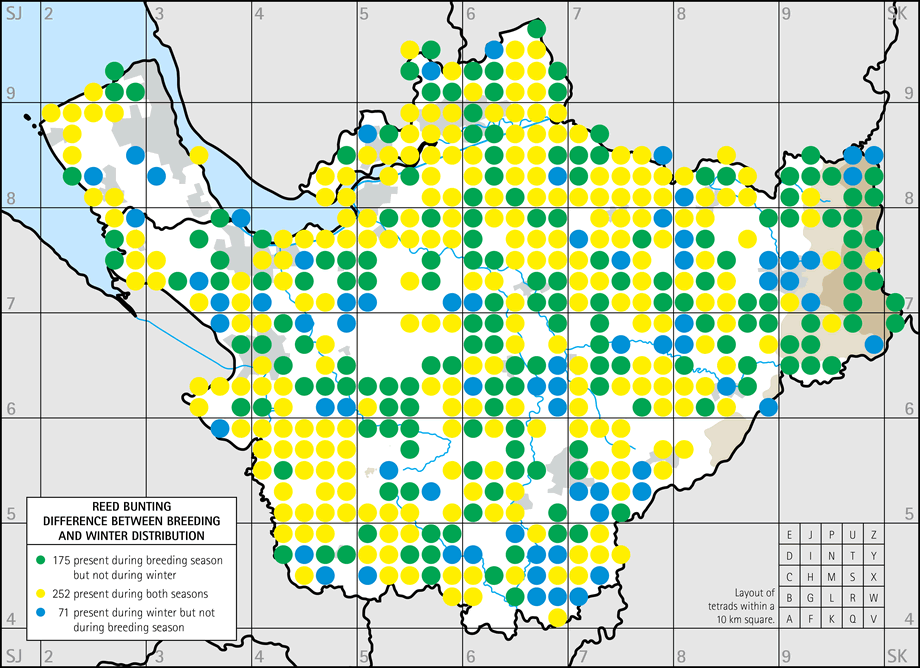
The map shows that there is some contraction of range, with winter birds found in 323 tetrads, 104 fewer than in the breeding season. There were 252 tetrads with Reed Buntings present in the breeding and winter seasons, 71 occupied in winter only and 175 with breeding season presence only. There is no particular geographical pattern to these shifts, except for a withdrawal from much of the highest land in the east.
Reed Buntings gather into flocks outside the breeding season, but most gatherings are small. Only fourteen counts were submitted of more than 25 birds, all in stubble, set-aside or wildbird crops, with the largest, 50 birds, on the Dee saltmarsh. Communal roosts are another feature of their ecology, but only five were reported, with a maximum of ten birds apart from a substantial roost at Woolston estimated at more than 150 birds on 3 December 2006.
Analysis of the habitat codes submitted shows a wide range spanning all of the habitat groups: 53% farmland; 17% semi-natural grassland and marsh; 16% freshwater; 6% human sites; 4% scrub; and 2% bog. Outside the breeding season, Reed Buntings concentrate on small grass and weed seeds, and weed-rich stubbles are strongly preferred as winter feeding habitat (Wilson, Taylor & Muirhead 1997). Certainly, in this survey Reed Buntings were one of the small passerines most likely to be found in any suitable stubble (E7). The lack of weedy stubble is probably the main factor that reduced the carrying capacity of the winter environment for Reed Buntings compared to that of the early 1970s (Peach et al 1999); this loss has been only partially compensated by Environmental Stewardship options such as set-aside and specially planted seed crops, where Reed Buntings seem especially to favour millet. Observers noted a few birds at ‘human’ sites, and Reed Bunting is one of the species that occasionally enters gardens, especially in late winter as natural food supplies dwindle, but surveyors for the BTO Garden BirdWatch have reported few since 1998.
Atlas account sponsored by Robin Hart