
Sandbach Flashes: birds and wildlife
About the Atlas
During the three breeding seasons 2004–06 and three winters 2004/05–2006/07, Cheshire and Wirral Ornithological Society (CAWOS) organised more than 350 volunteers to survey all of the county, trying to find every species of bird that was breeding or wintering
Ring Ouzel Turdus torquatus
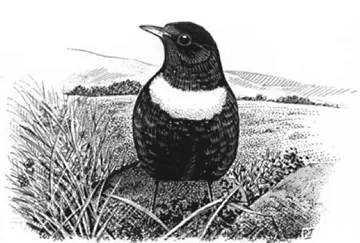
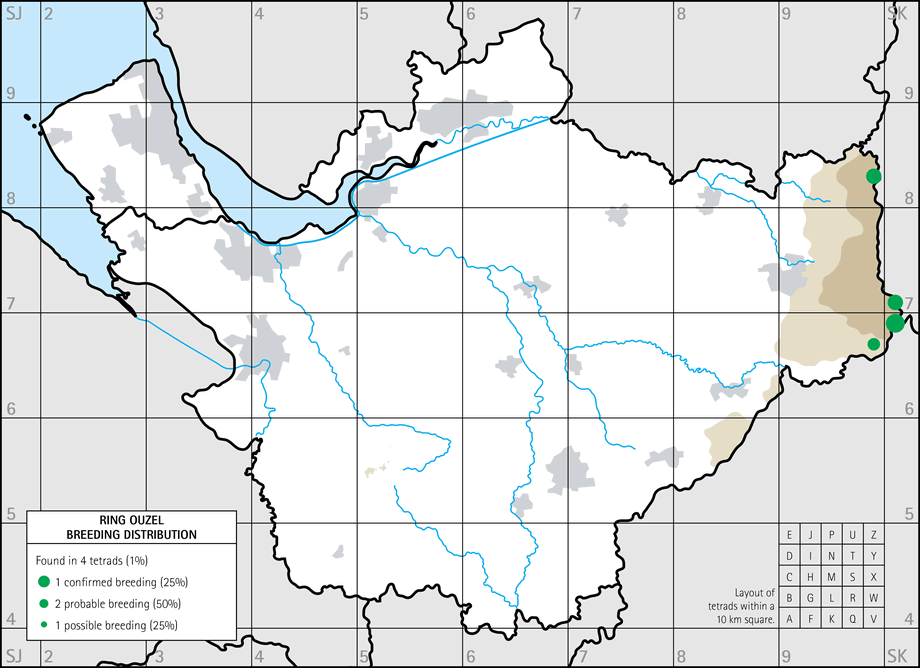
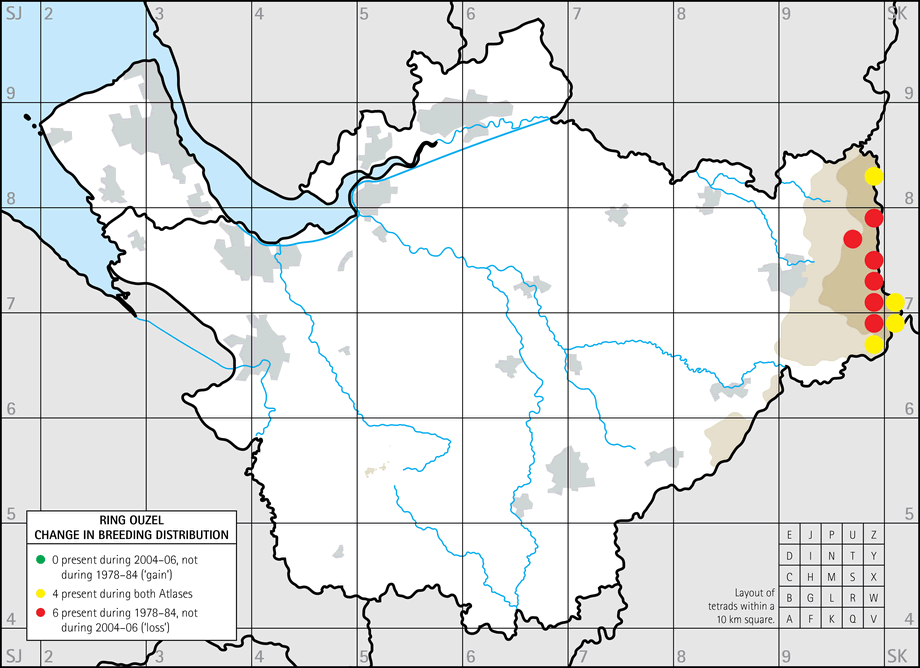
Our only summer migrant thrush, the Ring Ouzel is on the red list of species of conservation concern because of its rapid population decline. Nationally, the BTO’s second breeding atlas showed a drop of 27% in the number of 10-km squares occupied between 1968–72 and 1988–91, then a further 39-43% range contraction was estimated for the period between 1988–91 and 1999 (Wotton et al. 2002). RSPB surveys in the Staffordshire moorlands showed precipitous declines, from 61 pairs in 1985 to 18 in 1992 and 5 in 1996 (Brindley et al 1992, McKnight et al 1997). No quantitative evidence has been forthcoming of a decline in Cheshire, but in 1991 the county Bird Report stated that there ‘appears to be a general feeling’ that the species is becoming scarcer on its breeding grounds. Fieldwork for this Atlas shows that they are now breeding only on the very fringes of Cheshire, having dropped from 10 tetrads in the First Atlas to just three.
Ring Ouzels return early from their winter quarters in the Spanish and Moroccan uplands, birds often arriving during March, and they are usually on territory in the eastern hills in April. They breed at high altitudes in steep areas of gullies, rocky cloughs, rock outcrops and old quarries. They usually nest on or close to the ground in low vegetation, especially heather and bracken, also on rocky ledges and rarely in trees. The adults find their food, for themselves and their chicks, mostly on the ground, eating invertebrates, both adult and larvae, including earwigs, bugs, flies, sawflies, moths, beetles, millipedes, snails, slugs and earthworms. Most birds have two broods of chicks and the adults in particular are sustained through their later nesting attempts by the early fruits from plants such as bilberry. Thus, they favour a mosaic of heather moorland for nesting and short grass for foraging, and a loss in quality or availability of either component reduces the attractiveness of an area for Ring Ouzels.
The reasons for the Ring Ouzels’ decline are poorly understood. Responsible factors on the breeding grounds include habitat deterioration, increased competition with Blackbirds or the effects of climate change on a high-altitude species. Other suggestions involve afforestation, acid rain, recreational disturbance and increased predation, including by raptors. The use of anthelmintics to control parasites in sheep is likely substantially to reduce the abundance of soil invertebrates (Brown & Grice 2005). Conditions on passage could also have an influence. Numbers of Fennoscandian breeders appear to have held steady and perhaps the earlier timing of spring migration for UK birds, and their more westerly route, gives them greater exposure to hunting pressures, particularly in southwest France (Burfield & Brooke 2005).
The First Atlas suggested that the Cheshire population was limited to 9-12 pairs each year; it is probably now down to three or four pairs.
There were reports of wintering males within the breeding area in 2002/03 and 2003/04, but none during this winter Atlas period.
Atlas account sponsored by David Hinkes