
Sandbach Flashes: birds and wildlife

About the Atlas
During the three breeding seasons 2004–06 and three winters 2004/05–2006/07, Cheshire and Wirral Ornithological Society (CAWOS) organised more than 350 volunteers to survey all of the county, trying to find every species of bird that was breeding or wintering
Ringed Plover Charadrius hiaticula
Breeding
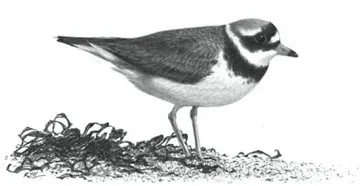
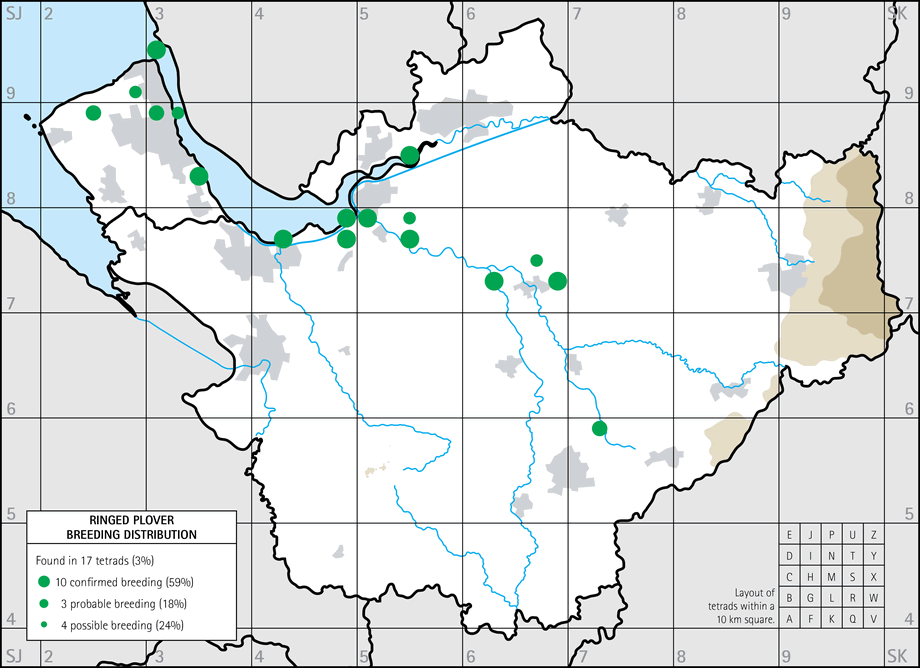
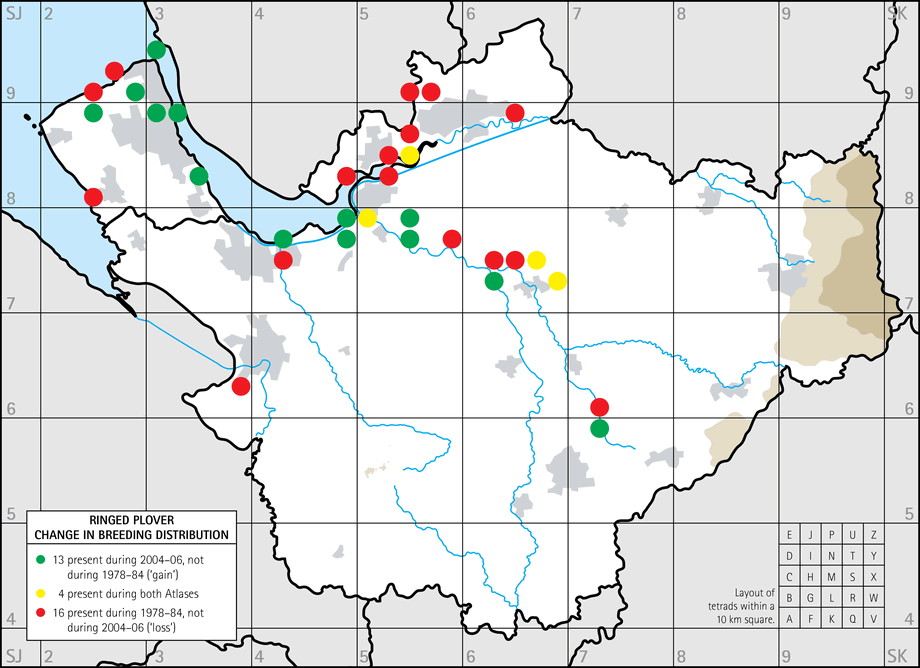
Ringed Plovers in Cheshire and Wirral favour transient habitat, especially post-industrial sites near to the shore, but these are abandoned if they become too vegetated. Birds were found at abandoned or reclaimed docksides, a demolished power station and petrochemical plant, a dry clay pit, flashes, lime beds and canal dredging deposit beds. Their breeding status is much the same as in our First Atlas but, as indicated by the ‘change’ map, few of the sites where they nested twenty years ago are still suitable; only four tetrads held birds in both Atlas periods. Their traditional breeding sites are sandy shores, but the Wirral beaches are far too disturbed and no Ringed Plovers use them now: the two records in 1978 and 1983, during our First Atlas, are the last known.
The female lays four eggs in a scrape on the ground, neatly arranged with their pointed ends always in the centre of the nest, and shares the incubation with her mate. After about 24 days the chicks emerge with their legs fully formed and able to run around and find their own food of invertebrates and insects. In the ten tetrads with confirmed breeding, five of them came from observers seeing the gawky youngsters and five with an adult sitting on eggs; three instances of ‘probable breeding’ arose from pairs seen. The young birds can fly after about another 24 days, and the pair usually has a second brood; I have dates for nests with eggs in Cheshire from 8 April until early July.
The trend in the national breeding population is not well known and the results of the BTO survey of Ringed Plovers and Little Ringed Plovers in 2007 are awaited. The spread away from the coast was noted in the BTO Second Atlas (1988-91), and a census in England and Wales revealed an increase of 12% in breeding birds in wet meadows, mostly at coastal sites, between 1982 and 2002 (Wilson et al 2005). The Cheshire and Wirral breeding population at the end of our First Atlas in 1984 was at its highest level for well over one hundred years, at 13 pairs. In the years since then, the annual bird reports have seldom recorded breeding anywhere other than at ‘River Mersey/ Weaver sites’ but clearly this Atlas has stimulated more thorough surveying and the county population is probably still around a dozen pairs.
Atlas account sponsored by Mike Allsopp
Winter
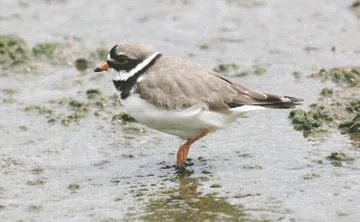
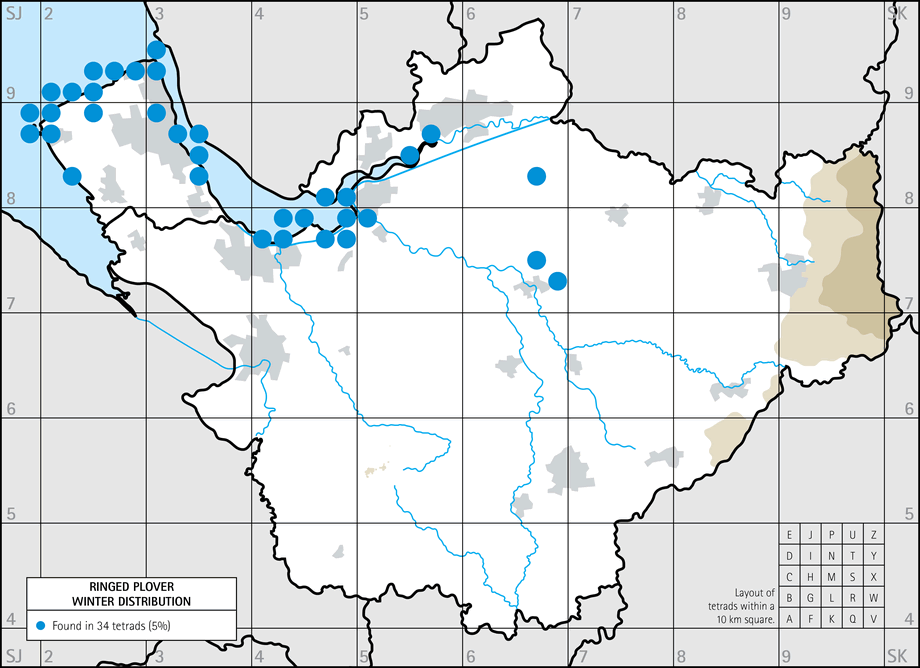
Large numbers of Ringed Plovers pass through in spring and autumn on their journeys between Greenland and Africa, and both the Mersey and Dee estuaries exceed the national threshold for passage of 300 birds, but far fewer winter in the county and no site is of conservation importance for the species. Most of those the wintering birds are of British stock, but there might be some immigrants from continental European breeding sites along the coasts of the Wadden Sea and Baltic. They find their food by watching for movement at or near the sand surface, taking primarily marine worms, crustaceans and molluscs and they tend to keep towards the top of the beach, away from the tide-edge.
The species is Amber Listed because of its decline in winter numbers nationally, and those in Cheshire and Wirral have certainly dropped over the last thirty years. At the beginning of the 20th century the Ringed Plover was a plentiful winter resident, both in the Dee and Mersey, and Coward (1910) had seen ‘large flocks consorting with Dunlins and Redshanks in December and January, and in February the numbers are often very great’. Without any numbers quoted, it is impossible to know what these adjectives mean, although they sound much larger than the present figures, as does Bell’s assessment of ‘common winter resident at the coast’, although he later says ‘regular in small numbers in the estuaries throughout the winter’ (Bell 1962).
By the start of the Birds of Estuaries Enquiry (now WeBS) in 1970 there were almost 300 Ringed Plovers wintering on the Dee but they were present only in single figures on the Mersey, if at all. The Dee figure of 386 in January 1975 was unusually high, but by the mid-1980s numbers on the Dee had dwindled to less than one hundred in most winter months, rising again by the early 1990s to average around 150, a level maintained, with yearly fluctuations, to the present, although most WeBS counts during this Atlas period were low, with only the odd winter month exceeding 100 birds.
Otherwise, the only three figure counts during this Atlas came from the northwest Wirral coast, with 120 at Hilbre in 2005/ 06, and 100 there in 2006/ 07, and separate counts of 150 birds in 2004/ 05 at West Kirby (SJ28D) and Hoylake shore (SJ29A), with 100 at West Kirby in 2005/ 06. The only other count over sixty was of 90 birds at Frodsham Marsh in 2004/ 05. Half of the Atlas records were in small groups of ten or fewer. Ringed Plovers were found in only three sites away from tidal areas. Two birds were reported in SJ68R, and two or three birds returned early to breeding sites in the Neumann’s Flash area (SJ67S/ W).
Atlas account sponsored by Mike Allsopp