
Sandbach Flashes: birds and wildlife
About the Atlas
During the three breeding seasons 2004–06 and three winters 2004/05–2006/07, Cheshire and Wirral Ornithological Society (CAWOS) organised more than 350 volunteers to survey all of the county, trying to find every species of bird that was breeding or wintering
Robin Erithacus rubecula
Breeding
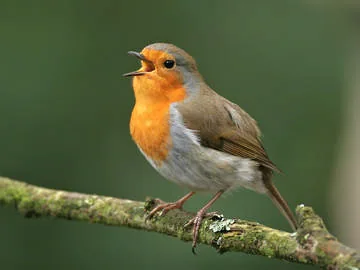
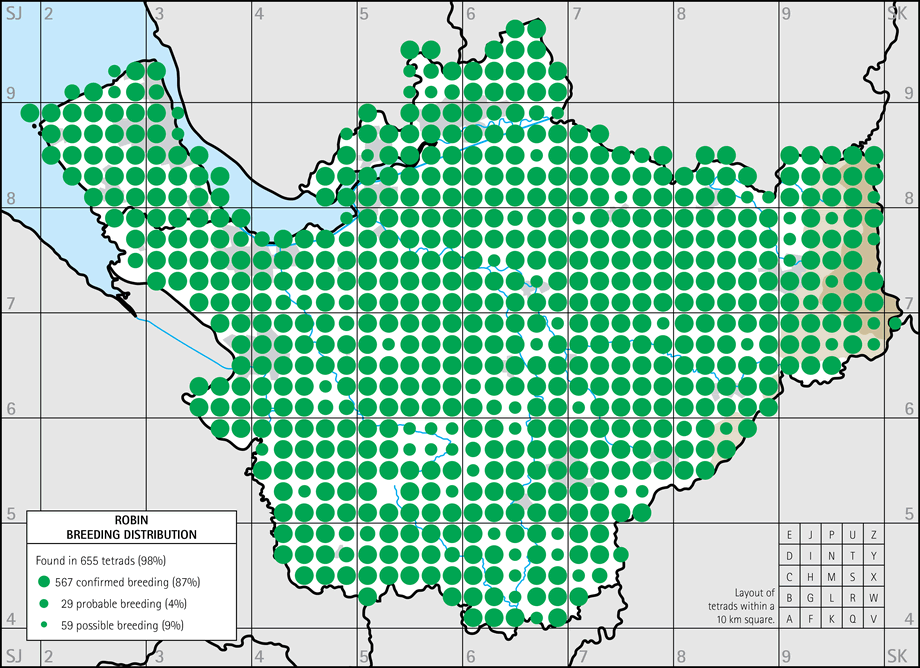
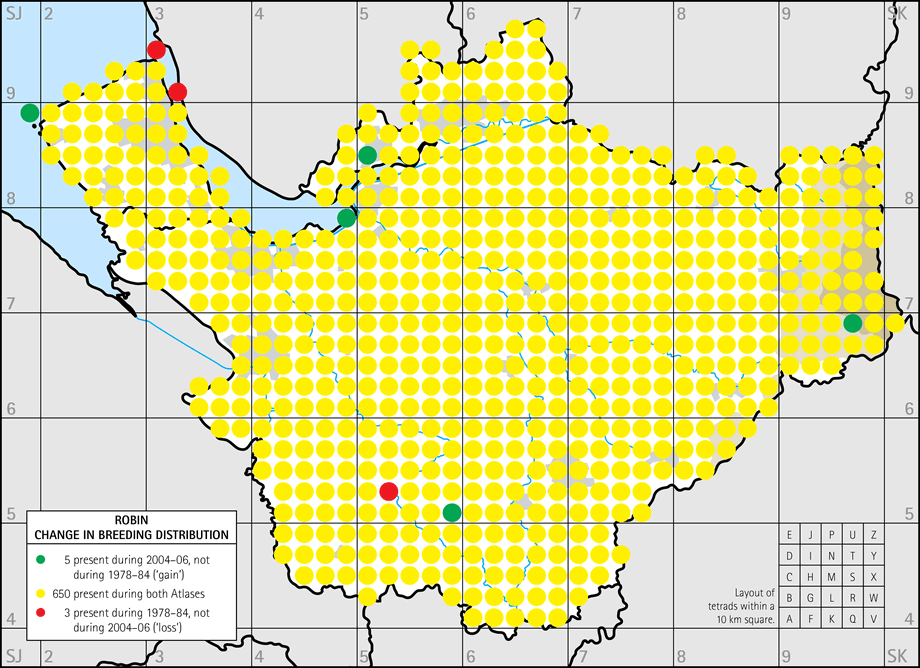
This Atlas shows that Britain’s national bird tied for second place as the most widespread species in Cheshire and Wirral, being present in the breeding season in 655 tetrads. The only significant difference from our First Atlas is that Robins now breed on Hilbre, but they are still missing from two of the highest tetrads.
The national population, and probably that in the county as well, is much higher than twenty years ago. A succession of cold winters had hit their numbers and they reached a low point in the mid-1980s, just after our First Atlas, but since then the national population index has risen steadily and in 2004 it was half as high again as twenty years previously. The analysis of Breeding Bird Survey transects shows that this is our fifth most numerous species, with a breeding population of Cheshire and Wirral in 2004-05 of 147,520 birds (126,890-168,160), a mean of 220 birds per tetrad. The distribution across the county is relatively even: the abundance map shows the highest densities exceed 300 birds per tetrad while the lowest are around 100 per tetrad. In the best habitats, broadleaved woodland with dense understorey, densities can reach 1,000 pairs per tetrad, each pair living in an area averaging just 0.4 ha (1 acre) (Mead 1984).
Robins also had one of the highest proportions of confirmed breeding, 87%. The majority of these, in 259 tetrads, came from fieldworkers seeing broods of recently-fledged young with their distinctive spotty plumage. Unfortunately some recorders included unaccompanied juveniles, not realising that they could have travelled some distance from their natal site, perhaps from an adjacent tetrad. In 218 tetrads observers logged parents carrying food or a faecal sac, with nests found in just 90 tetrads. A dedicated nest-finder of a former generation (Simson 1966) regarded the Robin as ‘just about the most cunning and secretive of our common birds’. Nests are usually in a dark spot, often in a bank, in a hole in a tree or an ivy-covered trunk, but many are in human artefacts. Near Hulme Walfield (SJ86M) Steve and Gill Barber were told by a farmer that he had moved a nest with eggs from a trailer he needed to use, but the nest remained active and young fledged.
Their familiarity with man was shown by the recorded habitat codes, with most in human sites (a total of 35%, 21% being rural), followed by farmland (30%), woodland (27%) and scrub (7%). Robins eat mainly invertebrates in the breeding season, foraging mostly on or near the ground and feeding themselves and their young on any grubs and spiders that they can find.
Atlas account sponsored by Robin Hart
Winter
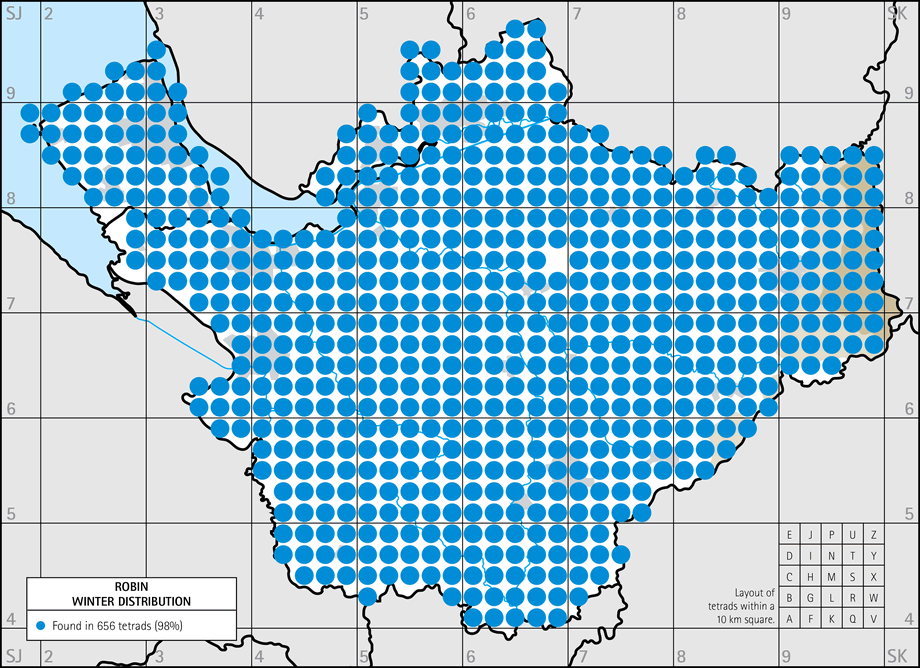
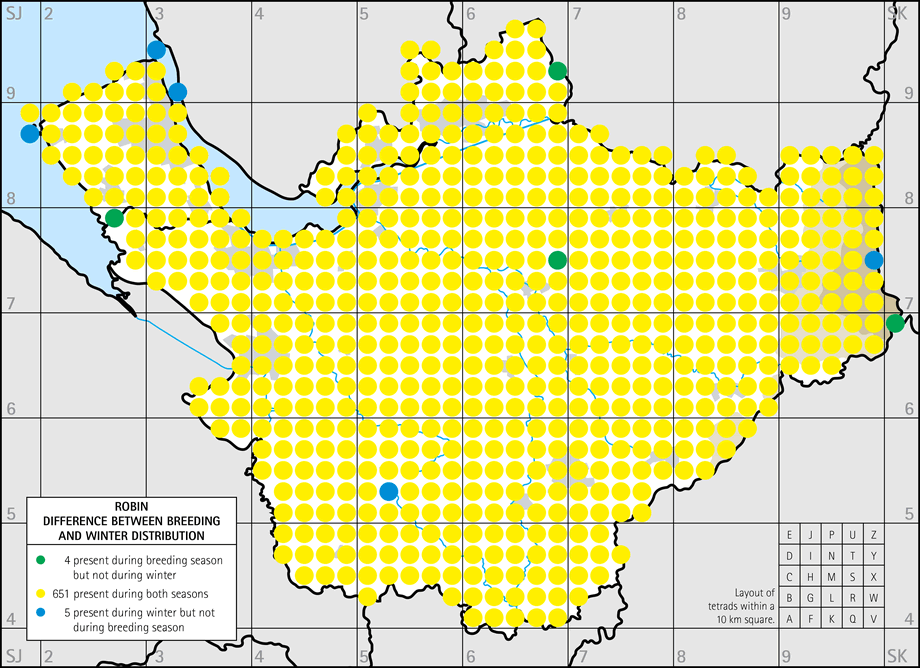
There is little difference between the Robin’s breeding and wintering distribution, although the winter map shows that they were missing from the two easternmost tetrads. Many birds do move from their breeding areas, however, as shown by one ringed at a feeding station at Linmere, Delamere on 16 January 2003 that was found in Nottinghamshire on 6 April 2003, 99 km away. Male and female Robins set up separate winter territories, often starting in autumn as soon as they finish moult, with males usually maintaining their breeding territory and females moving away, perhaps up to 5 km (Mead 1984). Unusually, both sexes sing to establish winter territories, using a different song from the breeding season. Birds with territories near street-lights often sing at night.
Robins can be very aggressive in establishment and defence of their winter areas, and the Christmas card picture of many birds together is not often seen. Most of the submitted counts were of one or two, with just 19 records of ten or more birds. Around well-provisioned feeding areas they seem to call a truce, especially in hard weather.
The presence of abundant cover within 2 m of the ground is an important feature of most occupied sites (BTO Winter Atlas) and the Atlas records showed that the main change in winter habitat from the breeding season is a reduction in the proportion of woodland records, with far more reported from hedges. There is a noticeable switch from preferring tall hedges in the breeding season (58% of the breeding season hedgerow records) to short hedges in winter (55% of the winter hedgerow records). They often use a low twig in a hedge as a perch from which to scan the ground and drop onto a spider or beetle. Robins try to find invertebrates on the ground throughout winter, often closely following gardeners to do so, and they also eat soft fruit, seeds, bread and fat. Vegetable food, however, rarely accounts for more than 10% of energy intake, showing the importance of live food and their susceptibility to periods when the ground is hard frozen or covered in snow (BTO Winter Atlas).
After the year-end, many males relax their winter territoriality and sing to attract a mate, and, especially in mild weather, some start building nests towards the end of our defined winter period, although they often leave them for several weeks before laying.
Atlas account sponsored by Robin Hart