
Sandbach Flashes: birds and wildlife

About the Atlas
During the three breeding seasons 2004–06 and three winters 2004/05–2006/07, Cheshire and Wirral Ornithological Society (CAWOS) organised more than 350 volunteers to survey all of the county, trying to find every species of bird that was breeding or wintering
Rook Corvus frugilegus
Breeding
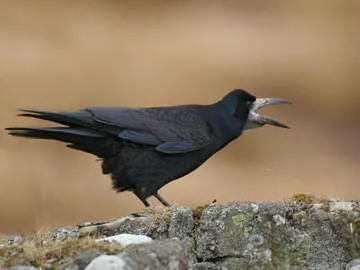
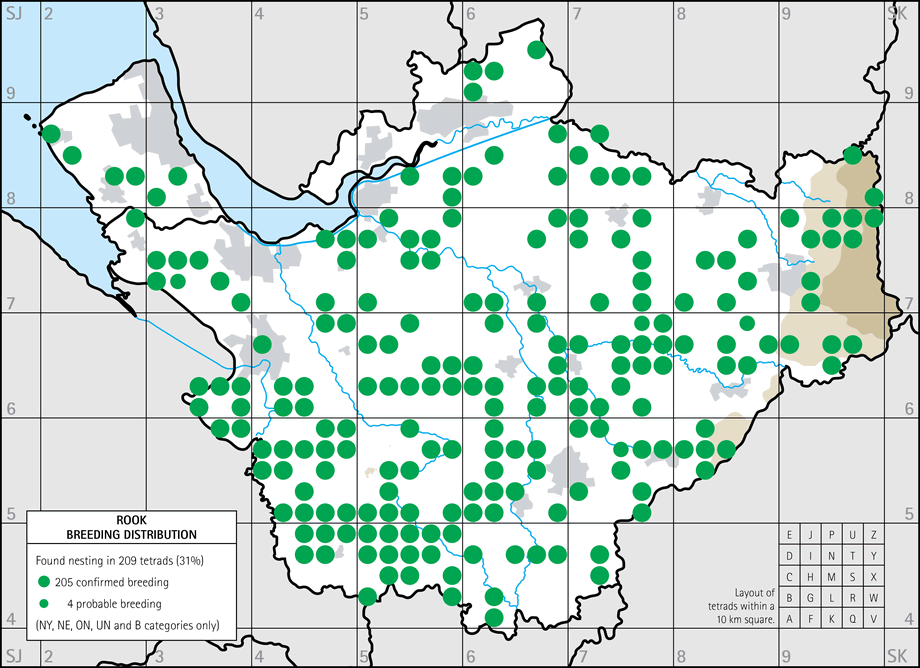
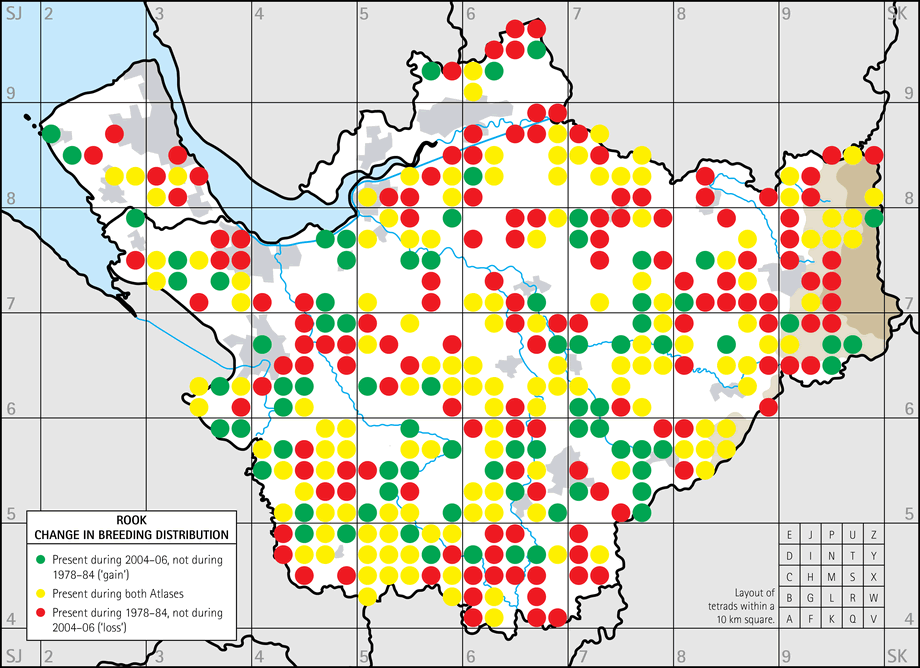
Rooks are familiar birds and ubiquitous. They are a bird of farmland, mainly feeding on soil invertebrates, especially earthworms, but they will scavenge on urban scraps and flock to landfill sites. Rooks nest colonially in the tops of trees, the largest rookeries holding more than one hundred pairs, and are a veritable cacophony of noise during the breeding season. As was said in our First Atlas, there is probably no tetrad in the county where Rooks do not appear at some stage during the breeding season, often miles away from a rookery. Some of these are one-year-old birds, too young to breed; family parties similarly can be found far away from breeding sites. Therefore, we follow the same convention as in our First Atlas and map only the categories of breeding status code referring to nesting sites: confirmed (NY, NE, ON and UN) and probable (B). This Atlas shows a significant reduction in the number of tetrads occupied, from 266 confirmed and 12 probable twenty years ago to 205 confirmed and 4 probable now.
This apparent decline in the county is puzzling. The national picture is of no significant change in breeding distribution between the two BTO atlases (1968-72 and 1988-91), but a 40% increase in abundance between 1975 and 1996 (Marchant & Gregory 1999). Rooks like areas of mixed agriculture, reaching their greatest density in an optimum combination of 44% tillage and 55% grass, with breeding density declining as farming moves away from that ratio in either direction (Brenchley 1984). With the dominance of grassland through much of Cheshire, the county is not likely to be a stronghold of Rooks. According to the BTO analysis of BBS transects in the county, the breeding population of Cheshire and Wirral in 2004-05 was 9,910 birds (4,620-15,190), an average of 50 birds per tetrad with confirmed or probable breeding. This corresponds only to about half of the average density of Rooks across the UK, perhaps emphasising the relative unsuitability of pastoral farmland for them.
However, the Breeding Bird Survey is not a good way to census Rooks or any colonial species, and a coordinated count of nests is required. The last census in Cheshire and Wirral, in 1975, found 346 rookeries containing 8,824 nests within the present recording boundaries, a substantial reduction from the previous count in 1944-45 which recorded 439 rookeries with a total of 15,866 nests. If the figure from the BBS were taken at face value, which is not advisable, the present total of around 5,000 pairs would represent a further major decline. Some observers count nests annually, with figures included in the county bird reports, and figures from the largest rookeries appear to be relatively stable for the last decade. Currently the county’s largest known colonies, with regular three-figure counts, are at Alderley Park (SJ87M), Inner Marsh Farm (SJ37B), Kelsall (SJ56P), Foden’s Flash (SJ75J) and the Crewe/ Alsager area.
It is obvious that the present picture is confusing, and a complete census of the occupied nests at the county’s rookeries is required. ‘The relative conspicuousness of Rook nests makes this one of the simplest breeding bird species to census. However, the extremely clumped, colonial distribution and the turnover in colony location from year to year make it especially important that, to be representative and adequately precise, censuses should cover large geographical areas and be either complete or drawn from a carefully constructed sample’ (Marchant & Gregory 1999). Unfortunately, the coverage in Cheshire and Wirral for the last national sample survey in 1996 was so patchy that no useful figures can be obtained.
A rookery survey should also obtain information about the species of tree used – only beech and pine being mentioned in data submitted for this Atlas – and a habitat assessment of the surrounding habitat. The Atlas habitat codes for Rook show 46% of records in farmland and 46% in woodland, with 7% in human sites. These figures are probably of little value because many fieldworkers recorded the nest site rather than the feeding habitat.
Although counts of occupied nests are the best way to assess the breeding population, they do not tell the whole story. Detailed work by Merseyside Ringing Group at some Cheshire and Wirral rookeries shows that they almost always lay 4 eggs but in most years raise only 1 or 2 chicks to fledging. In years with dry spring weather chicks are often under-weight and many die. In wet springs the adults presumably find it easier to obtain worms, and their chicks fare better. The productivity, and recruitment to the population, thus varies considerably from year to year.
Atlas account sponsored by Anne and Stephen Young
Winter
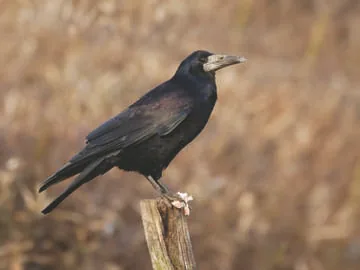
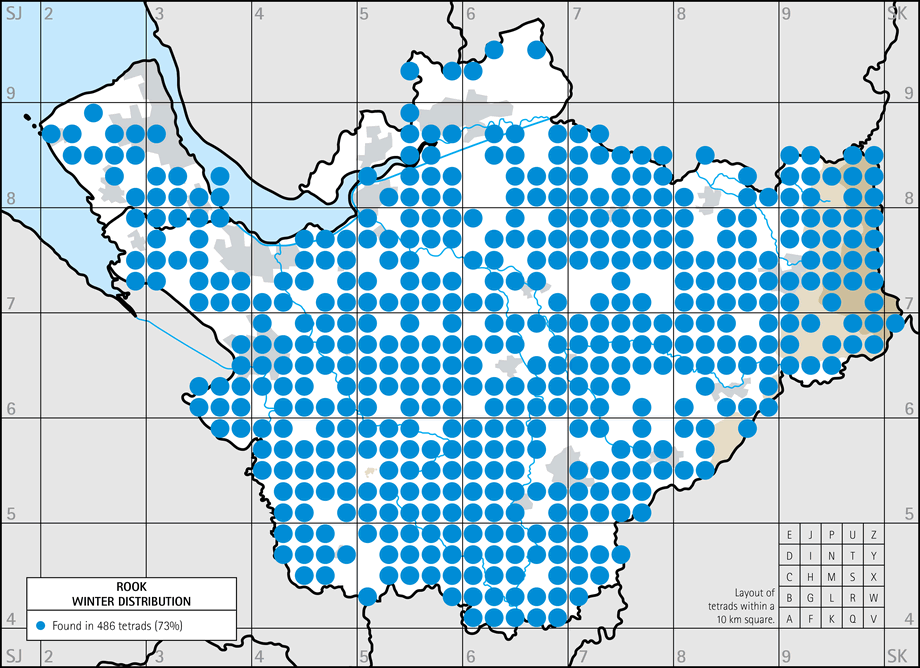
This is the most rural member of the crow family and the main determinant of its winter distribution in the county seems to be its avoidance of the most built-up areas. As in the breeding season, only 6% of the species’ habitat records were classed as human sites; intriguingly, two-thirds of these were suburban, with few in urban or rural areas. Almost three-quarters (74%) of records of Rooks were on farmland, with the main categories being 42% on improved grassland, 8% unimproved grassland and 6% stubble. Their winter food is mainly seeds, waste root crops and invertebrates, but they scavenge almost anything, and often flock to landfill sites. Many of the 18% of records in woodland can be accounted for by early-returning birds to arboreal rookeries: they refurbish nests from January onwards. Nearly all of the Rooks found in the county in winter will have been local birds: some from farther north in Britain disperse, usually no more than a few kilometres, but this is unusual for most English birds. In some years birds arrive on the east coast from northeasterly and easterly directions, but they seldom penetrate beyond the eastern counties (Migration Atlas).
Rooks spend almost all of their lives in flocks. The median size of gatherings reported for this Atlas was 25 birds, with 75 flocks of 100 or more but few (five) gatherings of more than 250. The largest were 600 birds at Maw Green Tip and adjacent flashes (SJ75E), and 400 on stubble near the Gowy Meadows (SJ47M). Larger flocks gather together noisily at night, with 1,000 in Crewe Hall Woods (SJ75H). Roosts were reported in 43 tetrads; although some are shared with other species, especially Jackdaws, the distribution of reported Rook roosts is quite different, with none in the south Manchester fringe or the south of the county.
Atlas account sponsored by Anne and Stephen Young