
Sandbach Flashes: birds and wildlife

About the Atlas
During the three breeding seasons 2004–06 and three winters 2004/05–2006/07, Cheshire and Wirral Ornithological Society (CAWOS) organised more than 350 volunteers to survey all of the county, trying to find every species of bird that was breeding or wintering
Ruddy Duck Oxyura jamaicensis
Breeding
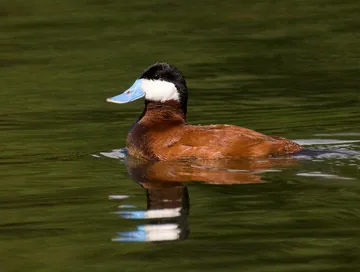
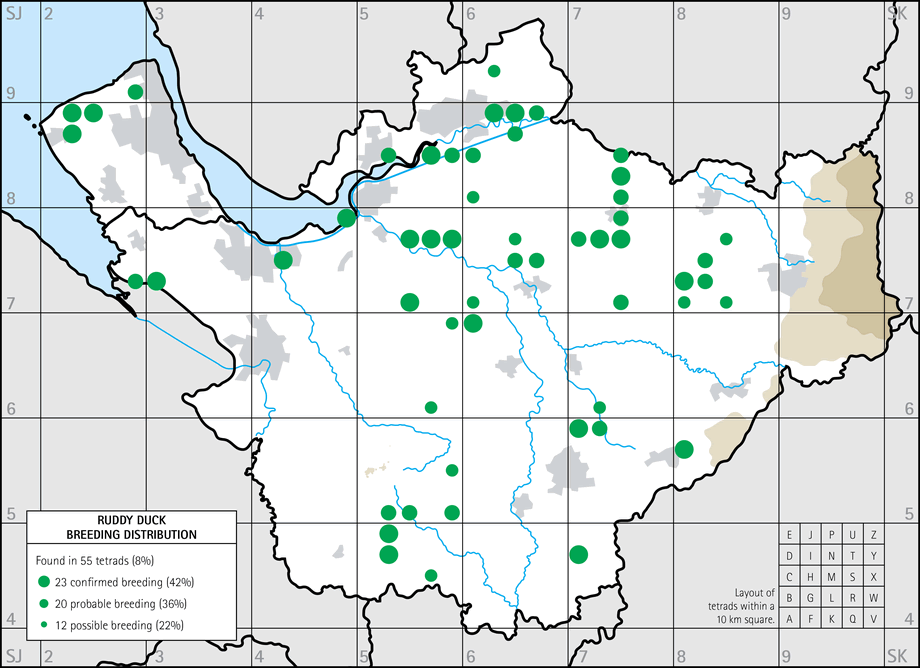
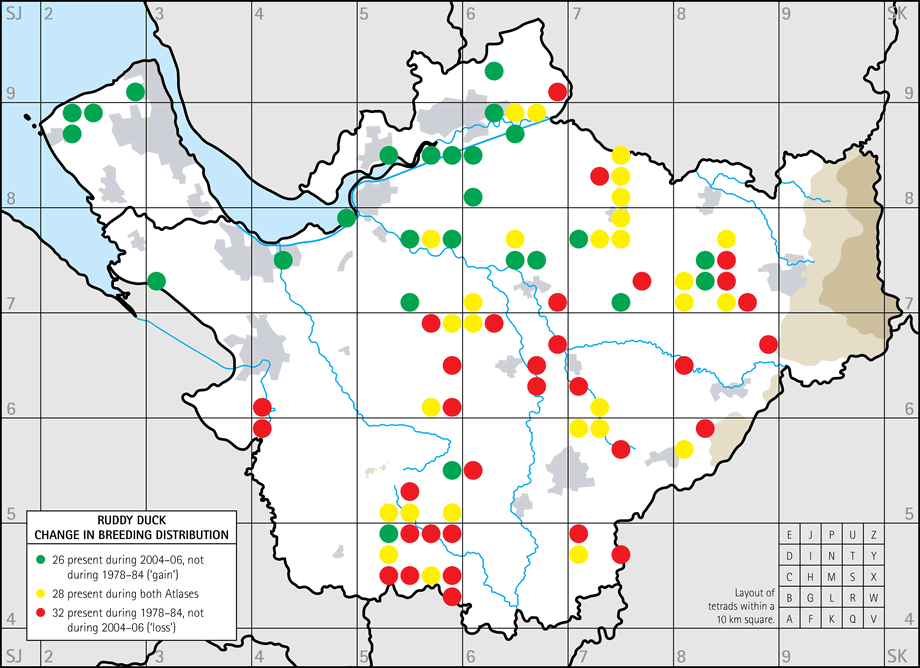
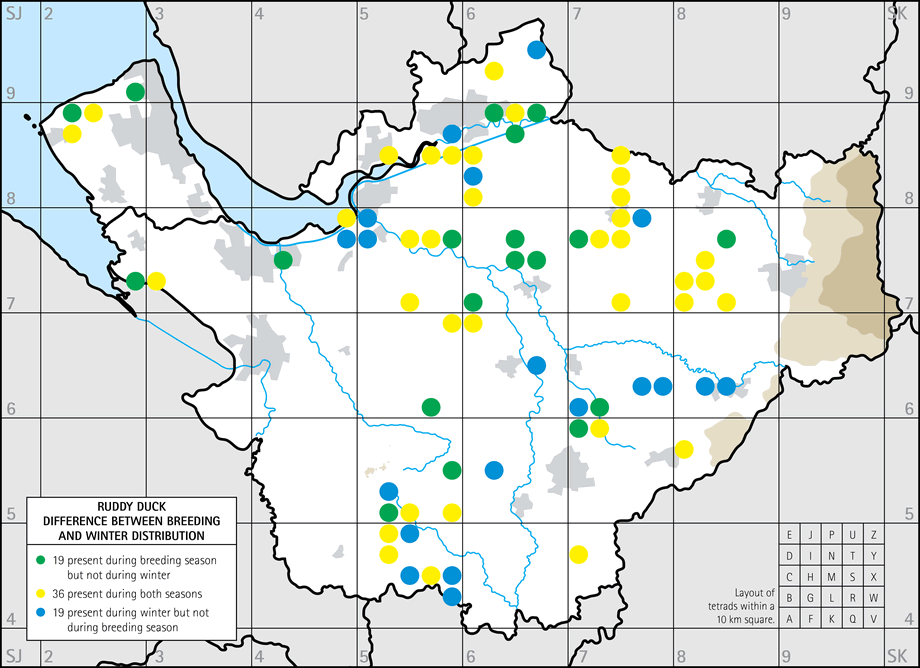
Our First Atlas text concluded with the sentence ‘There is no doubt that most of the Cheshire meres provide ideal breeding sites for the Ruddy Duck and have played an important part in its colonization of Britain’. Since then, they have spread further across the county and Ruddy Ducks have now bred on most of the county’s lowland waters. The ‘change’ map shows that in the last twenty years they have expanded into the Wirral and along the Mersey valley, although birds have been lost from many sites across the rest of Cheshire.
The submitted habitat codes show that nearly all birds were found on standing waters, mostly the larger ones, with some waterside vegetation in which to hide their nest. These are the last ducks to breed each year, with chicks seldom appearing before July, and broods hatching sometimes into early September. Males in the breeding season indulge in conspicuous display, but they are not territorial and many mate promiscuously without forming stable pair bonds with females. The typical size of their single clutch is 6-10 eggs, although observations at Woolston show that some Ruddy Ducks lay one or more eggs in another species’ nest, usually Tufted Duck or Pochard, but occasionally Mallard, leaving their offspring to be raised by another female. There can be large annual fluctuations in numbers of Ruddy Duck broods, often related to changes in water levels through the season: at Woolston only 5 broods were seen in 2004, 12 broods in 2005, and 10 broods in 2006.
It is impossible to discuss this species nowadays without mentioning ‘the cull’. The Ruddy Duck is closely related to the White-headed Duck Oxyura leucocephala, but their conservation status is very different: Ruddy Ducks are common and widespread across their native north America, with a population of half a million or more, but White-headed Ducks are endangered, with fewer than 15,000 birds spread across their range of Spain, north Africa and Asia. Measures to protect and restore habitats and ban hunting have helped the Spanish population to rise from 22 in 1977 to 2,500 in early 2003 but the critical threat to this species was identified as hybridisation with immigrant Ruddy Ducks from Britain.
A group of UK conservation organisations spent many years, starting in 1992, researching the issues and eventually concluded that the only solution was to eradicate the Ruddy Duck from Britain in order to prevent possible extinction of the White-headed Duck. This proposal to cull Ruddy Ducks, agreed by the UK Government in March 2003, aroused some impassioned debate amongst nature conservation and animal welfare organisations, and professional ornithologists and amateur birdwatchers, with journalists and economists pitching in, and even some political activists complaining that it is ‘racist’ to try to preserve a species. The UK Ruddy Duck eradication programme started in autumn 2005. By mid-winter 2006/ 07, the UK population had been reduced to about 2,000 birds, just one-third of the level in January 2000.
The two species would not have met if Ruddy Ducks had not been introduced to waterfowl collections here, mainly by the Wildfowl and Wetlands Trust. Sir Peter Scott obviously had an inkling that they could cause problems, and it is worth quoting in full from his foreword to Lever (1977): ‘Having been carelessly responsible myself for allowing the North American Ruddy Duck to escape and build up to what seems like a small but viable population in England, I am in no position to pass judgment on others. To be sure the Ruddy Duck is decorative and apparently harmless but no one can know what insidious effect it may have on the ecological web. I really should not have allowed them to fly out into the countryside – although they look delightful in flight.’
Some observers have not submitted records to the annual county bird reports in protest at the cull, and it is not known if any have withheld records from this Atlas.
Atlas account sponsored by Anne Morris
Winter
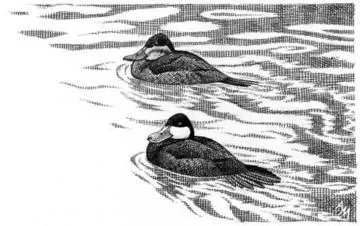
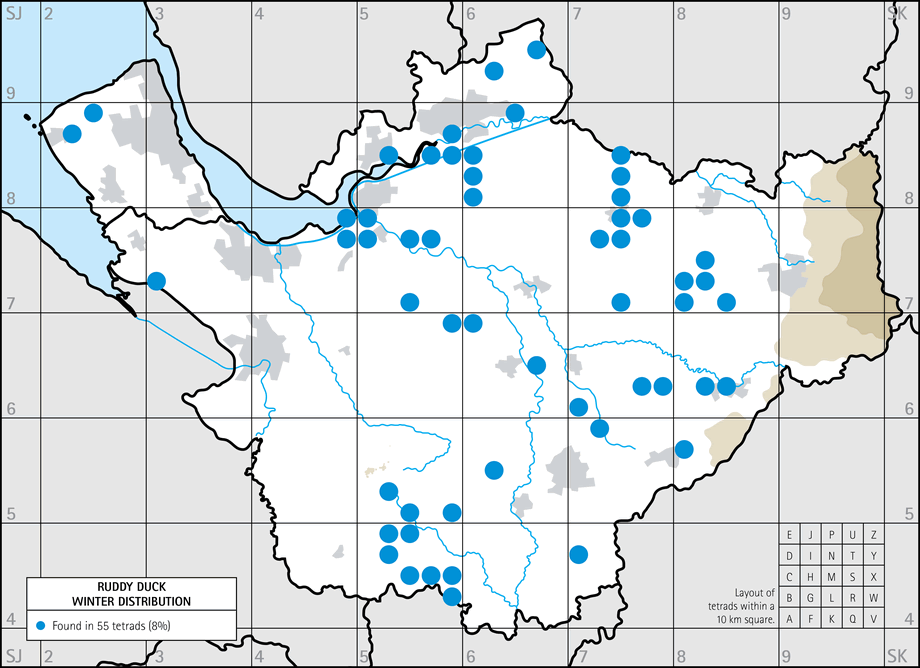
The winter distribution of Ruddy Ducks in Cheshire and Wirral is similar to that in the breeding season, but they spread out somewhat to occupy a few more sites, and most birds leave their main breeding sites in the county. At three of the winter tetrads the observer found birds in February and commented on an early return to a breeding haunt. In north America, Ruddy Ducks are migratory, undertaking long journeys to the warmer waters of the west coast and Mexico in winter, but comparatively little is known about the introduced British population. Observations show that birds tend to congregate in large flocks on reservoirs, especially in the midlands and south-east England.
The habitat codes show clearly this move to larger waterbodies: in the breeding season 13 (out of 58) were on G1 or G2 whereas in winter there were only 4 on G2 (out of 55). They feed mostly by diving and swimming along bottom, and favour eutrophic waters with plenty of nutrients to supply their varied diet of pondweeds, algae, seeds and some aquatic insects and crustaceans.
In the compilations of national WeBS counts, Houghton Green Pool (SJ69G) and Woolston Eyes (SJ68P) are the only Cheshire sites listed with five-year (2000/ 01 to 2004/ 05) peak mean counts of more than 30 birds (38 and 31 respectively) (Banks et al 2006). More than half of the Atlas records were of single-figure flocks and, apart from Houghton Green Pool, only two other sites registered counts over 20 birds: Frodsham Marsh (SJ57E) with 50 birds in 2004/ 05 and Appleton Reservoir (SJ68C) with 23 birds on 19 November 2006.
Owing to the secretive nature of female Ruddy Ducks when breeding, the best population estimates are made in winter. These show the rapid rise, by 81% in ten years from 1993/ 94 to 2003/ 04 and by as much as 569% from 1978/ 79 to 2003/ 04 (Eaton et al 2007). The present cull is just as rapidly reversing their numbers.
Atlas account sponsored by Anne Morris