
Sandbach Flashes: birds and wildlife

About the Atlas
During the three breeding seasons 2004–06 and three winters 2004/05–2006/07, Cheshire and Wirral Ornithological Society (CAWOS) organised more than 350 volunteers to survey all of the county, trying to find every species of bird that was breeding or wintering
Shelduck Tadorna tadorna
Breeding
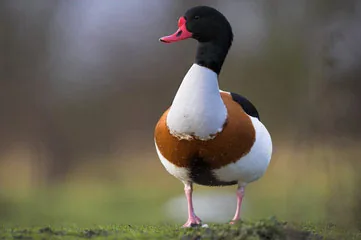
Shelducks have considerably changed their behaviour in recent years. Ancestrally a coastal breeder, they now occupy more tetrads inland than at the coast, and from 1993 onwards they have abandoned their traditional post-breeding moult migration to the Heligoland Bight and up to 20,000 birds gather in July to moult on the Mersey estuary, the largest flock in Britain (Wells & Friswell 1998).
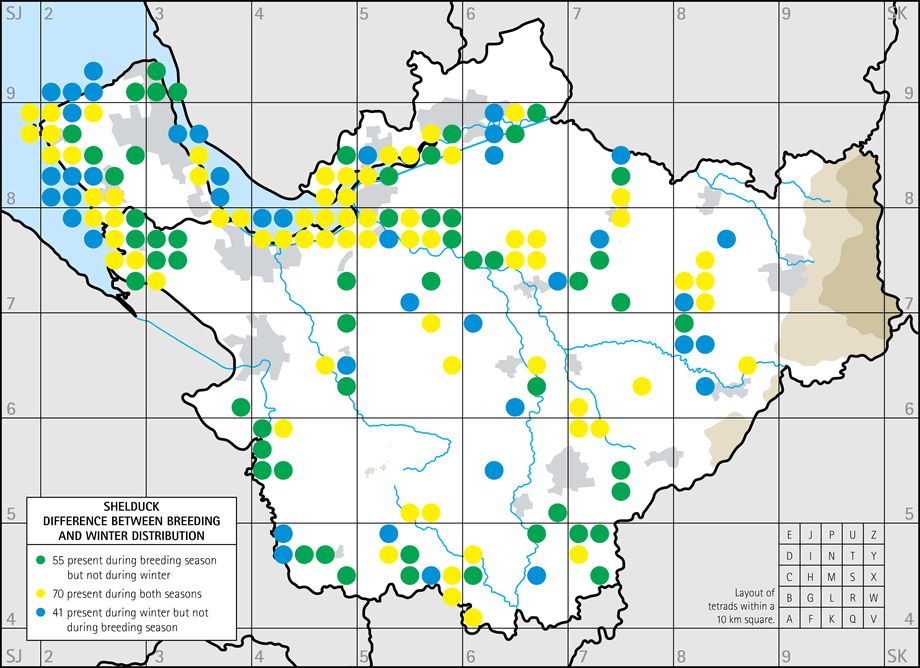
Shelducks were confirmed or probably breeding in 59 tetrads in our First Atlas; this has risen to 98 tetrads in those categories now. The 66% increase is almost entirely in inland areas, more than 2 km from tidal waters, as the species has spread across lowland Cheshire. Following occasional previous records, inland breeding in the county has been annual since 1977. The habit rapidly took hold and there were 7 inland tetrads with confirmed and 12 with probable breeding in our First Atlas, and 12 tetrads confirmed and 47 probable in this survey. Shelducks also now nest on Hilbre: they just missed out on our First Atlas, nesting in 1985 but not during 1978-84.
In the estuaries, birds feed on the flowing tidal water, but not much around high or low tides, mostly sieving the mud for the tiny snail Hydrobia which forms the overwhelming majority of their diet. They also eat shrimps, small clams Macoma and ragworms; it is not known on what the inland breeders are feeding.
Breeding Shelducks establish and defend territories of around 1 ha in size, in which pairs do most of their feeding, but these territories do not contain the nest-site, nor do they bring their brood to the same area. Non-breeding birds stay in flocks until they are two or three years old. The female chooses a nest-site, most often in a rabbit burrow, but they will use a variety of suitable holes including in trees, crevices in haystacks, nest boxes (as suspected in the Wybunbury area (SJ65V)), and even in man-made structures. A female laid eight eggs in the hide at Hale Duck Decoy in 2003. Colin Schofield saw a pair fly out of a dockside building in Birkenhead (SJ39F) on 9 June 2004, and even in such incongruous surroundings it is likely that they had at least been prospecting for a nest-site, or may have already had a nest inside.
Eggs are normally laid from mid-April onwards, into June, although young had hatched by 23 April 1995 at Budworth Mere. Typical clutches contain 8-10 eggs, sometimes up to 12, but there may be more where another female has dumped some eggs into the nest. The female alone incubates, for about 30 days, with the male avoiding the nest for this time, but he knows when the chicks are hatching and returns to guard them and his mate. Despite being accompanied by both parents, many chicks, perhaps two-thirds of the brood, die, usually in the first week or so of life, often from predation by large gulls, but it is seven weeks before they have grown enough to fly. Some pairs look after their offspring throughout this period, but many chicks gather into crèches, with a few adults watching over groups of twenty or more youngsters (Patterson 1982). Crèches of 66 and 41 young were counted in Stanlow Bay in 1999 and a massive crèche of 149 chicks was seen off Ince on 2 July 2000 (CWBRs).
Nearly all of the records of confirmed breeding in this Atlas came when fieldworkers spotted a pair with their delightfully-plumaged chicks, 11 being the largest brood noted. There were five tetrads where a bird was seen visiting a probable nest-site (N), and a further five with pairs displaying, but the vast majority of probable breeding records refer to pairs seen. Such paired birds are not necessarily intending to breed but may be prospecting the area for future years.
With their wide range of nesting areas, Shelducks were catholic in their choice of habitat. Almost all of the inland birds were on standing waterbodies, of all sizes, with birds often seen spreading out into adjacent grassland, either semi-natural or agricultural land, and sometimes into tilled crops.
Some of the most favoured estuarine tetrads held tens of pairs, and surveys in 1998 of the Mersey estuary led to a population estimate of 100+ pairs (CWBR). Few inland tetrads held more than one or two pairs, however, and the county population is likely to be around 200 pairs, considerably more than the estimate twenty years ago of 25-50 pairs.
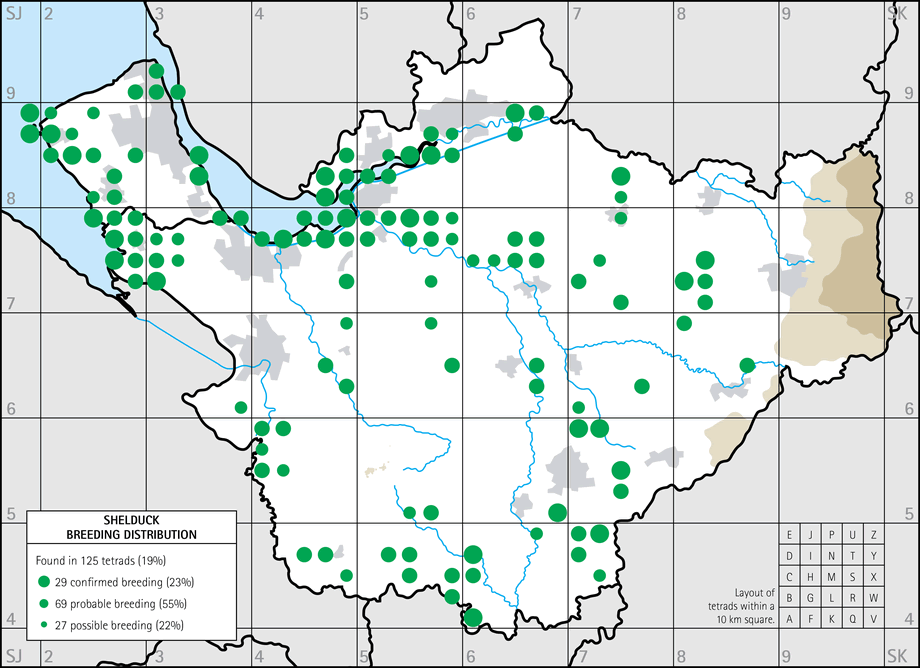
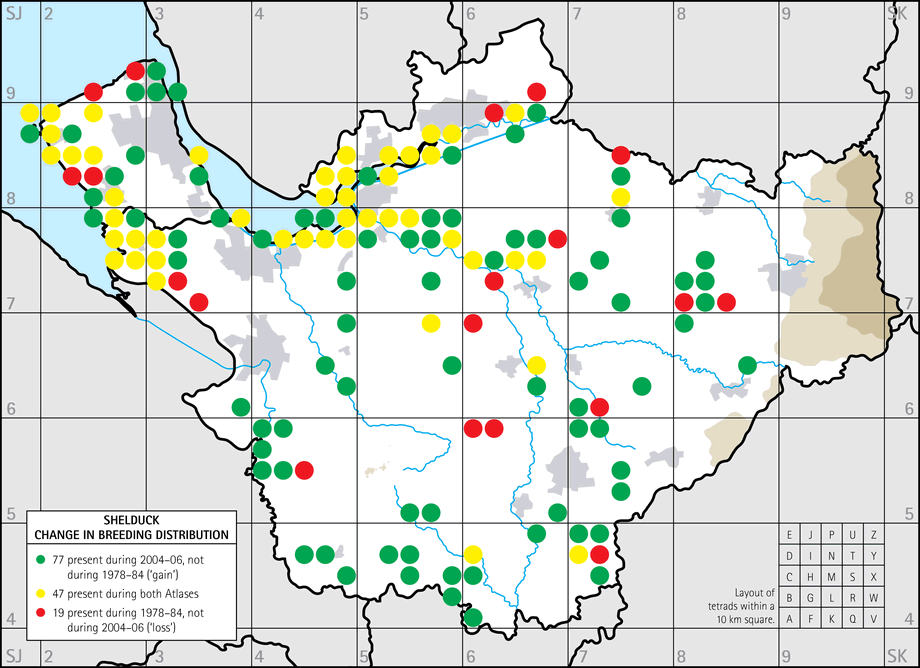
Atlas account sponsored by www.deeestuary.co.uk
Winter
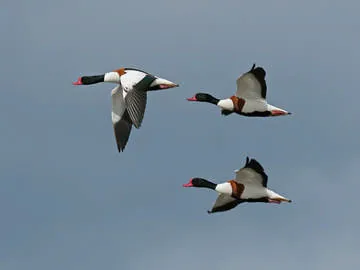
WeBS counts show that our two estuaries are the top sites in Britain for Shelducks, with five-year peak mean figures far exceeding the threshold for international importance of 3,000 birds, averaging 14,500 (Mersey) and over 11,000 (Dee). This status is based on the moulting flock on the Mersey, peaking in July or August, and the maximum on the Dee, usually in October. Midwinter totals are much lower, typically 4,000 on the Dee. The numbers actually staying to winter on the Mersey have dropped considerably since the moulting flock became established, previously reaching 4,000 to 5,000 birds, but since the late-1990s seldom above 3,000: could it be that the pressure of the huge moulting flock actually depletes the food available until the hydrobia reproduce again in the spring?
Most of the Shelducks wintering here are thought to be British breeders, perhaps with some immigrants from Scandinavia and continental Europe (Migration Atlas). The origins of our birds were nicely illustrated by two ringed females found within three weeks of each other in 1990/ 91: one, caught during an overnight ringing session on the drained New Brighton Marine Lake had been hatched the previous summer on the edge of the Solway in Cumbria, and the other, found dead at Frodsham, was a bird-of-the-year from 1989 ringed at Slimbridge, Gloucestershire so those two made movements of around 160 km in opposite directions to converge on the Mersey.
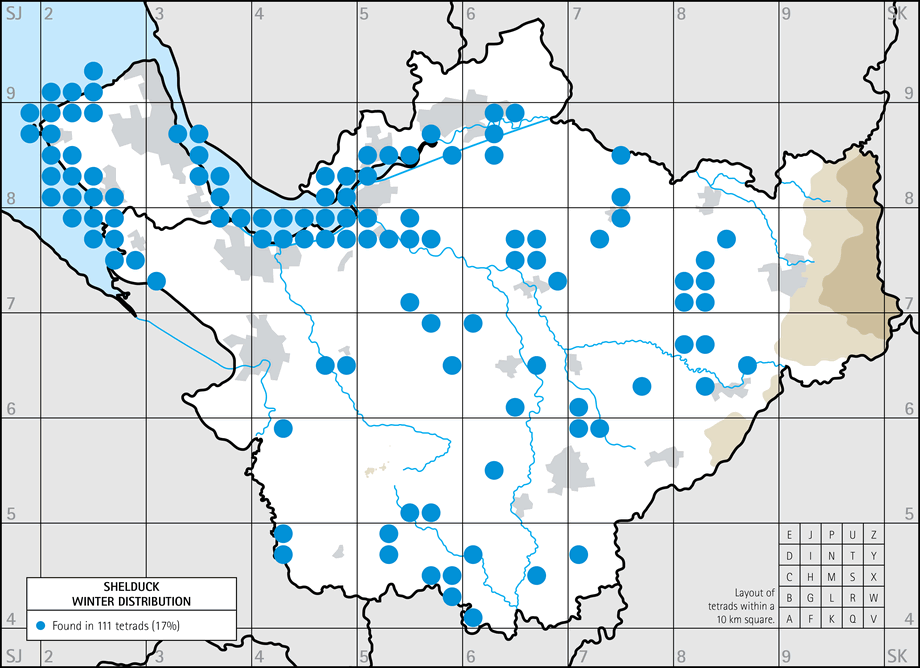
Although the map shows that they are quite widely distributed, there are few birds wintering inland and the vast majority of the county’s birds are in the estuaries. The only non-estuarine tetrads with flocks counted in three figures were Frodsham Marsh no.6 bed (SJ47Z), with a maximum of 220 birds and Fiddlers Ferry (SJ58M) with up to 100 birds. Both of these are feeding and loafing sites adjacent to the tidal Mersey, however, and only two truly inland sites registered a flock of more than ten birds: Sandbach Flashes (SJ75E/ J) with up to 45 birds, and flooded fields alongside the river Weaver at Aston (SJ57N).
A century ago, Coward (1910) wrote of large flocks frequenting the banks of the Dee and Mersey estuaries, but his ‘large flocks’ were of hundreds, rather than the thousands of the present day: the largest counted was more than 800 strong, near Denhall on the Dee in February 1906. Bell’s assessment was much the same in 1962: ‘the numbers wintering in the estuaries are variable, and are difficult to assess over these areas, but may number several hundred’. More quantitative information came from the wildfowl counts, forerunners of WeBS, with, for instance, more than 2,000 at Gayton and 660 on the Mersey at the same time on 16 February 1969. Numbers wintering on the Mersey rose spectacularly to reach 12,000 in 1980/ 81, then gradually levelled out over the next decade to the figures quoted above, around 4,000 to 5,000 birds on each estuary.
Their diet is much the same as in the summer, predominantly mud-snails and tubifex worms, although they are also attracted to grain, but in winter Shelducks have to spend more than half of their time feeding. As the winter passes, adult birds become more restless, and during February aggression amongst the flock members increases as they anticipate the coming season.
Atlas account sponsored by www.deeestuary.co.uk