
Sandbach Flashes: birds and wildlife
About the Atlas
During the three breeding seasons 2004–06 and three winters 2004/05–2006/07, Cheshire and Wirral Ornithological Society (CAWOS) organised more than 350 volunteers to survey all of the county, trying to find every species of bird that was breeding or wintering
Short-eared Owl Asio flammeus
Breeding
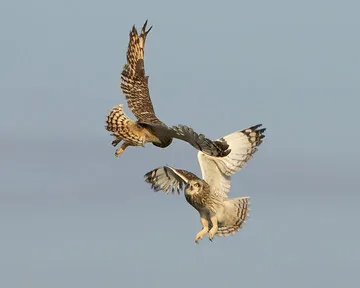
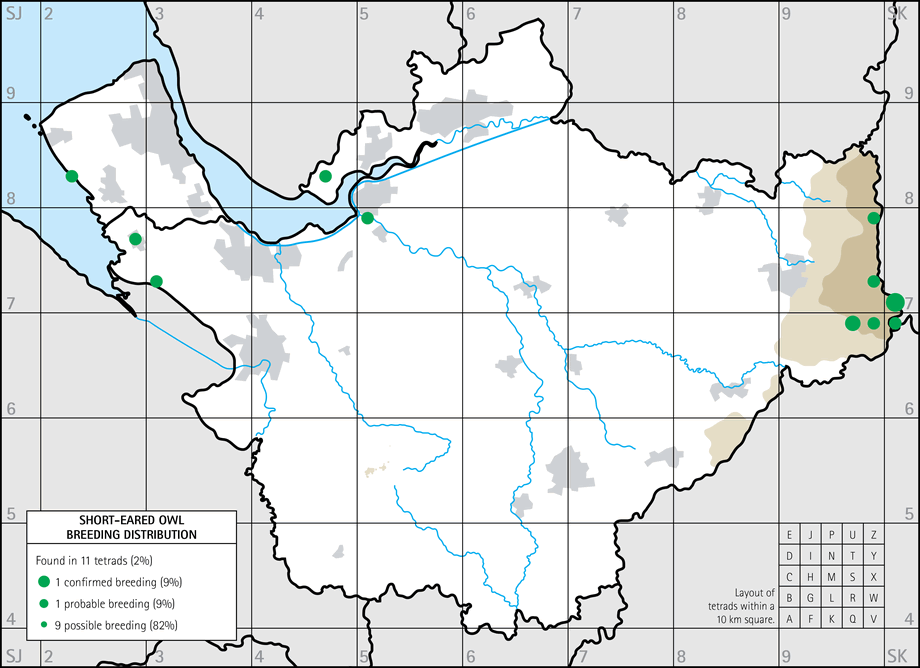
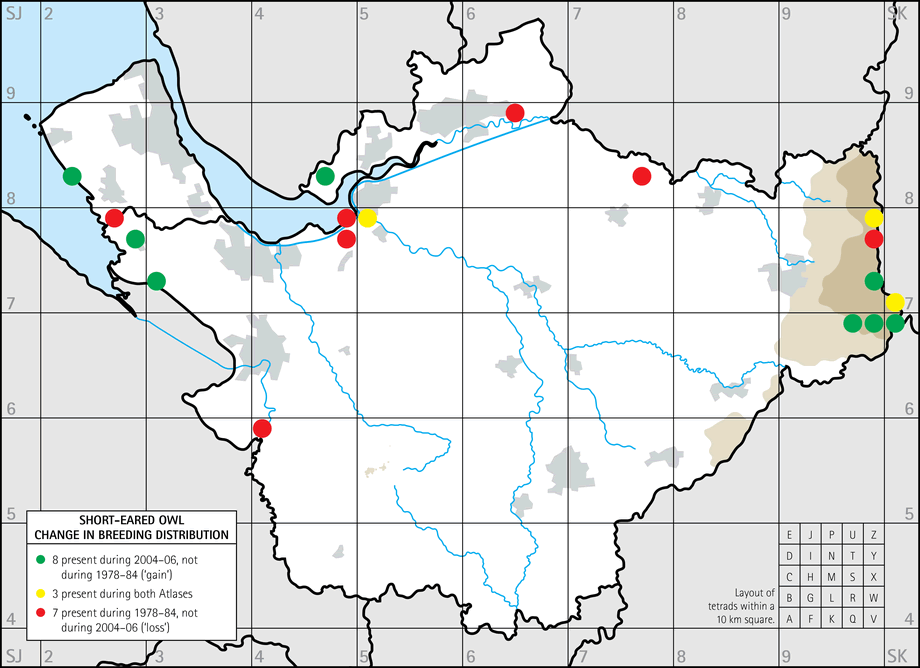
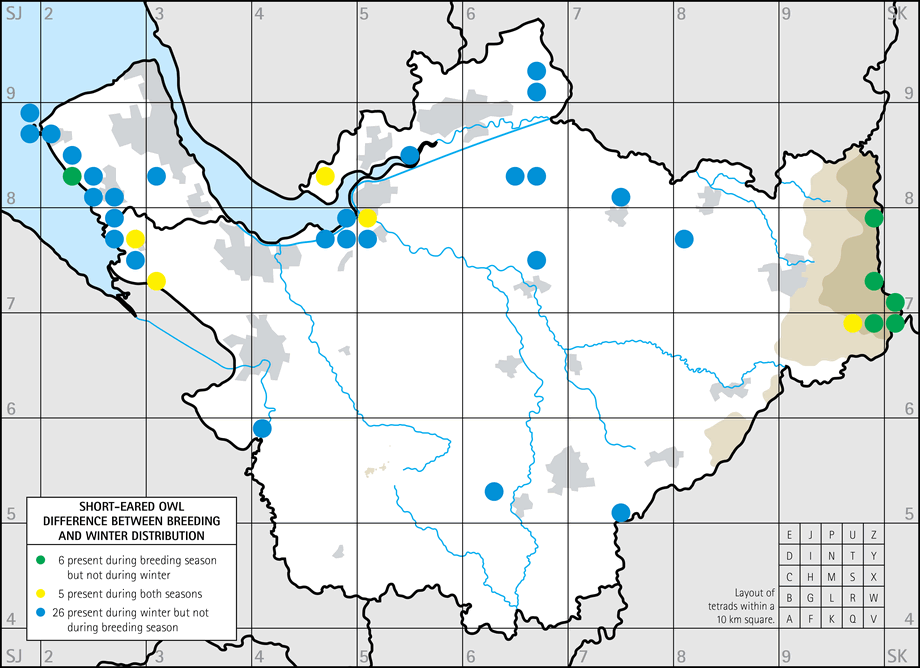
This is a bird of two habitats, the upland moorlands and the estuarine edge, and Short-eared Owls may be found prospecting for breeding sites around the highest and the lowest points of the county, but nowhere in between. They probably bred in the Frodsham Marsh area for two or three years in the mid-1970s, with a nest found in 1975, and ‘a pair is reported to have bred in the county’ according to the 1989 annual bird report, but with no detail. Odd sightings of single birds in the breeding season were recorded on the eastern moors in 1990 to 1993, 1996, 1998 and from 2003 onwards. During this Atlas period, pairs were seen in two of the moorland tetrads, with breeding proven in one of them. Surveys of the South Pennines Moors SPA showed a 50% increase between 1990 and 2004-05 in the breeding population of Short-eared Owls, and it seems that the Cheshire moorland fringe has shared in this rise in their fortunes (Eaton et al 2007).
Short-eared Owls nest in open country, in moorland, marsh land and bogs, and in young conifer plantations; in recent years they have also been seen prospecting in set-aside fields, and have been known to breed in them elsewhere in England. The adults hunt by day, especially in the afternoons, and at night, quartering the ground with their long winged flight. In the breeding season, they depend especially on Field Voles which comprise more than 80% of their food items, with the remainder being mice, shrews and birds.
Much of their lives is determined by the abundance of Field Voles, which varies on a cycle of three or four years. Short-eared Owls can have a protracted breeding season, some birds laying eggs in March while others linger late in wintering areas, even until mid-May in some years. This is the only Palearctic owl that builds a nest, making a scrape lined with dead grasses. They can lay 4 to 9 eggs or more, with most in ‘vole years’, but clutch size varies with latitude, decreasing at more southerly sites, and figures from Cheshire are unknown. Their ground nests are vulnerable to predation, especially by foxes and crows, and chicks scatter from the nest 12-17 days after hatching to hide in the undergrowth, but cannot fly until 25 days or older.
Atlas account sponsored by Dr J. D. Atkinson
Winter
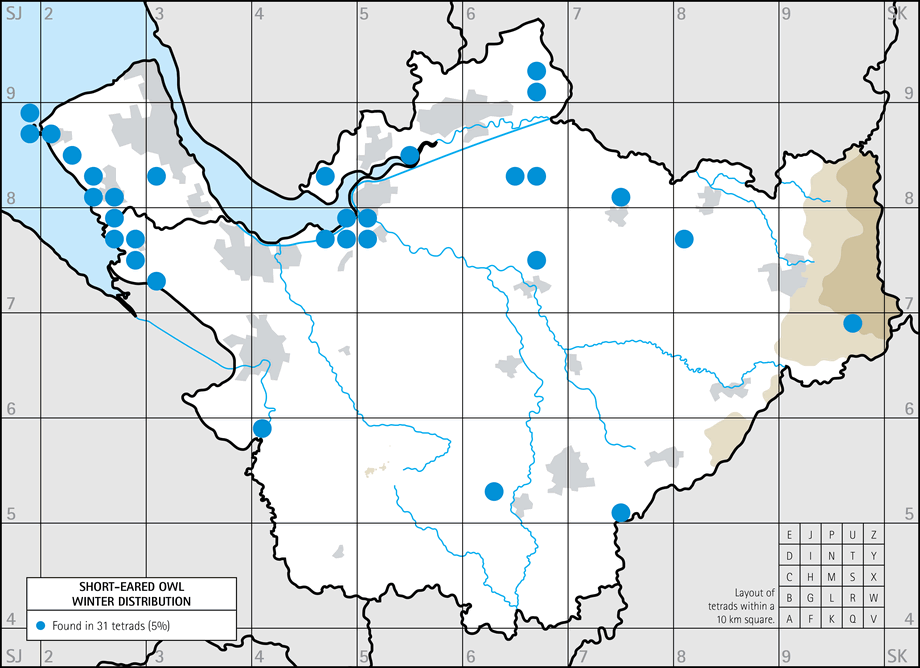
Both of the Asio owls undertake long-distance migration, with long sea crossings no barrier to them. Our wintering population is likely to comprise birds from northern England and Scotland, and immigrants from Fennoscandia (Migration Atlas). Young birds disperse in all directions, but many recoveries suggest a movement away from upland moors and hills to coastal localities. The Atlas map shows that most of the winter records are along the edges of our estuaries, with a scattering of tetrads visited elsewhere in lowland Cheshire. Apart from one bird making an early return to the eastern hills, their breeding season sites are vacated. The winter habitat codes reinforce the impression of a bird of rough open land. Of the 34 records, 13 are semi-natural grassland and marsh (8 of them saltmarsh), 3 bog, 12 farmland (7 of them unimproved grassland) and 5 estuarine.
In winter, Short-eared Owls take more birds than in the breeding season, also preying on wood mice and brown rats as well as the staple fare of Field Voles. In some years, large numbers reach Britain following the periodic crashes in abundance of small rodents, especially voles, but there is no evidence that numbers in Cheshire and Wirral fluctuate greatly. Totals of 24, 23 and 21 birds were recorded for the three winters of this Atlas period, similar figures to most winters for the last decade. Where several birds are present, they roost communally on the ground, possibly sharing a site with Hen Harriers. Two areas held most of the birds. Counts from the Dee saltmarsh included five on Heswall Shore (SJ28K) in 2005/ 06 and nine on Gayton Sands (SJ27U) in 2006/ 07. Frodsham Marsh (SJ47Y/ SJ57E) held groups of 4, 4 and 3 in the three winters.
Although there is little indication of numbers and their true status before the onset of modern recording, wintering Short-eared Owls might have been more numerous and widespread a century ago, when Coward (1900) wrote that ‘this well-known autumn visitor is found in open situations in Cheshire, from the coast sandhills to the moors of the East, and is often flushed by shooting parties from its resting place amongst the turnips or in the heather’. Bell’s summary in 1962 sounds little different from today: ‘the bird is now only an autumn to spring visitor and confined almost entirely to the Mersey marshes around Frodsham, and in West Wirral, where it appears regularly in small numbers’.
Atlas account sponsored by Dr J. D. Atkinson