
Sandbach Flashes: birds and wildlife

About the Atlas
During the three breeding seasons 2004–06 and three winters 2004/05–2006/07, Cheshire and Wirral Ornithological Society (CAWOS) organised more than 350 volunteers to survey all of the county, trying to find every species of bird that was breeding or wintering
Shoveler Anas clypeata
Breeding
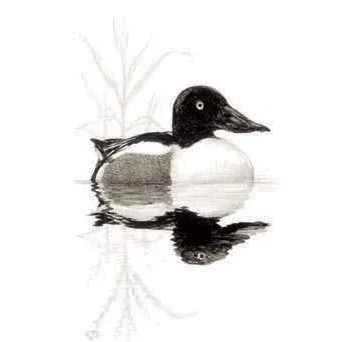
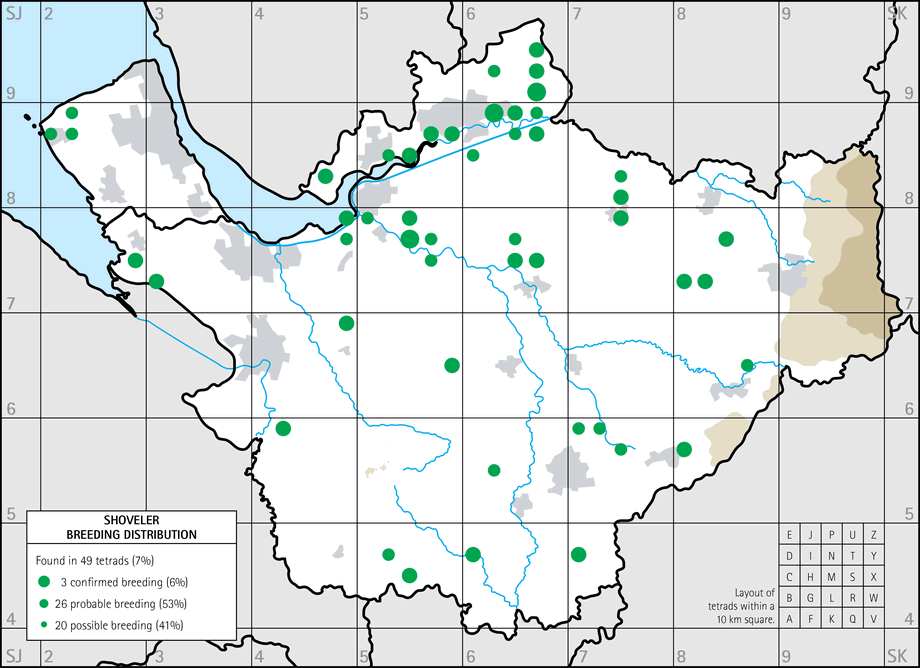
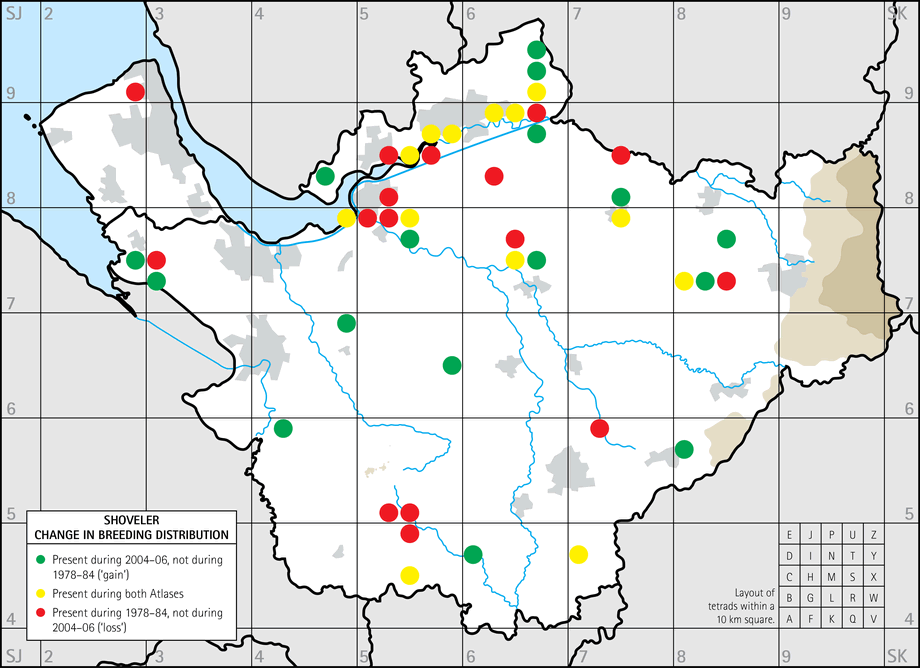
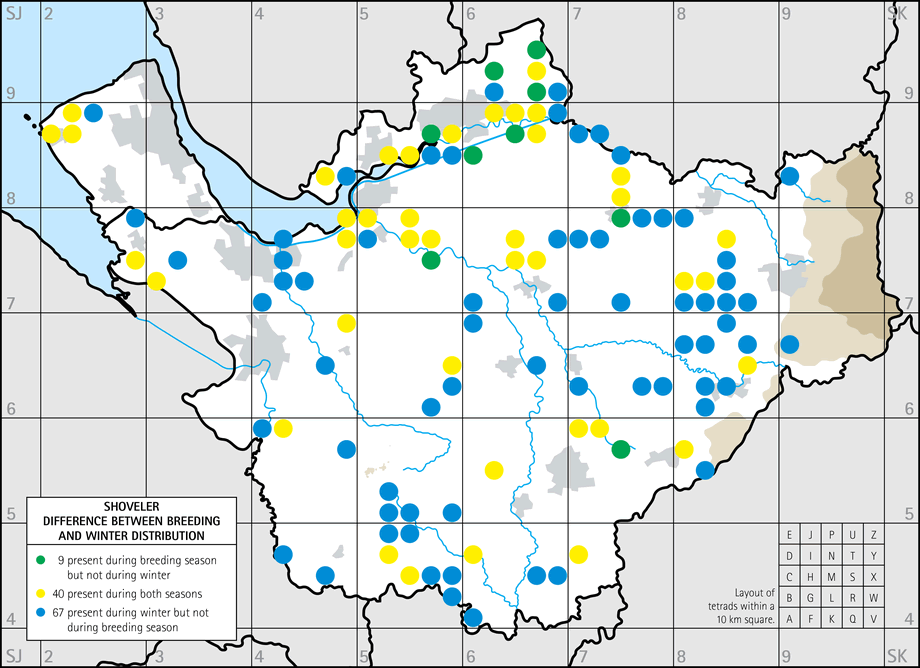
For many years in Britain, Shovelers seem to have been contracting their breeding range and increasingly concentrating on a limited number of sites, especially nature reserves and others with nature conservation designations (BTO Second Atlas). This also seems to be true in Cheshire and Wirral. As in our First Atlas, the species’ stronghold is the Mersey and lower Weaver valleys, and Shovelers were found in slightly more tetrads than twenty years ago (49 compared to 40), but with significantly fewer providing proof of breeding (3 compared to 11). Females were seen with ducklings in SJ57N in the lower Weaver valley, at Woolston (SJ68J) and Risley Moss (SJ69Q). Birds were recorded visiting a probable nest site or displaying in a further three tetrads, SJ27X on the Dee saltmarsh, Inner Marsh Farm (SJ37B) and Woolston (SJ68P), with pairs seen in 23 more tetrads.
In the 19 years between our two Atlas periods (1985-2003), the annual county bird reports have logged confirmed breeding in 16 of the 19 years, but never at more than three locations in a year. All of the sites have been in the north of the county: Woolston (15 years), Frodsham Marsh (4 years), Gatewarth SF (4 years), Fiddlers Ferry (2 years), Astmoor (2 years), St Helens Canal (2 years) and Risley Moss (1 year).
The species’ habitat requirements are defined by its remarkable bill, from which it gets both its common and scientific names (clypeata = shield-shaped). The prominent projections (lamellae) on its upper and lower mandibles strain material taken in through the tip of the bill, allowing it to feed on tiny particles including plankton. With this method of feeding, they mainly choose shallow eutrophic waters with nutritious material suspended in the water, and may well lose out in competition with fish.
Unusually for a dabbling duck, breeding Shovelers are territorial, the males defending a feeding territory for the pair. The female nests in vegetation, usually not far from the water’s edge, in late April, and incubates the eggs for just over three weeks while the drake stays nearby on the water. Any furtive-looking single male Shoveler in May should be watched carefully in case he has a duck on a nest in the vicinity: she comes off the nest to feed in bouts adding up to three or four hours a day, more than other ducks. With these aspects of behaviour, a briefly-observed male or pair could actually be nesting. Broods of up to 12 chicks have been seen, but 8 or 9 is more normal, and many of the males accompany their female with the brood.
Nationally, there were estimated to be over 1,000 breeding pairs in Britain in 1988-91 (BTO Second Atlas), but Shoveler has now (2007) been added to the list of species monitored by the UK Rare Breeding Birds Panel because of its perceived scarcity. The county population is unlikely to be more than 5 pairs breeding.
Atlas account sponsored by Syngenta CTL
Winter
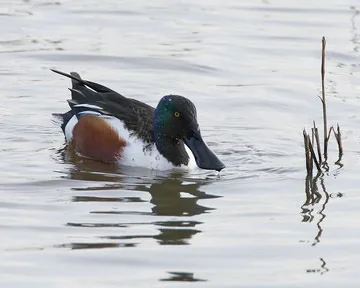
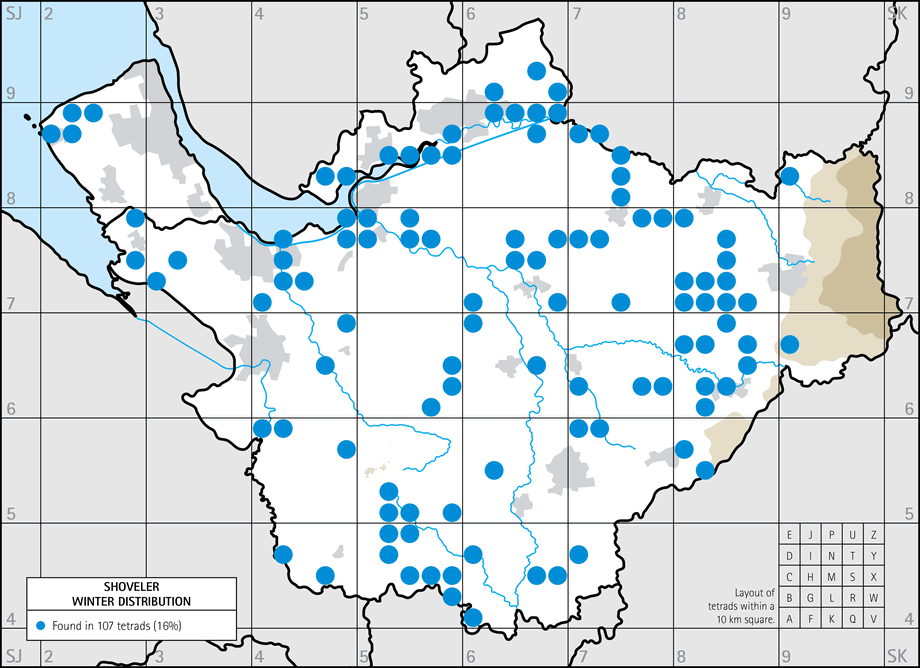
The Atlas map shows that almost every site (40 of the 49) in the county with breeding season presence also has Shovelers in winter, but they are not the same individuals. Most British birds move out, being found anywhere from Denmark to Iberia, but mainly in western France and Spain. A bird ringed as a fledgling at Runcorn in June 1976 was shot that September in Essex, no doubt on its way to the continent. The Shovelers wintering here come from the east, most of all from Russia, and the species is found in an extra 67 tetrads which did not have birds in the breeding season (Migration Atlas).
As in the breeding season, Shovelers find most of their food on or near the water surface. They more commonly feed while swimming than other dabbling ducks, and less often upend. Groups can often be seen swimming in a line or in circles, each dabbling in the water disturbed in the wake of the one in front. Much of their diet is animal material, mainly freshwater snails, crustaceans and insect adults and larvae: Shoveler is the most carnivorous of the dabbling ducks at the Ouse Washes in Cambridgeshire (Owen et al 1986).
That Shovelers are different from other ducks is illustrated by the locations of the largest flocks in the county in winter, all on waters that tend not to hold the biggest gatherings of other species: 108 on Bar Mere (SJ54I/ SJ54J), 94 on Tabley Mere (SJ77I), 78 on Deer Park Mere, Cholmondeley (SJ55K) and 60 on Neumann’s Flash (SJ67S). Although large waterbodies tend to hold the most birds, wintering Shovelers are often to be found on small waters. In six tetrads they were on ponds, with 26 on small waterbodies compared to 65 on lakes, reservoirs and sand quarries. The map shows that they do not visit the upland reservoirs and, apart from some on the Dee saltmarsh in SJ27X, this is not a bird of the estuaries; until 2004/ 05 the Dee estuary had been included as a site of national importance for Shoveler on the basis of inclusion of birds at Inner Marsh Farm.
The shallow waters that are its preferred habitat are the first to freeze in hard weather, at which times most Shovelers fly to France or Spain. In some of the hard winters of the 1970s and 1980s, the county bird reports show that they were noticeably scarce.
The species has obviously become much more common in the last hundred years. To Coward & Oldham (1900) Shoveler was known as a winter visitor to the neighbourhood of Chester and to the Dee Marshes, but ‘in other parts of the county this duck has not often been observed’. Coward was most familiar with Shovelers as passage migrants, and summarised their status as a regular visitor on migration to the estuaries and inland waters. It was never numerous on the tidal waters but ‘occasionally a few were seen with Mallards and Pintails; as a rule it rests during the day on ponds’ (Coward 1910). In winter Coward had seen birds, in most cases singly, on the meres.
Boyd (1951) noted that the species had shown a marked increase in the last thirty years and was then seen on the meres in every month. He wrote that the largest numbers on the mid-Cheshire meres are present in winter from October to January, with from 20 to 25 at Arley and Tabley, where they often rested on the ice. Bell (1962) said that ‘outside the breeding season it is found in all months on certain meres, such as Rostherne, Tatton, Tabley, Sandbach Flashes and others’. The maximum quoted at Rostherne was about 50 between September and January, with all the other large flocks listed by Bell at the migration seasons.
Atlas account sponsored by Syngenta CTL