Sandbach Flashes: birds and wildlife

About the Atlas
During the three breeding seasons 2004–06 and three winters 2004/05–2006/07, Cheshire and Wirral Ornithological Society (CAWOS) organised more than 350 volunteers to survey all of the county, trying to find every species of bird that was breeding or wintering
Siskin Carduelis spinus
Breeding
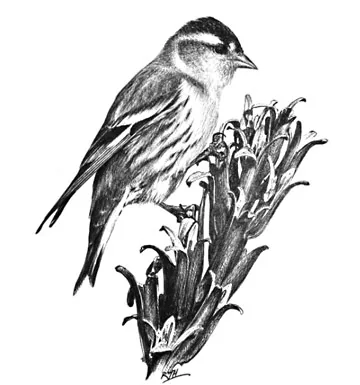
The entire life cycle of this woodland finch is dictated by tree seeds. When seeds are abundant, Siskins can breed as early as February; in other years they delay until April or May. Early chicks are fed on the seeds of opening Spruce Picea cones, whereas later broods are reared on seeds from pine cones, with other seeds and insects. Their population may well vary considerably from year to year, as they usually rear two broods in years of early breeding, and only one in other years.
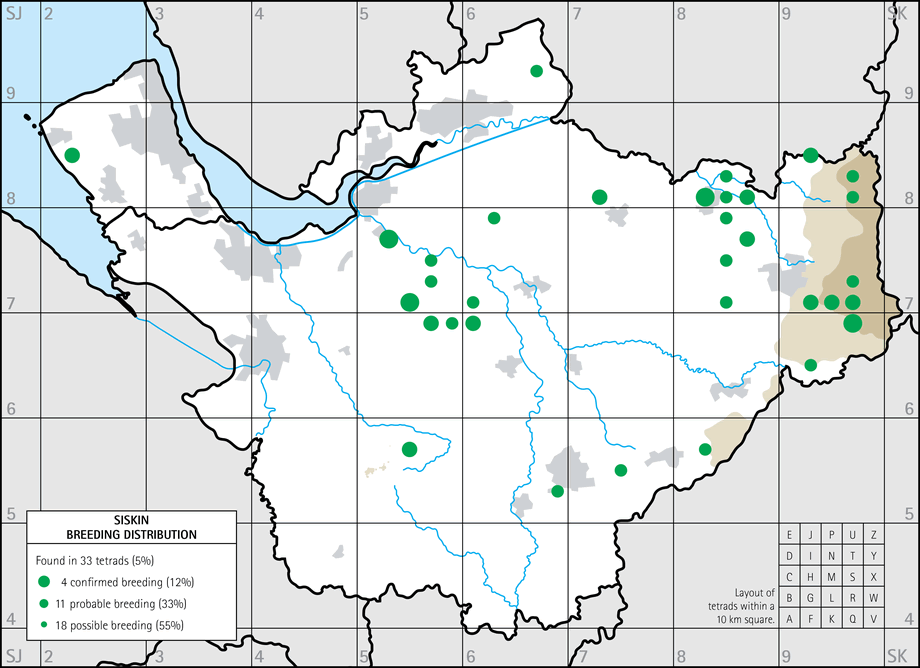
Their breeding range has expanded greatly in Britain (BTO Atlas), attributed to maturing of conifer forests, and this expansion has included Cheshire. Breeding was first proven in Delamere Forest in 1962 and 1964, with a poorly-documented record in Wirral in 1976, but there were no breeding records during our First Atlas in 1978-84. The annual county bird reports show that observers mostly concentrate on any large flocks, but they contain sporadic records of birds in ‘summer’ with breeding proven in 1990, when a pair were feeding young in Lyme Park on 4 June. From then on, records that would merit a breeding status code came from a gradually increasing number of sites, especially Macclesfield Forest, Lyme Park and Alderley Park, with the annual county reports noting birds singing in most years, seen carrying nesting material twice and ‘breeding suspected’ once. There was no more confirmation of breeding until this Atlas started in 2004, however, but this is a tricky species in which to prove breeding and it is difficult to establish its true status in the county. Many males sing on passage, from late winter onwards, sometimes even performing their ‘butterfly’ display flight on bright spring mornings, and it can be problematical to separate locally breeding birds from Siskins on their way to breed in Scotland; their wide variability in timing of breeding from year to year further complicates this.
Although most submitted habitat codes were broadleaved or mixed woodland, the Atlas map shows a clear correlation with coniferous woodland, with occupied tetrads in Delamere and Macclesfield Forests, with another group of tetrads around Wilmslow and a few scattered records elsewhere. Four tetrads furnished proof of breeding, three of them with observers in gardens seeing recently-fledged juveniles being fed by their parents, two of them in May 2004 and the third in 2006. The fourth record came in 2005 when Sheila Blamire had the good fortune to be able to stand on a slope above Wildboarclough (SJ96U) and look down into a nest in the top of a small pine only 3 or 4 m tall, where she saw a nest with the female Siskin regurgitating food for the chicks whilst the male called nearby.
Atlas account sponsored by David Simmons
Winter
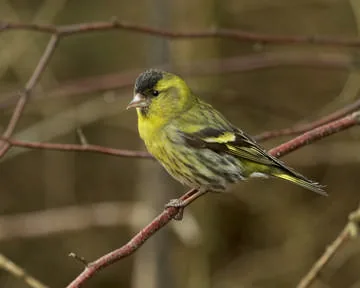
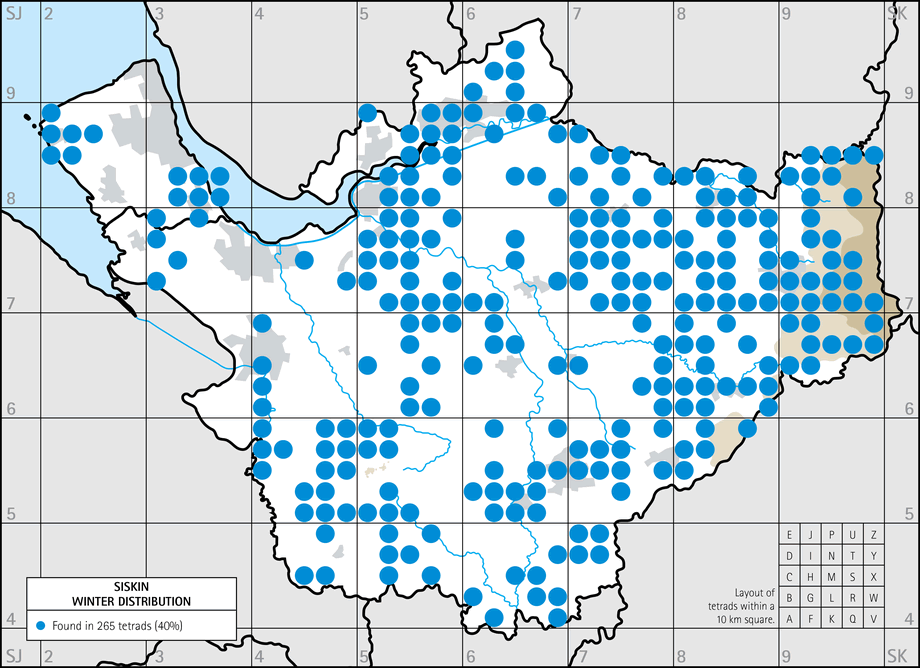
The biennial variation in the natural seed-crop means that in alternate years Siskins tend to stay in woodland, often in quite large flocks and usually in the tops of the trees. In these years many birds move north to their breeding grounds without visiting gardens and feeding stations. Some birders describe this as ‘a bad year for Siskins’, but it is actually the opposite: natural feeding conditions were so good for the species that they had no need of artificially-provided food, and migrated north to breed earlier than normal.
This alternate-year pattern is shown well in the records for this Atlas, and parallels that found for Lesser Redpoll, another finch that feeds on tree seeds; indeed the two species were often found together, especially in waterside alders and birches. In the winters 2004/ 05 and 2006/ 07 Siskins were recorded in 82 and 90 tetrads, whereas in the middle winter, 2005/ 06, they were found in more than twice as many, 189 tetrads. Evidence for the switch between natural food and bird feeders comes from the habitat codes submitted for this Atlas. In 2004/ 05 and 2006/ 07, most of the habitat records (51%) were from woodland, with 33% from human sites; in 2005/ 06, their habitat choice was reversed, with 39% in woodland and 53% of records in human sites.
Siskins are nearly always found in flocks. Of the 266 counts submitted, half of them were of ten birds or more, and eight tetrads recorded flocks of 100 or more. As well as being far more widespread in 2005/ 06, far more Siskins were counted in the middle winter, again more in total than the other two winters put together.
Many of the county’s ringers have concentrated on this species, the results showing that there are two populations of Siskins wintering here, from breeding areas in continental Europe and in Scotland. These different groups appear to intermingle and are indistinguishable in the field, or in the hand. It is not known where our local breeding birds spend the winter.
Although Siskins are now much more numerous, the species’ behaviour has obviously not changed much in more than a century. Coward (1910) wrote that the ‘Siskin is only known in Cheshire as a winter visitor, sometimes occurring in considerable numbers, but in some seasons being scarce or absent … almost invariably met with in compact flocks in alders and birches, feeding upon the seeds’, and fifty years later, Bell (1962) repeated this statement of their status. The annual county bird reports from 1964 on, however, record no years when Siskins were absent. The number of reports, and of birds, increased considerably from the 1970s as Siskins adopted a new habit of visiting gardens and feeding on peanuts, with most birds now preferring niger seed when it is on offer.