
Sandbach Flashes: birds and wildlife
About the Atlas
During the three breeding seasons 2004–06 and three winters 2004/05–2006/07, Cheshire and Wirral Ornithological Society (CAWOS) organised more than 350 volunteers to survey all of the county, trying to find every species of bird that was breeding or wintering
Skylark Alauda arvensis
Breeding
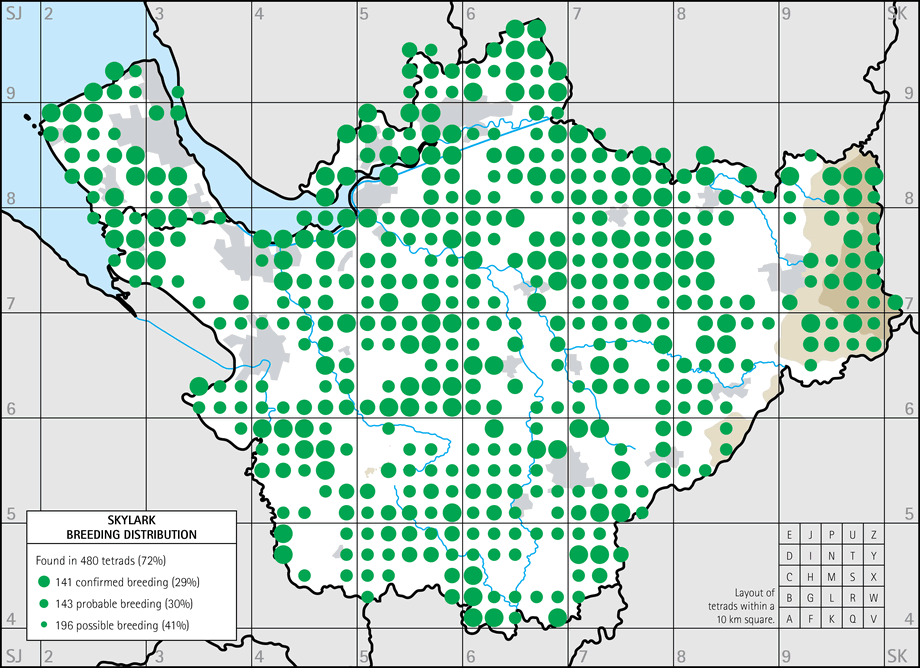
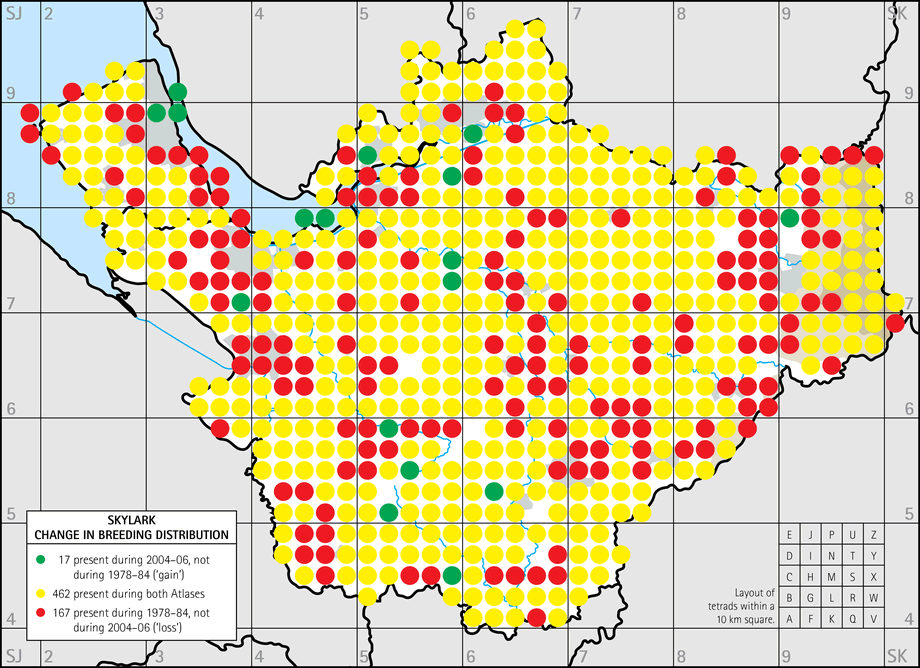
The Skylark has become an icon for the effects of industrialised agriculture on our wildlife, so it is depressing to see the extent of loss of this species between our two Atlases. The change map shows Skylarks lost from 172 tetrads, with 17 gains. To put it another way: in 1978-84, there were only 39 tetrads in which the species was not found; in this Atlas, there were 185 blank tetrads. Most of the losses are scattered across agricultural Cheshire, and the distribution map shows several significant gaps, such as the east of SJ87 and the west of SJ46, where Skylarks were present in every tetrad twenty years ago; birds were already patchily distributed in SJ37 in the First Atlas, now an obvious blank area. The species has also abandoned Hilbre and most urban areas such as Chester, Ellesmere Port, Northwich, Runcorn and the east Wirral conurbation, although odd birds breed nowadays in derelict brownfield sites in the Birkenhead docklands.
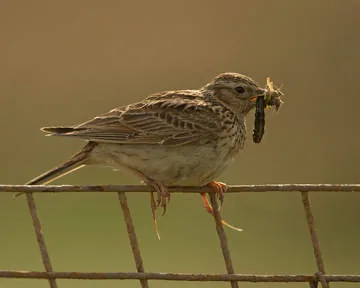
The habitat codes showed, unsurprisingly, that 81% of records were on farmland, with the main categories 33% improved grassland, 15% unimproved grassland, 16% mixed grassland and tilled land and 12% tilled land, so disproportionately high use was made of unimproved and mixed farmland, plus 11% of records on semi-natural grassland and marsh. On improved grassland, high fertilizer applications have led to vegetation that is too tall and dense for nesting, as well as high nest failure rates through trampling by cattle or frequent mowing for silage. Skylarks’ ground nests suffer high levels of predation, which they minimise by nesting far away from field edges and having the shortest incubation period of all British birds (11 days), with chicks scattering from the nest about 8 days after hatching, well before they can fly. The 79 broods that I have ringed in Cheshire, mostly at Frodsham Marsh, 1981 to 2007, had hatching dates from 4 May to 12 July. They normally lay a clutch of 4 eggs, reducing with later attempts: I found a mean brood size of 3.5 chicks in May, 3.4 in June, and 2.9 in July. Skylarks are not choosy about the food they bring to their chicks, taking whatever invertebrate prey is abundant in the area. Adult Skylarks carry large items of food for their chicks, often visible from a distance with the naked eye, and males sometimes sing with a beak full of food! Some Atlas surveyors found the species frustratingly difficult, and many observed just song, although some recorded it as D – display, accounting for the high proportion of ‘probable’ breeding.
The national population index dropped by 40% during the fieldwork period of our First Atlas, 1978 to 1984, and has fallen by another 32% in the twenty years since then. Cheshire can never have been one of the most important counties for Skylark, however, as improved grassland holds the lowest Skylark density of all habitat types (Browne et al 2000).
Atlas account sponsored by Chester RSPB Group
Winter
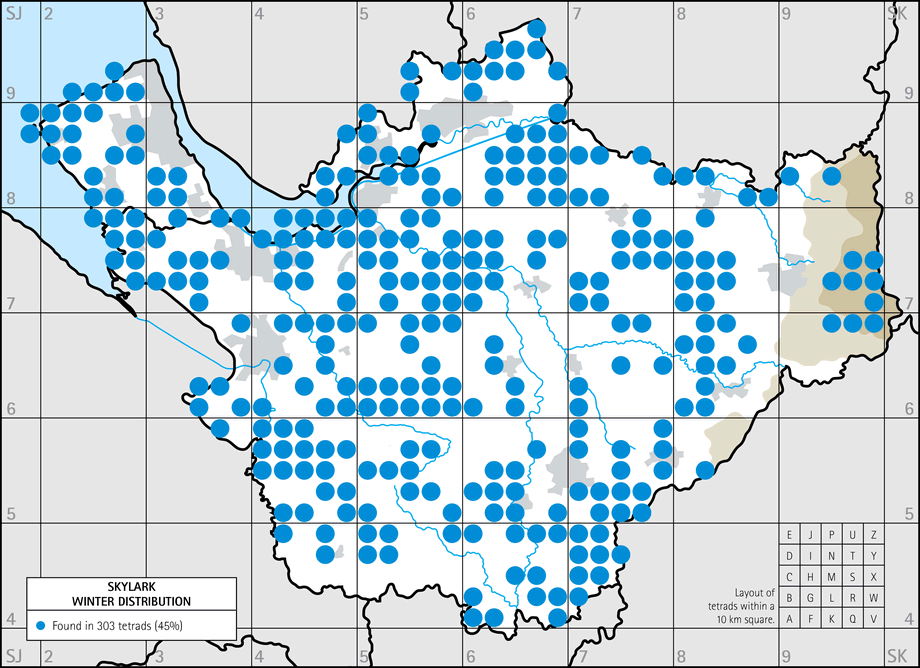
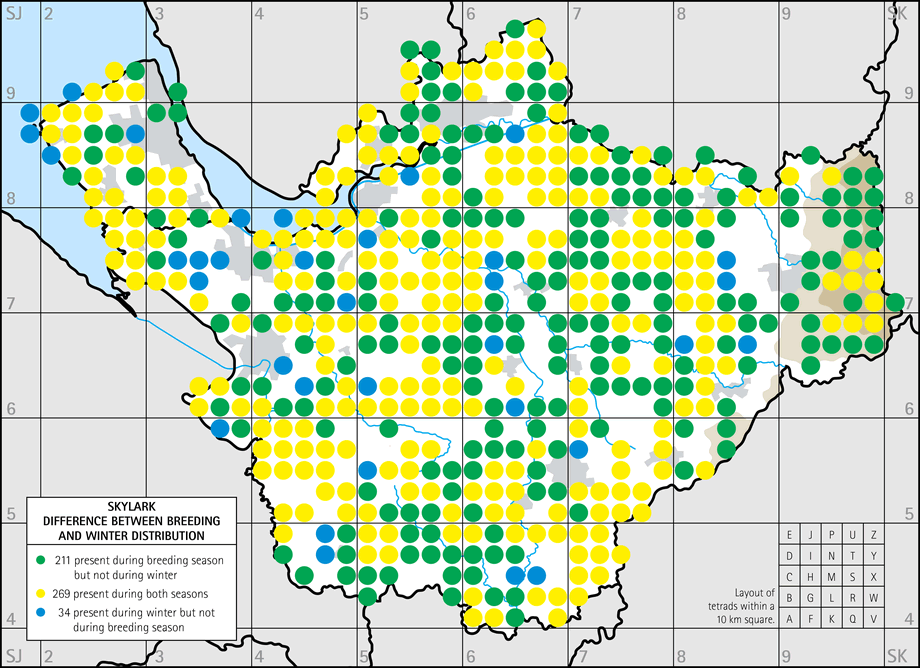
Many Skylarks remain on their territories in the lowlands all year round. Others leave their breeding areas and join flocks, moving to lower ground or southwards. The winter map shows a similar distribution to that for the breeding season, although the species is everywhere more thinly distributed. Detailed studies have shown that Skylark winter density halves for every 140 m increase in altitude (Donald 2004) and most birds quit the eastern hills: Skylarks were recorded in 30 tetrads above 200 m in the breeding season, but only 10 of them in winter, and six of these ten were February records with the observers noting song, so probably most of these records were breeding birds returning early to their territories. 269 tetrads were occupied in both seasons, 211 tetrads had birds in the breeding season but not in winter and 34 tetrads were occupied in winter but not during the breeding season.
As well as the altitudinal move, and some partial migration, Skylarks shift habitats in winter. Grazed grassland, never their favourite habitat in the breeding season, is used even less in winter, and their preferred winter habitats are coastal marshes and weedy cereal stubbles. They are always wary of predators from the field edges, so Skylarks feed only in large fields, avoiding anywhere less than 2.5 ha and selecting fields larger than 7.5 ha, and they favour areas with low hedges and no large trees (Gillings & Fuller 2001). They roost at night on the ground, often where they have been feeding.
Of the winter habitat codes, 85% were farmland and 10% semi-natural grassland and marsh. Observers in 61 tetrads recorded birds in stubble, more than any other species, with amplifying comments indicating 7 instances of wheat stubble and four of maize. Most birds were found in singles or pairs, probably the resident birds, and the median flock size was only four. 72 flocks were counted with 10-30 birds, and there were just 33 submitted counts of more than 30 birds in one flock. Seven flocks of 100 or more birds were reported during this Atlas, from widely scattered parts of the county. The largest by far, 1000 birds, was on the Dee saltmarsh in SJ27U, with others on the Dee in SJ27S and SJ28Q, and the Mersey saltmarsh in SJ47D. Three-figure gatherings on farmland were at Risley (SJ69Q and SJ69R), with flocks noted on stubble near Little Leigh (SJ67D) and Blakenhall (SJ74I). Extrapolating from the mean density, there are probably just over 5,000 Skylarks in the county in an average winter.
Outside the breeding season, Skylarks switch to a mainly vegetarian diet, taking a great variety of leaves, seeds and cereal grain (Green 1978). They gain most of their energy from grain and seeds, also taking any arthropods whenever they can find them, but – perhaps because they cannot find sufficient seeds – they often eat copious quantities of leaves; these are of low nutritional value, however, and their digestive system is not adapted to breaking down cellulose. Much of the cause of their population decline is attributable to winter food supplies. On arable land, the shift to autumn sowing of cereals hit Skylarks badly, in two ways: the loss of stubble reduces overwinter survival, then, for much of the breeding season, the crop is too tall for them to nest in. High levels of insecticide and herbicide use on farmland have also reduced weed seed and invertebrate food resources.
The general description of the species’ status has probably not changed for a century. Coward wrote that ‘in winter it is absent from the bleak moorlands, but frequents the open country of the lowlands in flocks. Especially during hard weather when the inland districts are almost forsaken, great numbers of larks frequent the Dee marshes.’ Boyd noted that ‘throughout winter even in the coldest weather many remain in the stubble and old potato ground’. Probably the main aspect of their behaviour that has changed is their hard weather movements, for which Skylark used to be a classic species. Coward and Bell wrote about memorable movements of large flocks, and the county bird reports in the 1980s detailed several movements out of the county, or to the Dee, in spells of freezing weather up to December 1989. The only significant episode since then was in January/ February 1997 when up to 5,000 were found on the Dee in cold weather. No such event has been recorded in the last decade of mild winters.
Atlas account sponsored by Chester RSPB Group