
Sandbach Flashes: birds and wildlife

About the Atlas
During the three breeding seasons 2004–06 and three winters 2004/05–2006/07, Cheshire and Wirral Ornithological Society (CAWOS) organised more than 350 volunteers to survey all of the county, trying to find every species of bird that was breeding or wintering
Snipe Gallinago gallinago
Breeding
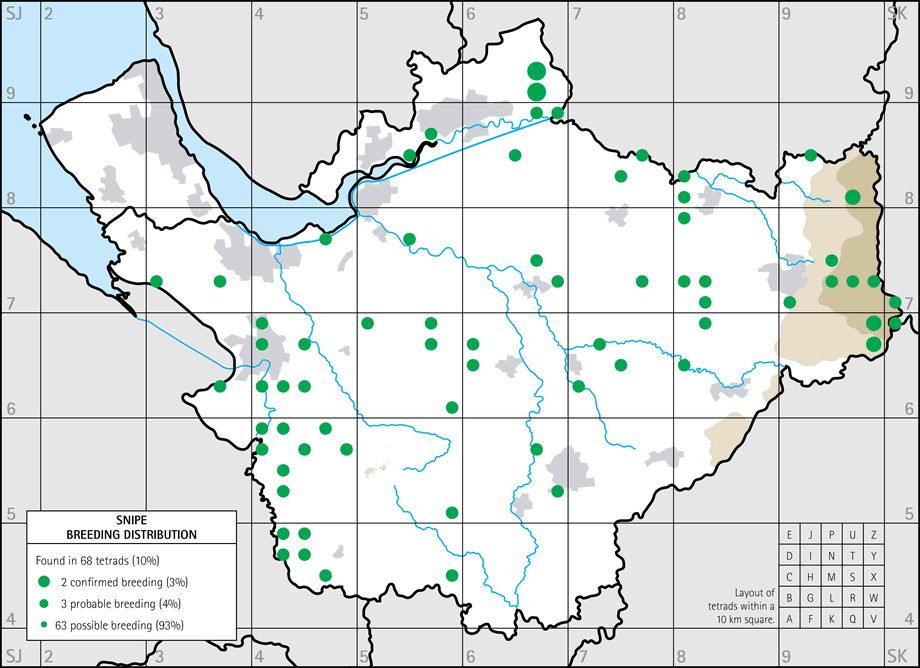
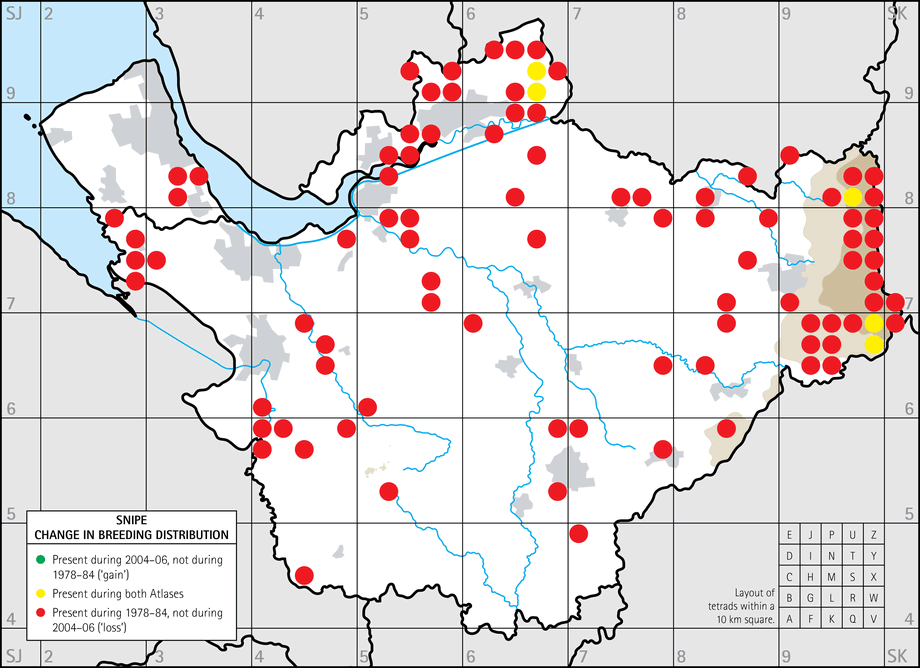
Breeding Snipe have declined considerably since our First Atlas and the species now has just a tenuous hold on the county. The picture is confused in a standard Atlas map by 59 tetrads with H records, almost all of which were late wintering birds observed in April; these were scattered across Cheshire, with Inner Marsh Farm the farthest into Wirral. There were only nine tetrads with evidence of breeding (apart from ‘H’).
It is difficult to track the decline of the last twenty years because, as with many species, as soon as fieldwork for our First Atlas finished, few observers recorded breeding birds. From 1985 to 2003, the annual county bird reports contain records of confirmed breeding in only six years, with just one pair each year: 1988 ‘one bird flushed away from a nest’ at an un-named location; 1989 ‘confirmed at one site in the eastern hills’; 1990 ‘a pair appears to have bred successfully on Frodsham Marsh’; 2000 ‘bred Risley Moss’, with no further details; 2001 ‘one pair bred Risley Moss’; and in 2003 two adults with a well-grown young bird were at Aldford Brook Meadows (SJ45J) on 30 June. During this Atlas, there were three occupied nests in 2005 at Risley/ Rixton Moss (SJ69Q) and in 2006 broods of chicks were seen in two tetrads (SJ69Q and R) at Risley Moss.
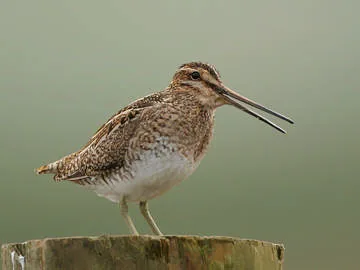
Most other evidence of breeding comes from observers seeing, and hearing, the male birds’ unusual displays, either ‘drumming’, flying over a territory and splaying his outer tail feathers during descent, making a peculiar throbbing noise or, whilst perched on a post or in flight, giving a repeated ‘chipper-chipper-chipper-chipper’ call. Some observers recorded these as ‘S’ – breeding calls heard – and others as ‘D’ – display or courtship – so little emphasis should be placed on the apparent differences between ‘possible’ and ‘probable’ breeding. Drumming and chippering can be given by sole male birds so they indicate no more than ‘possible’ breeding, but a paired male continues with these displays, even on moonlit nights, whilst his mate incubates their eggs. During this Atlas, Snipes were displaying in June in three upland tetrads, and heard drumming in four more.
They are on the Amber List of species of conservation concern, because of their UK population decline. National surveys of waders breeding on wet lowland grasslands in England and Wales, conducted in 1982 and 2002, showed a 62% drop in breeding Snipes, with most of the country’s birds concentrated onto a small number of damp, protected sites, with cattle and sheep grazing (Wilson et al 2005). The main reason for their decline in the lowlands is drainage of farmland. Snipes need damp areas in which they can probe for worms, with some insects, crustaceans and molluscs, using the sensitive and flexible tip of their bill to feel for food, much of which they take at night.
The trend in the upland and moorland strongholds of the species is not fully known, but surveys in the South Pennines Moors SPA, of which the eastern hills of Cheshire is a part, have shown a 16% rise between 1990 and 2004-05 in the breeding population of Snipes (Eaton et al 2007). The decline in the Cheshire hills is puzzling.
Atlas account sponsored by Syngenta CTL
Winter
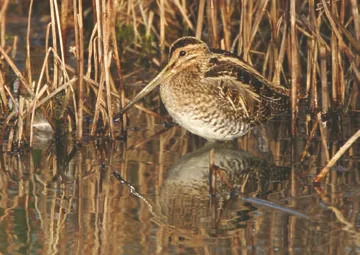
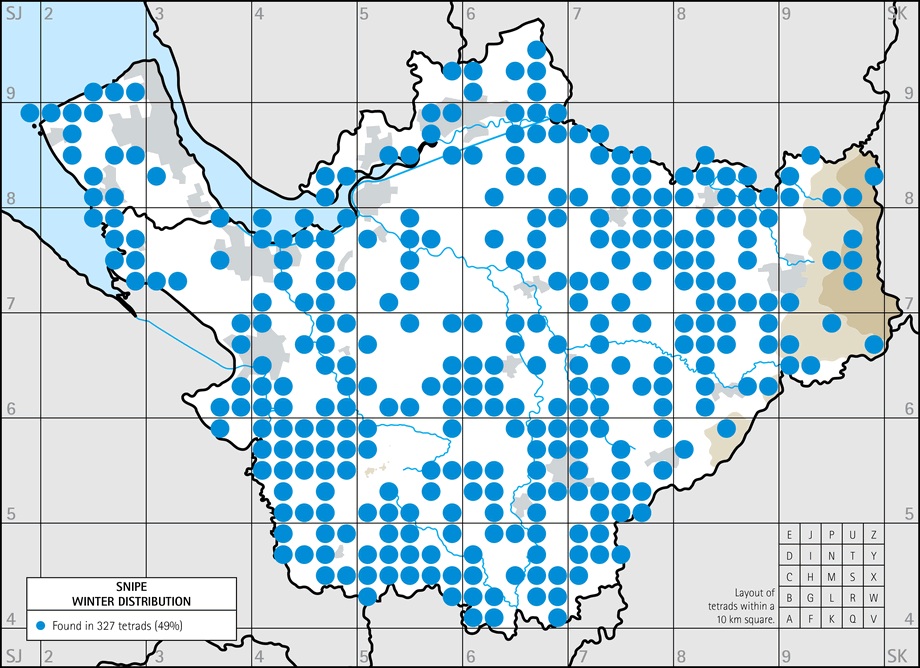
Although most of the county’s farmland dries out too much to provide suitable breeding conditions for Snipes, it stays sufficiently wet during winter for Cheshire and Wirral to hold significant numbers of birds. They were recorded in 327 tetrads, almost half of the winter tetrads. They clearly avoid built-up areas, and were scarce in the higher land in the east of Cheshire. In the rural lowland parts of the county, many Atlas fieldworkers expressed surprise at how widespread they were, and how easy to find: any suitably damp area was likely to hold Snipe, well camouflaged but easily detected, if flushed, by their rasping ‘zip’ call and characteristic zigzag flight.
Snipes occupied a wide range of habitats. 39% of records came from farmland, most on improved or unimproved grassland, with 5% in flooded stubble fields. 33% were in freshwater habitats, mostly standing waterbodies (25%) of any size from pond or marl-pit to mere, with almost all of the rest on narrow ditches or streams. Semi-natural grassland or marsh accounted for 21% of habitat records (10% water-meadow/ grazing marsh, 6% reed swamp, 3% saltmarsh and 2% other open marsh) with 2% in bogs. They tend to rest by day and feed at night, eating more vegetable matter and seeds during winter, perhaps taken incidentally to their main diet of earthworms and tipulid larvae, with beetles, flies and their larval stages (BTO Winter Atlas).
They tend to form loose flocks when feeding or loafing. More than three quarters of records were accompanied by counts, showing that the median flock size was six birds. There were 16 counts of over 50 birds and four over 100, all in the last winter, 2006/ 07. The largest flock in the submitted Atlas records was near Statham (SJ68T), where David Bowman flushed an exceptional total of 166 birds on 20 December 2006, with other groups of 121 and 112 at Risley Moss (SJ69Q and SJ69R), and 104 at Aldford Brook Meadows (SJ45J). The wintering population of the county certainly exceeds 2,000 birds, and may be considerably more.
There is a substantial migratory movement of Snipe across Europe, with perhaps one million birds wintering in Britain and Ireland. Snipe from Iceland winter in the Western Isles and Ireland, and our wintering population comprises birds from Finland, Sweden and elsewhere in northern Europe as far east as Russia. Many of the Snipes breeding in Britain move south or depart for winter, to Ireland, France and northern Iberia, to be joined, during hard weather, by some immigrants that had started the winter in Britain (Migration Atlas).
The species’ winter status has probably not changed much in one hundred years. Coward (1910) wrote that ‘during the winter months the Snipe is generally distributed throughout the county, frequenting pit-sides and damp meadows, often singly or in couples, but sometimes in wisps of considerable size’. Boyd (1951) had notes of from fifty to one hundred or more during mild weather in each of the months November to February. He commented that ‘hard frost scatters them … many leave the district, and the few that remain pop up from any deep unfrozen ditch or spring which they rarely visit at other times’. Bell (1962) summarised the species as an ‘abundant winter visitor … birds found in all suitable localities during the winter’.
Atlas account sponsored by Syngenta CTL