
Sandbach Flashes: birds and wildlife
About the Atlas
During the three breeding seasons 2004–06 and three winters 2004/05–2006/07, Cheshire and Wirral Ornithological Society (CAWOS) organised more than 350 volunteers to survey all of the county, trying to find every species of bird that was breeding or wintering
Sparrowhawk Accipiter nisus
Breeding
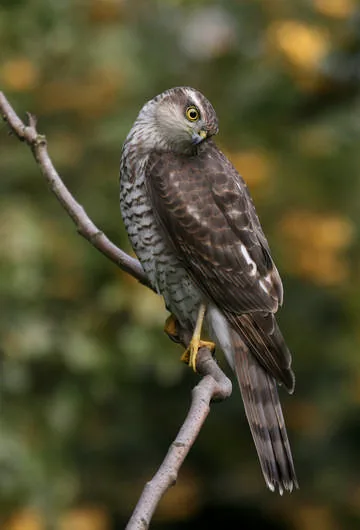
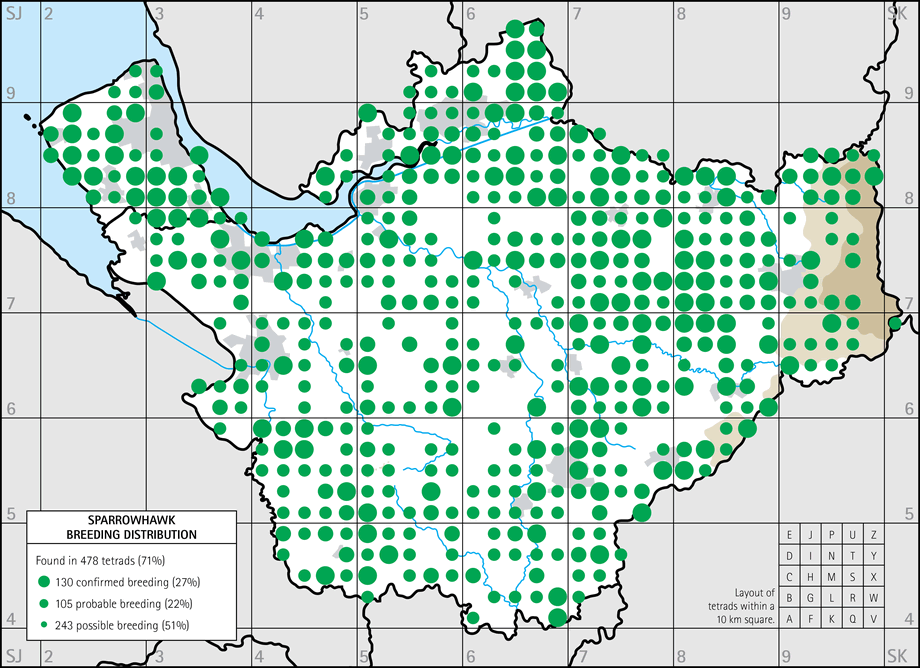
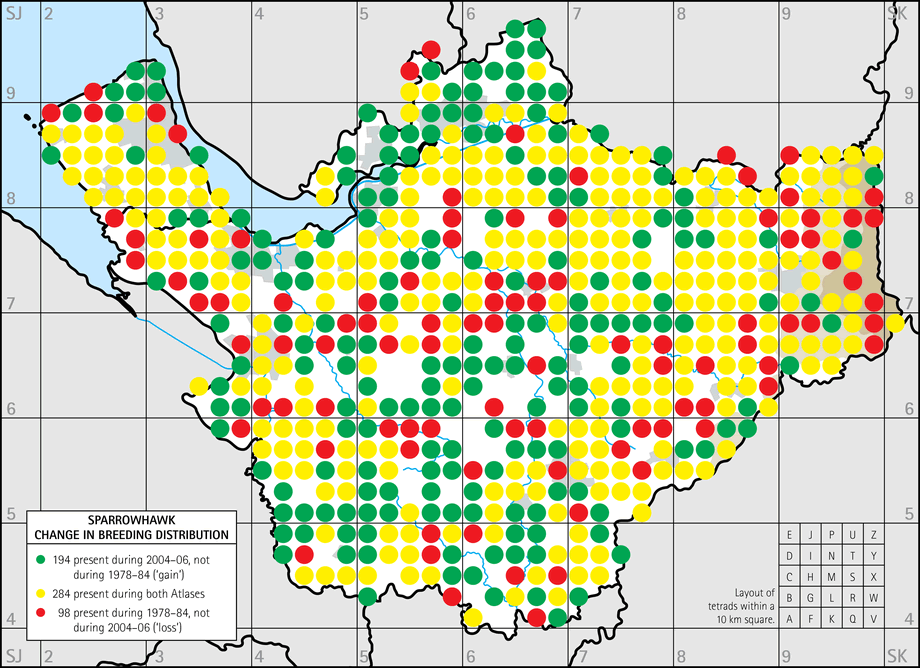
This survey shows that Sparrowhawks are much more widespread than they were twenty years ago, when the species was still recovering from the effects of organochlorine pesticides. In our First Atlas they were found in 382 tetrads, 97 of them with confirmed breeding and 84 with probable breeding; the equivalent figures in this Atlas have risen to 478, 130 and 105. They nest only in trees, especially in the largest available woods, but otherwise they use parks and large gardens as they have spread into the areas of densest human population, including the Mersey Valley and north Wirral, and across much of agricultural southwest Cheshire. The main areas of absence are the treeless areas of the highest land (where they seem to have withdrawn from several tetrads in which they were found in the First Atlas) and the estuarine saltmarsh, along with the Gowy valley and scattered parts of central Cheshire. Although Sparrowhawks always nest in woodland, they often hunt in other areas, and the reported habitat codes reflect this: 49% woodland, nearly all of them broadleaved or mixed, 4% scrub, 31% farmland and 13% human sites.
The size difference between the sexes is greater than in any other raptor, female Sparrowhawks being around twice the weight of males, allowing the pair to exploit a very wide range of prey (Newton 1979). Their diet is exclusively birds, up to their own body weight or even more. Males especially take tits and finches, and species up to the size of Blackbirds. Females can catch much larger prey, tackling anything from Woodpigeons downwards. In the breeding season Sparrowhawks mostly catch fledglings, and they time their own breeding to be later than that of most of the smaller woodland birds, so that maximum numbers of prey are available to feed their own young. They will fly a long way from their nest to find food, typically up to 3-4 km in good habitat and 4-6 km in poorer areas, thus overlapping their hunting range with other Sparrowhawks (Newton 1986). There is inevitably, therefore, a chance that records of birds seen hunting, or carrying food for their young, belong to an adjacent tetrad. Observers found nests in 46 tetrads, with adults carrying food providing the bulk of confirmed breeding records (65), and 19 observations of recently fledged young, chicks spreading out through woodland whilst still obviously showing flecks of down amongst their plumage. In 7 tetrads birds were seen building or visiting a probable nest-site (B or N) and in 8 tetrads surveyors reported the agitated ‘kek-kek-kek’ calls of adults; however, half (51) of the probable breeding records came from fieldworkers seeing display, one or both adults circling on stiff wings high above their territory, with 35 reports of pairs.
The Sparrowhawk population nationally is now about double that at the start of our First Atlas in 1978, but we do not have a good quantitative estimate of the county population because Sparrowhawks are only sporadically recorded on BBS transects. [Nests tend to be regularly spaced in suitable habitat, that spacing varying strongly with altitude, from nests 0.5 km apart at elevations up to 70 m to a separation of 2 km at altitudes above 300 m; the altitude is a proxy for density of suitable prey, but this relationship works remarkably well across the UK.] The hunting range of male birds in the breeding season may be as little as 30 ha, mostly woodland, at low elevations, but more than 250 ha at 200 m altitude (Newton 1986). These figures suggest that a density of 1-2 pairs per tetrad is sustainable in reasonable habitat. With this Atlas survey showing 235 tetrads with confirmed or probable breeding the Cheshire and Wirral population is likely to be in the range 300-400 pairs, more than twice the figure in our First Atlas, but only half the total for Kestrels. The national estimate for the British population is 38,600 pairs of Sparrowhawks, very similar to that for Kestrel (35,400) (Baker et al 2006); Cheshire and Wirral is a less well-wooded county than many, so it is not surprising that our total of breeding Sparrowhawks is lower than that for Kestrels.
Atlas account sponsored by James Quinn
Winter
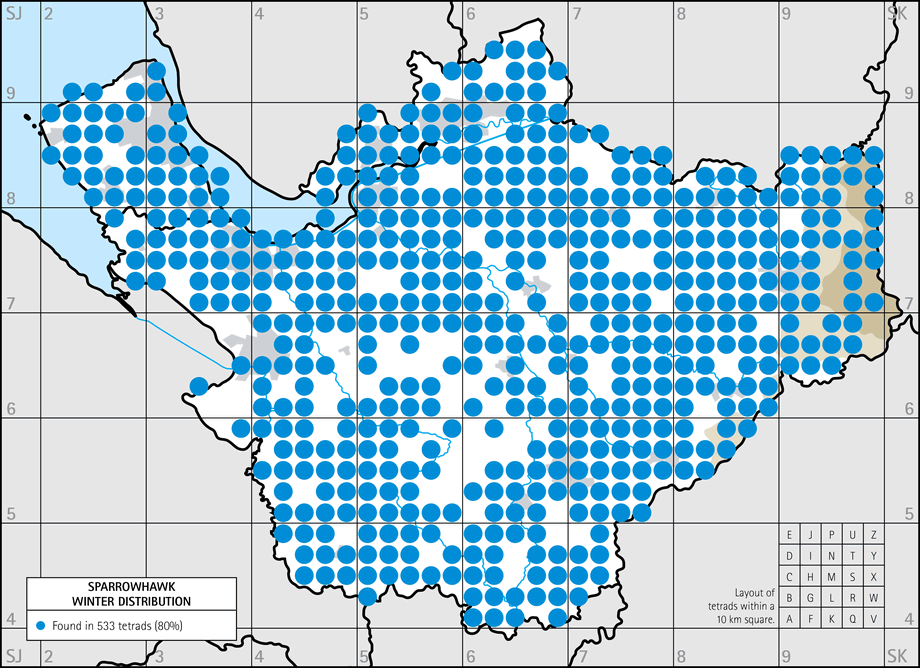
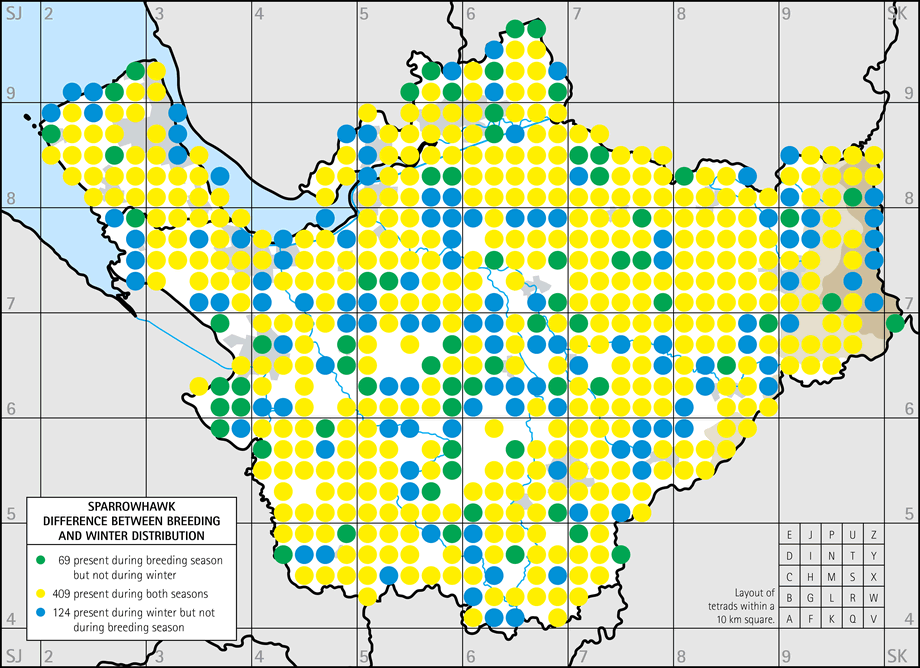
Most Sparrowhawks which have good-quality territories remain in them all year round, while those on low grade territories tend to move away, whether they had successfully bred or not. First-year birds spend much of the winter trying to find a suitable territory, although not many succeed, fewer than 20% of birds breeding at one year of age. There is also an influx in winter of migratory birds, mostly from Norway and Denmark (Migration Atlas). There is thus no reason why the winter distribution map of Sparrowhawk should be similar to that for the breeding season, but it is: the species is widespread but missing from the sparsely-wooded areas of central Cheshire and not found in some of the bleakest upland tetrads.
In winter, there is less reason for the apparent correlation with woodland because the sexes tend to separate, males hunting mostly in woodland and females more often in open country. This is dictated partly by their size and manoeuvrability, allied to the likely habitat preferences of their favoured prey. In summer, their prey is overwhelmingly the naïve fledglings but by wintertime, the easy pickings have gone and birds are more difficult to catch. The range over which Sparrowhawks have to hunt to fulfil their daily needs increases greatly, to a mean of 350 ha at low elevations – ten times the breeding season figure – and more than 800 ha (two tetrads) at 200 m altitude (Newton 1986); these figures are for male birds, with females travelling perhaps twice as far, covering four times the area. The greater variety of habitats covered in winter is shown by the recorded habitat codes, with 27% woodland, 5% scrub, 2% semi-natural grassland and marsh, 44% farmland and 21% human sites.
When they have no chicks to feed, Sparrowhawks hunt mainly in the first three hours of daylight, then are inactive for large parts of the day, usually from late morning onwards. There is a late-afternoon flurry, especially by first-year hawks, as some of them attack birds coming into roosts. I have found, in 23 years of ringing birds roosting at Norton Priory, Runcorn, a significant correlation from year to year between the total of thrushes ringed and the number of Sparrowhawks caught: in years with more thrushes roosting, there are likely to be more hawks visiting.
Coward and Oldham noted that ‘in winter the Sparrowhawk frequents the more open country. It hunts over a regular beat as a rule, passing a given spot about the same time day after day’. To Boyd (1951) the species was a fairly common resident, but by Bell’s time (1962 and 1967) it had become very scarce, as the lethal impact of organochlorine pesticides hit them hard. The present county population may well be the highest in recorded ornithology.
Atlas account sponsored by James Quinn