
Sandbach Flashes: birds and wildlife

About the Atlas
During the three breeding seasons 2004–06 and three winters 2004/05–2006/07, Cheshire and Wirral Ornithological Society (CAWOS) organised more than 350 volunteers to survey all of the county, trying to find every species of bird that was breeding or wintering
Starling Sturnus vulgaris
Breeding
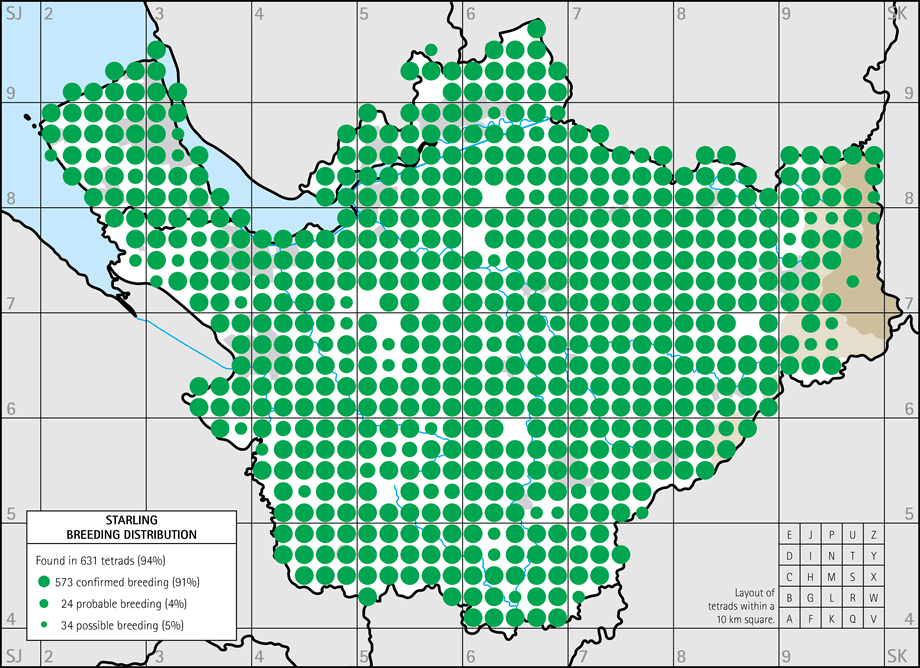
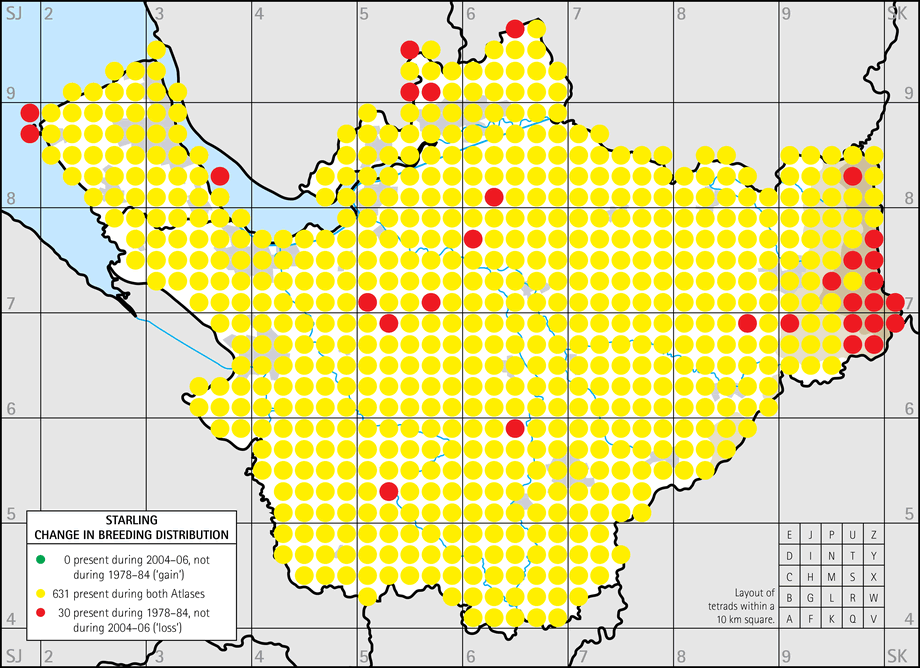
Starling was the most widespread breeder in our First Atlas but now is not in the ‘top ten’ in terms of the number of occupied tetrads. As a breeding bird, they have a distribution very similar to that of House Sparrow, both having been lost in the last twenty years from Hilbre and from the eastern hills: of the eleven tetrads above 350 m, they were confirmed breeding in one, possibly breeding in another and missing from nine.
Starling is now on the British Red List of species of conservation concern. The English population peaked in 1978, dropped by about 20% during 1978-84, the fieldwork period for our First Atlas and continued to fall every year since then, such that by 2004 the national index was about 75% lower than just twenty years previously. The slump started earlier, and the decrease was greater, in their secondary habitat of woodland than in their preferred farmland. A detailed analysis of BTO data showed a marked regional effect, with the decline greatest in pastoral areas such as Cheshire. In northwest England, Starlings achieved their greatest concentrations near habitation, especially suburban areas, followed by urban and rural, with fewer on farmland but about five times higher densities on grassland than arable areas (Robinson et al 2005).
Although Starling is now only the 16th most widespread species in the county, judged by the number of tetrads in which birds were found in the breeding season, it is the ninth most abundant species. The analysis of the BBS transects in 2004-05 shows that the breeding population of Cheshire and Wirral is 72,240 (50,190-94,290) Starlings.
The nub of the species’ problems has clearly been identified as reduced overwinter survival, especially of first-year birds; despite on average laying more eggs, rearing more chicks, losing fewer nests and laying earlier in some years, allowing more pairs to have second broods, the population is dropping because more birds die in winter (Freeman et al 2007). The reasons for the decline are less easy to define. Although Starlings supplement their winter diet with seeds, and indeed they will eat almost anything they can find, the key food all year round is soil invertebrates, found in areas of short grassland. They like to feed amongst cattle, and perhaps the tendency to keep stock indoors during winter has affected the species. It is not known, however, what has happened in the Cheshire uplands in the last twenty years to cause the loss of Starlings. A survey of the upland farmers would be instructive.
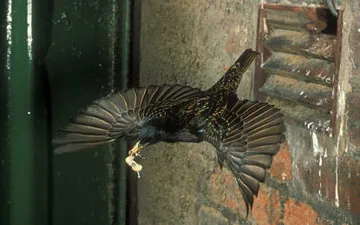
Starling chicks need insect food, especially leatherjackets, the larvae of crane-flies (tipulids), which their parents find amongst short-cropped grass, especially mown lawns and saltmarsh; adult birds will fly up to a mile or more to a sure source of food, and are very obvious from late April as they fly back to their nests with a beakful of invertebrates. With chicks squawking in their nests, this must be amongst the easiest of all birds in which to prove breeding, and indeed Starlings had the second-highest percentage of confirmed breeding of all species. In 206 tetrads, birds were seen with food for their young, with a further 13 where adults were noted carrying faecal sacs away from the nest, another obvious feature of this species. Fieldworkers recorded nests in 154 tetrads, which are mostly nowadays in man-made structures, especially under the eaves or in chimneys of buildings; nests in holes in trees are much scarcer than twenty years ago, although six observers noted nests in oak, ash and alder, sometimes in a naturally formed hole and other times using an old woodpecker’s nest. In a further 200 tetrads, recently-fledged young were seen; this is clearly the least reliable evidence of breeding in a tetrad because youngsters become independent very quickly, within about ten days (Feare 1984) and some parties of Starlings will fly long distances from their natal site within days of fledging.
The Atlas data show most habitat codes from human sites (60% of records, with 38% rural, 17% suburban and 5% urban), with 28% farmland and 11% woodland or B1 (scrub, regenerating woodland).
Atlas account sponsored by Dr P. Griffiths
Winter
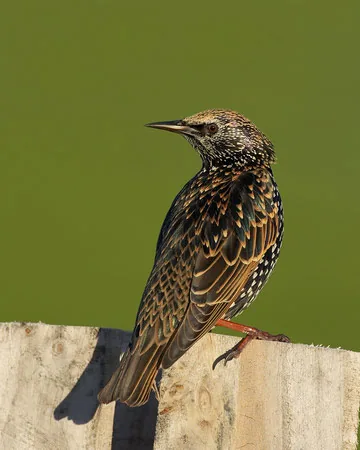
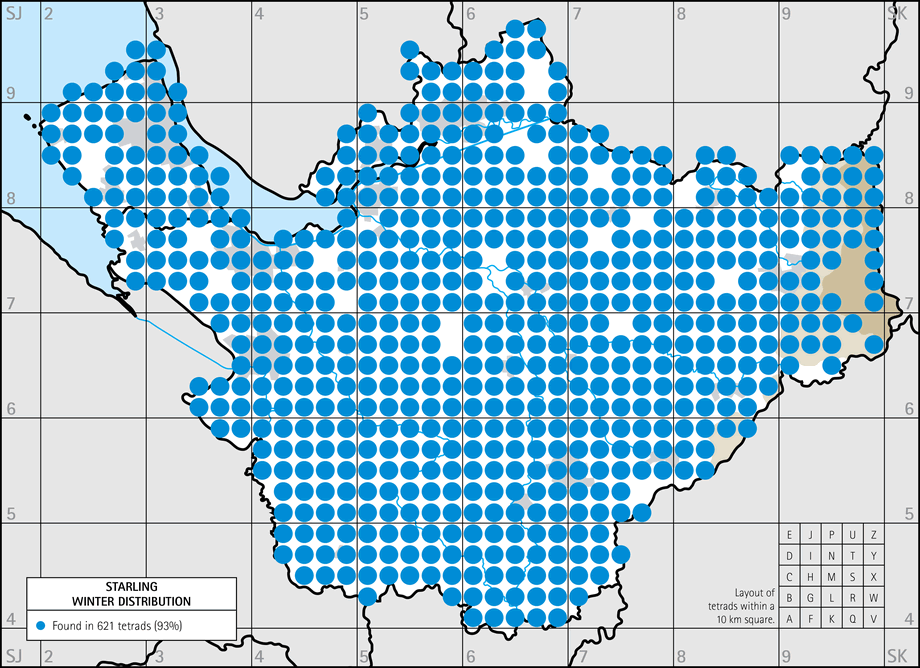
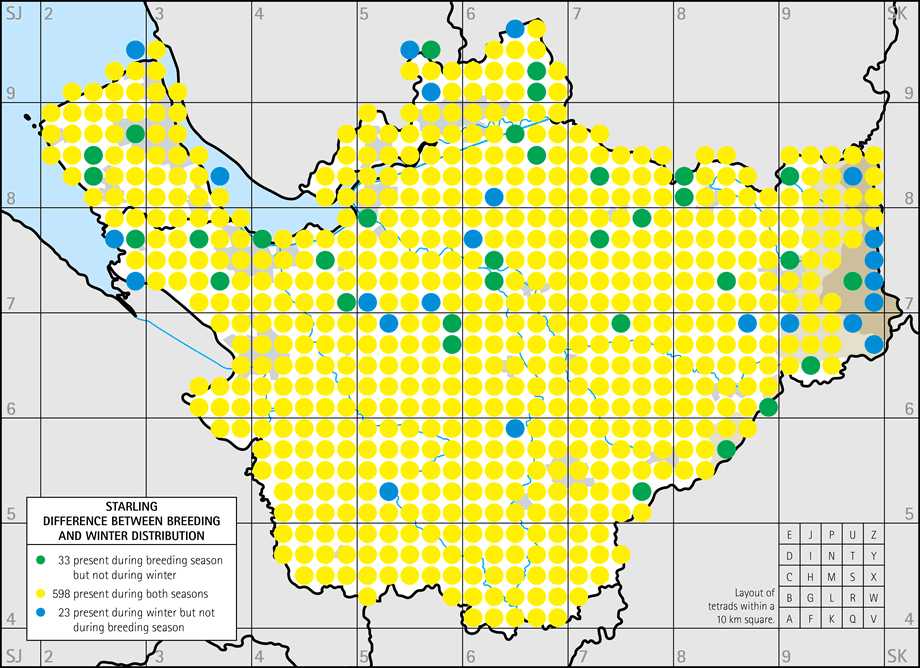
Our breeding Starlings are mostly sedentary, or make short movements within Britain, but their numbers are augmented in winter by millions of birds from Eastern Europe. Merseyside Ringing Group has 88 records of ringed Starlings overseas, including twelve from as far as Russia, Belarus and the Baltic states. Some of these stay in large flocks in the countryside but others come into gardens and mix with local birds. The Atlas map shows that the winter distribution is similar to that of the breeding season, with the only significant difference being birds present in seven of the tetrads in the eastern hills where they were not found breeding. The habitat codes submitted in winter, however, show a very different distribution from the breeding season, with 60% of the winter records on farmland (including 31% improved grassland), 30% human sites, 7% woodland or scrub, many of these used for roosting, and 3% semi-natural grassland and marsh. The phrase ‘human sites’ does not only mean habitation, and birds were noted in a number of tetrads feeding on landfill sites or sewage farms.
They spend almost all of their lives in groups from a few birds to many thousands. Large feeding flocks are especially a feature of the south of the county, birds foraging on pasture or stubble, particularly favouring recently slurried fields or those used by cattle or sheep. Starlings are wintering in fewer gardens, according to the BTO's Garden Bird Feeding Survey, having fallen from presence in about 85% of gardens in the mid-1990s to 70% now. Similarly, from its inception in 1979 to 2003, the late-January RSPB Big Garden Birdwatch found Starling to be the most numerous bird in gardens, but it no longer holds top spot and the numbers of Starlings per garden are down to less than a quarter of those recorded in 1979. These results do not necessarily imply any change in populations, but could indicate changed feeding habits and less need to visit artificial food sources, especially with warmer winters of late.
Roosting or pre-roosting flocks were reported widely across the county, with some massive counts in the south of the county headed by the half a million birds in Nantwich (SJ65K) in 2004/ 05, up to 300,000 in conifer windbreak trees near Wardle (SJ65D) in 2005/ 06 and 250,000 at Bulkeley (SJ55H) in 2004/ 05. Elsewhere, the Runcorn-Widnes Bridge (SJ58B) has held hundreds of thousands of birds in the past, despite concerted attempts by local authorities at dispersing them, and there were estimated to be up to 70,000 there during this Atlas period, and another traditional site is the reedbed at Rostherne Mere (SJ78L) – mentioned by Coward (1910) – holding a conservatively judged 45,000 in 2006/ 07. Many smaller roosts were reported, often in leylandii, with willows used at Woolston (SJ68P), a plane tree in Warrington town centre (SJ68E), a water tower near Congleton (SJ86Q) and industrial buildings across the county. Large roosts may have a catchment 20 km in radius (BTO Winter Atlas), and the map of reported roost sites is difficult to interpret, amalgamating three winters and ignoring changes within a winter. Coordination of counts and mapping flight-lines to roosts would make an admirable project for CAWOS.
Atlas account sponsored by Dr P. Griffiths