
Sandbach Flashes: birds and wildlife

About the Atlas
During the three breeding seasons 2004–06 and three winters 2004/05–2006/07, Cheshire and Wirral Ornithological Society (CAWOS) organised more than 350 volunteers to survey all of the county, trying to find every species of bird that was breeding or wintering
Stock Dove Columba oenas
Breeding
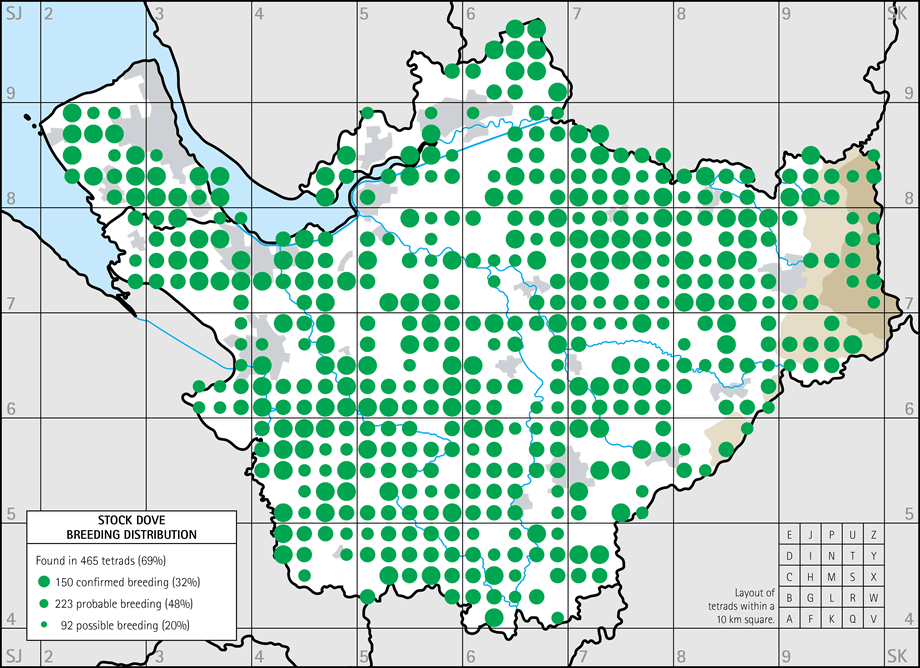
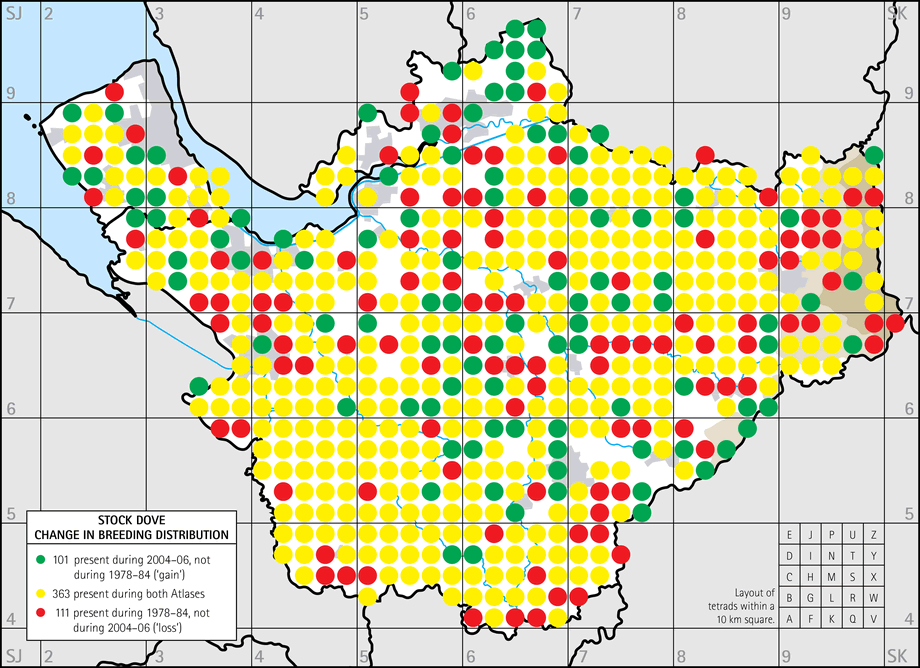
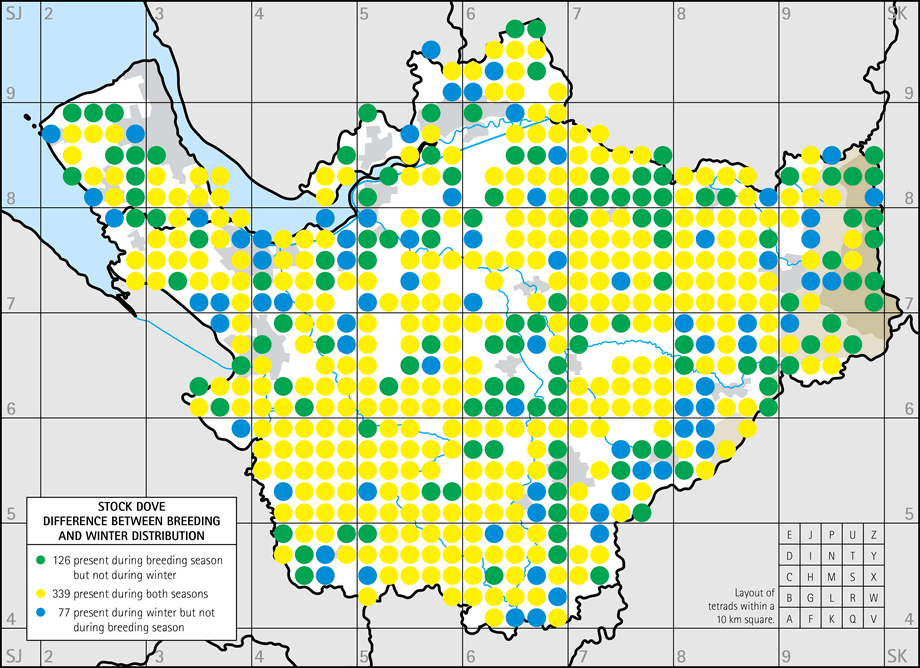
The distribution of Stock Doves has changed little in twenty years. As in our First Atlas, they are widely spread across the county, with the gains and losses almost balancing out and no coherent pattern except perhaps for the cluster of eight newly occupied tetrads in SJ69. In some areas they could have been under-recorded, some birdwatchers having a blind spot for pigeons and not recognising their far-carrying excited ‘coo-oo-up’ calls. They avoid most urban areas, with gaps around east Wirral, Chester, Widnes, Warrington, Northwich, Congleton and Macclesfield visible on the distribution map. This also shows in the habitat records, with only 6% of codes from human sites, mostly in rural areas, and 54% in farmland, 36% in woodland and 3% in scrub. This is primarily a bird of parkland, the edges of woods and farmland with copses and hedgerow trees.
Their diet of farmland seeds, leaves and buds, meant that they were badly hit in the 1950s and early 1960s by the poisonous organochlorine seed-dressings, but, following the ban on their use, Stock Dove numbers bounced back. Their stable distribution in the county might suggest that their population has levelled out between our two Atlases, and the BTO figures show the national index to be just 16% higher than in 1984. Grazing farmland has deteriorated as a breeding habitat for Stock Doves in recent years, however (Siriwardena et al 2000). According to the analysis of BBS transects in Cheshire and Wirral, the Stock Dove breeding population in the county in 2004-05 was 2,130 birds (870-3,390), an average of only just over four birds per tetrad in which they were found.
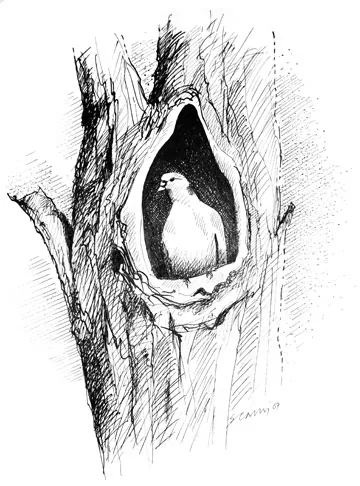
Stock Doves may have several broods in a season lasting from February to September, although most activity is in June. Their nests are completely different from the rest of the pigeon family, in a large tree cavity, so they find themselves in competition with species including Tawny and Little Owls and Jackdaws. They readily take nest boxes and are in fact the commonest occupant of boxes erected for Barn Owls in the area of west Cheshire covered by the Broxton Barn Owl Group. Oak was the only species of nesting tree recorded during this Atlas. Observers proved breeding in less than one-third of tetrads, mostly by finding nests (123 tetrads), with recently fledged young reported in 20. Birds were found carrying sticks or visiting likely nest sites in a further 27 tetrads, these activities counting as probably breeding.
Atlas account sponsored by Syngenta CTL
Winter
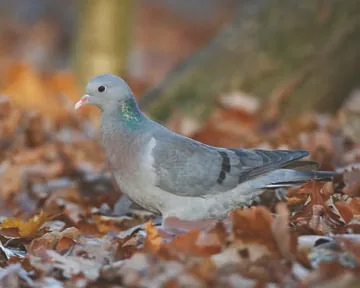
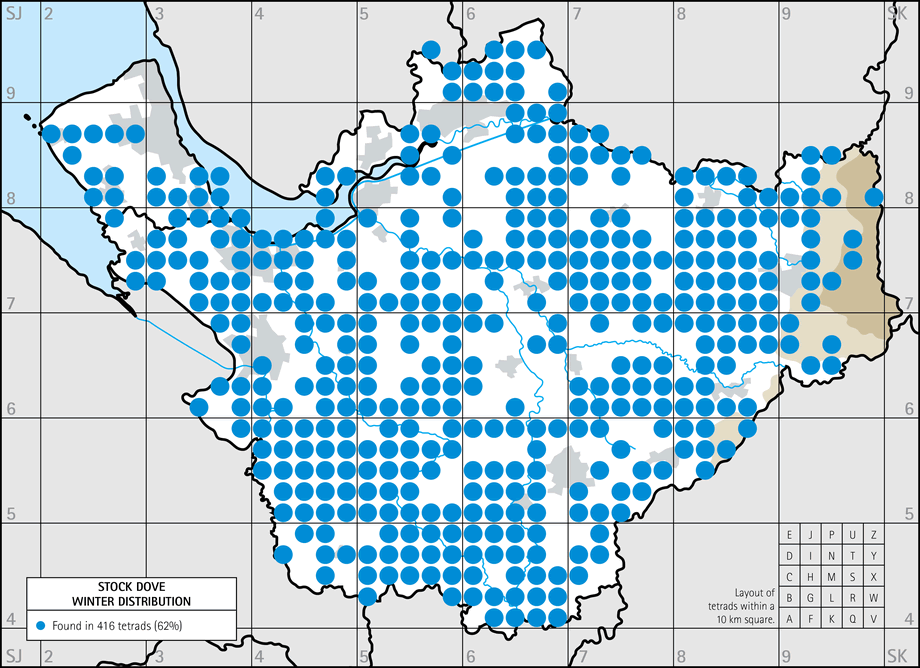
Stock Doves were recorded in 49 fewer tetrads in winter than during the breeding season, perhaps because some birds move to join flocks. There are noticeable gaps in the Wirral peninsula, and in the centre of the county around Winsford in SJ66, and they seem to withdraw from the highest altitudes, as was reported in the national BTO Winter Atlas. Stock Dove flocks are seldom as large as those of Woodpigeons, although they sometimes join them and form mixed flocks. The median count of Stock Doves was four birds, with 16 flocks of 50 or more, the biggest being 200 at Capenhurst (SJ37R) and Frodsham Marsh (SJ57E). Their roosts are less noticeable, being reported in only three tetrads, two of them in single figures but that at Fiddler’s Ferry (SJ58M) holding up to 150 birds. From mid-January onwards, some birds were seen in pairs prospecting suitable nest sites.
In winter, many Stock Doves shift habitats to farmland, which makes up 72% of the winter records, including 9% in stubble. This is one of the few species to take advantage of maize stubble, commented upon by observers in twelve tetrads. Far fewer (20%) were in woodland, with only 3% of codes from human sites, and 2% from saltmarsh. Stock Doves feed mainly on weed seeds, although it is almost impossible to see what they are taking when foraging in a field. They especially favour slurried fields and manure heaps, with birds also reported from game cover, rape, sprouts, cattle and horse pastures and paddocks, and a field of improved grassland left to go to seed.
As with Woodpigeon, the migratory status of the winter flocks has been in doubt. Coward (1910) thought that ‘apparently the numbers are increased in winter by immigrants’, and Hardy (1941) described them as a winter visitor in small flocks. Boyd (1951) said they were sedentary, found throughout the Great Budworth district at all times of year in woods and hedgerows and feeding in the fields, often in company with Woodpigeons. Bell (1962) wrote that there was no evidence of migration, probably meaning that birds were not seen flying past Hilbre, but noted that sizeable flocks, between 50 and 100, had been reported frequently in autumn, and again in February in hard weather. Analysis of the national database of ringed birds now shows that British Stock Doves are indeed sedentary, with a median distance of movement of 6 km, and only four birds have shown movements over 200 km, three of them to France or Spain. Three foreign-ringed birds have been found in southeast England (Migration Atlas).
Atlas account sponsored by Syngenta CTL