
Sandbach Flashes: birds and wildlife
About the Atlas
During the three breeding seasons 2004–06 and three winters 2004/05–2006/07, Cheshire and Wirral Ornithological Society (CAWOS) organised more than 350 volunteers to survey all of the county, trying to find every species of bird that was breeding or wintering
Stonechat Saxicola torquatus
Breeding
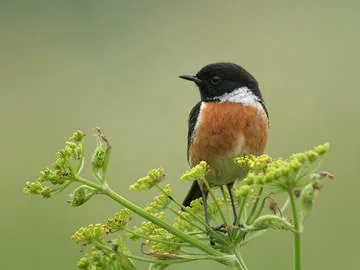
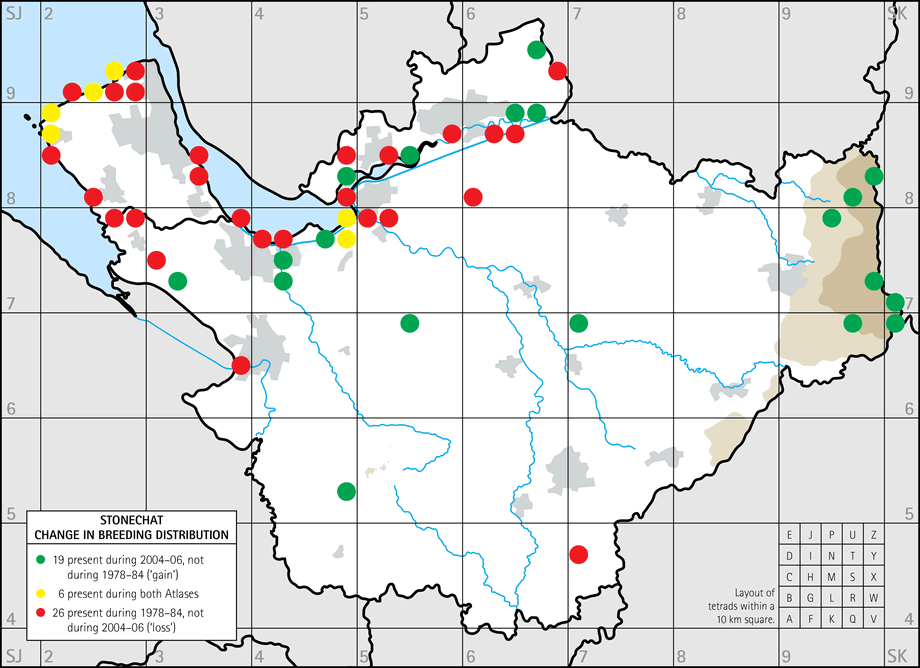
Stonechats have undergone a fascinating shift in distribution since our First Atlas: twenty years ago, this was a species breeding in the lowest-lying land in the county, mainly in the north Wirral and the Mersey valley. Now, there are far fewer on the coast and others breeding at the highest altitudes in the eastern hills. As an insectivorous resident, this species is susceptible to hard weather and it is tempting to think that warmer winters have allowed them to flourish.
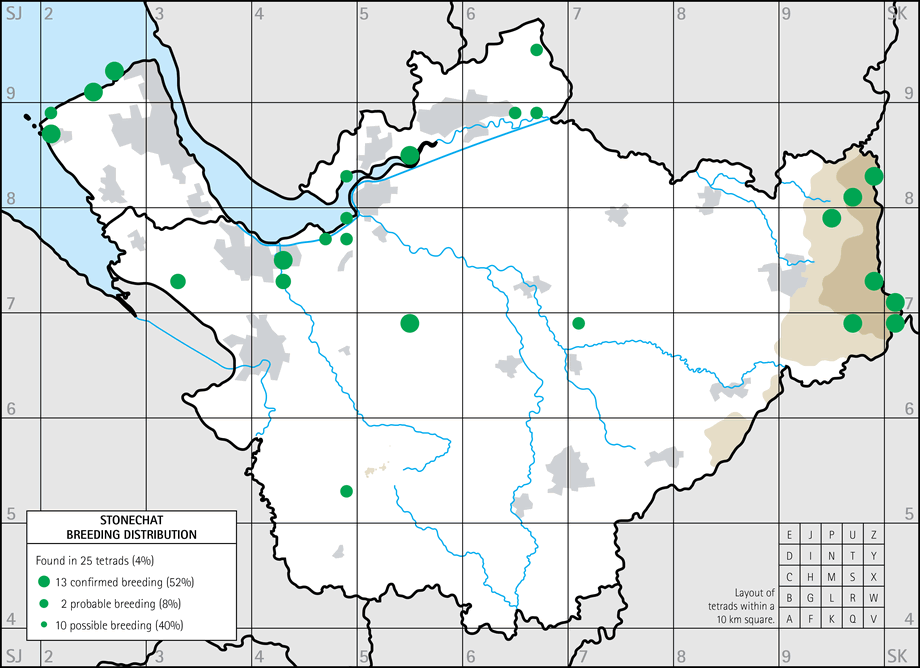
Since the end of fieldwork for our First Atlas in 1984, the annual county bird reports have several times lamented the loss of Stonechat as a breeding species, and there are only six records in the 19 years to the start of this Atlas in 2004, one each in 1986, 1990, 1992, 1995, 2002 and 2003. The record near Three Shires Head (SK06E) in 1995 was of special significance, although not noted as such in the bird report, as it appears to be the first recorded breeding in the hills since Coward and Oldham (1910) said that it ‘nests in the hill-country in the east but is not abundant’. Neither Boyd (1946) nor Bell (1962), in their writings on the county’s birds, made any comment on its status in the hills. Another pair bred ‘in the east of the county’ in 2002, then the start of this Atlas in 2004 coincided with a resurgence in records.
It is impossible to know to what extent the increase in fieldwork for this survey yielded more records, but upland breeding was well established in Cumbria and Lancashire long before it was reported in Cheshire. In Lancashire, the tetrad Atlas in 1997-2000 found over 40 pairs in the uplands of Bowland and the west Pennines. In Cumbria, atlas fieldwork spanning 1997-2001 estimated a total of 1,000 pairs, mostly along the coast but with several hundred in the Lake District hills up to an altitude of 500 m.
Stonechats will breed in a wide variety of habitats, probably the only common characteristic being ‘rough’ ground, avoiding woodland and most areas in agricultural use. They need scattered bushes, trees, fence-posts or wires for use as song-posts and for perching whilst watching for their insect prey. Their catholic taste was borne out in this survey when the 28 occupied tetrads yielded as many as 18 different habitat codes. The most frequent were C5 (dry grassland – 6 records), B7 (scrub – 6 records) and E2 (unimproved grassland – 5 records), with no other code being registered more than twice.
Stonechats start to breed early in the year, with eggs often laid in late March in lowland sites, although later at higher altitude. They nest from ground level up to about 1 m, usually at an arm’s length deep inside gorse or other dense bush. Most pairs have two broods, and three is not unusual, extending the season into August. With an average of 5 chicks each time, this high reproductive potential allows them to balance the losses in cold weather, or alternatively allows rapid population growth when overwinter survival is higher.
This is a conspicuous bird, perching prominently and having a loud alarm call, a typically chat-like ‘tack tack’, albeit with a weak song. Adults with food in their bills, especially when feeding recently-fledged broods, are easy to see. The breeding status codes reflect this, with one record of a nest with young, two of adults carrying food for their young and ten tetrads where observers saw recently fledged young.
As well as the shift in the distribution to the eastern hills, the birds in Delamere represent a return to an area where Oldham found a brood in 1904, in 1927 it was said to be nesting regularly (Bell 1962) and Boyd (1951) found them breeding in the 1930s.
There were 13 tetrads with proven breeding at some stage during this Atlas survey. The national population index (dating only from 1994) roughly doubled from 1994 to 2004 and Cheshire and Wirral have shared in this growth. The number of breeding pairs in the county is probably just into double-figures, its highest recorded level since 1978.
Atlas account sponsored by Irene Blagden
Winter
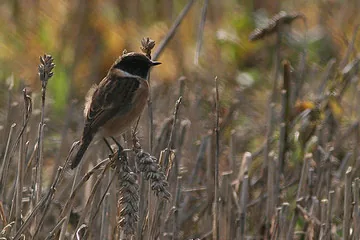
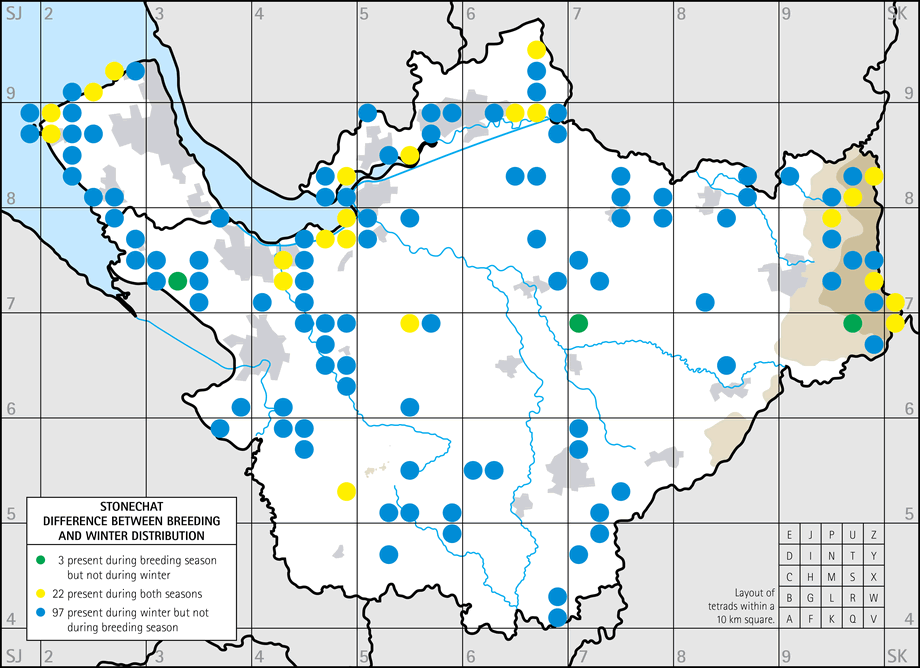
Many Stonechats are strongly territorial in pairs throughout the winter, either enlarging the breeding territory by a factor of two or three, to ensure the availability of sufficient food, or establishing new winter territories, many of which are coastal and may be totally unsuitable as nesting habitat (Migration Atlas). As an early breeding species, many males are singing in January and most birds have staked their territorial claim before the end of February, so some of the mapped ‘winter’ records will be from breeding birds. In fact, only three of the tetrads with a breeding season record were not also occupied during winter.
The Cheshire and Wirral breeding birds cannot, however, account for all of the Stonechats present in the county during winter. The BTO Winter Atlas text, based mostly on experiences in the Channel Islands, misleadingly emphasises the sedentary nature of the species. The Stonechat has evolved as a partial migrant to guarantee survival of at least a proportion of the population in the event of either migratory or winter catastrophes, and many of the birds found here in winter must have moved in from breeding areas elsewhere. There is no indication of Stonechats wintering here from anywhere outside Britain. The main stronghold of the species within Britain is in north-western Scotland, relatively few of those birds remaining for the winter, with some of them known to have migrated south as far as Spain and Portugal (Migration Atlas). Cumbrian-bred birds have been proven to winter in Kent. So, the likely origin of many of the birds wintering in Cheshire and Wirral is northern Britain. A fascinating challenge for the county’s ringers would be to test this suggestion.
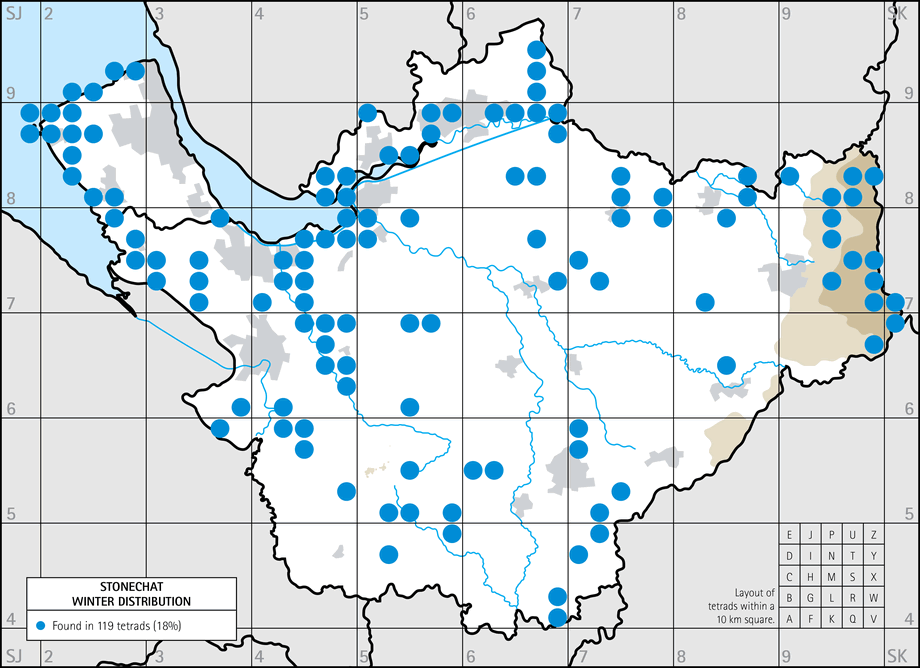
The Atlas map shows that there are three main components to the Cheshire Wirral wintering population. Some birds visit the coast; others tough it out in the eastern hills; while a third group follows the lines of rivers, especially the Mersey and the Gowy. All of these areas provide the rough ground that the Stonechat needs, and perhaps the recent habitat improvements in the Gowy corridor – particularly aimed at Barn Owl conservation – have incidentally benefited wintering Stonechats. A wide variety of habitat codes was recorded, with 44% on farmland (mainly grassland and low hedges), 31% semi-natural grassland and marsh (mostly wet areas, grazing marsh, reedbeds and saltmarsh), 8% scrub and 5% bog.
As in the breeding season, their main food is invertebrates, spotted by watching from a perch and taken from the ground. They require a certain warmth for their prey to be active, and the winter distribution of Stonechats nationally is more or less bounded by the 4º C January mean isotherm. All parts of the county comfortably exceeded that criterion, although eastern Cheshire was a little colder than that in January 2006. When their favoured insect prey is scarce, or hard to find, Stonechats occasionally take berries and they can survive for a few days on a vegetable diet.
Coward and Oldham (1910) quoted Brockholes (1874) that Stonechat was ‘a partial migrant, a few remaining all winter’, and they knew a few winter records themselves. Boyd (1951), writing about the Great Budworth area, stated that it is ‘distinctly uncommon and has been seen only 13 times in 40 years, as a winter visitor’. Bell (1962) added that, as a winter visitor it has been seen ‘in most of the last 10 years around West Kirby and Hoylake, and in the Frodsham area’. All of these writers indicate the species’ relative scarcity.
In this Atlas survey, although fieldworkers were not required to submit records from the same tetrad in more than one winter, in fact for this species some observers did so, giving useful indications of recurrence at wintering sites: records were submitted from 91 tetrads for just one winter, from 27 tetrads for two winters and from 2 tetrads for all three winters. Most surveyors also gave counts of the Stonechats seen. For the three winters of this survey, 2004/05 to 2006/07, there were Stonechat records from 57, 48 and 58 tetrads, with totals of 107, 84 and 117 birds. It may not be a coincidence that January 2006 was the coldest of the three years.
These are the largest numbers of Stonechats known to have been wintering in the county since ornithological recording began.
Atlas account sponsored by Irene Blagden