
Sandbach Flashes: birds and wildlife

About the Atlas
During the three breeding seasons 2004–06 and three winters 2004/05–2006/07, Cheshire and Wirral Ornithological Society (CAWOS) organised more than 350 volunteers to survey all of the county, trying to find every species of bird that was breeding or wintering
Tawny Owl Strix aluco
Breeding
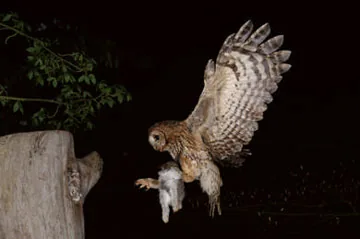
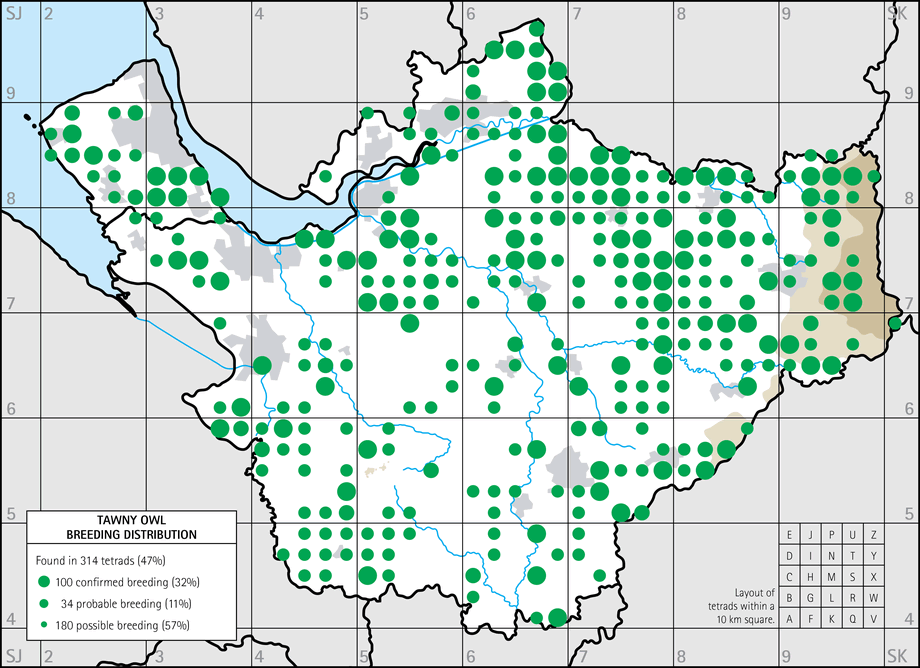
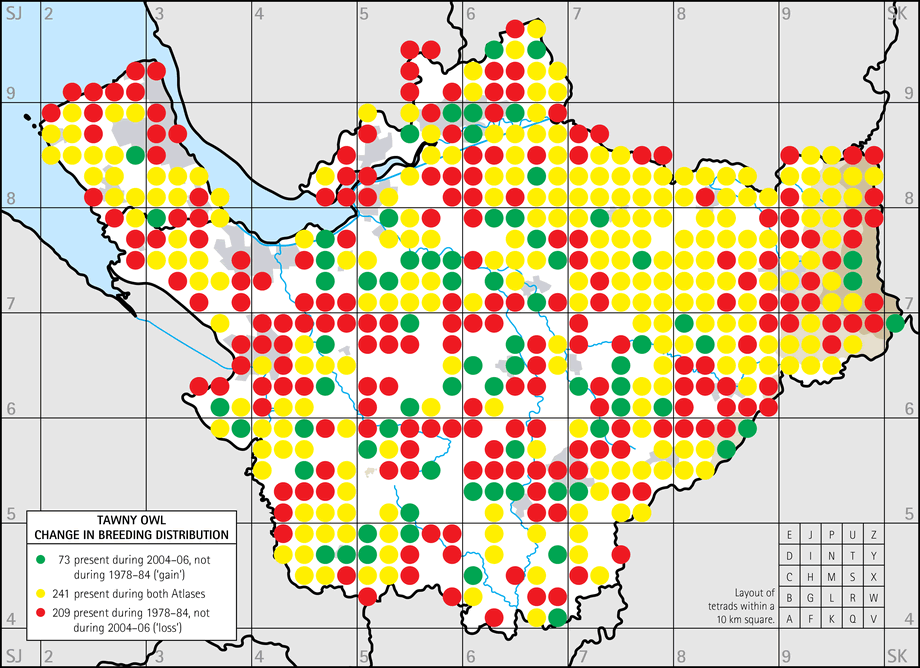
This is the woodland owl, and Tawny Owl distribution shows a strong correlation with woodland cover. Two-thirds of the habitat codes submitted were category A (woodland), all but a handful of them A1 (broad-leaved) or A3 (mixed). Provided that there are sufficient trees, even large gardens are occupied in some areas, and in 53 tetrads, habitat codes for human sites were recorded, 5 urban, 25 suburban and 23 rural. The Atlas map shows that Tawny Owls have significantly contracted in range since our First Atlas, mainly retreating into their core wooded areas.
Tawny Owls hunt mostly by waiting on a perch then pouncing when they hear some movement below. Their main prey is small mammals, especially wood mice and bank voles, with shrews and moles. Some individuals are adept at catching frogs, and others take a surprisingly high proportion of earthworms and beetles, especially when they have hungry chicks to feed. Birds, of any size from Jay to Wren, may comprise 10% of their diet, with urban and suburban owls taking far more birds than rural ones.
They nest in a hole or ledge, or an old nest of a corvid or raptor, or a squirrel’s drey. Nest-boxes are also used, and are perhaps especially good for them, because Tawny Owls often seem to choose a natural site with a shallow entrance from which over-adventurous half-grown chicks can fall out of the nest, often with fatal consequences unless the bird can climb back high enough to be safe from predators.
The typical timing is for Tawny Owls to lay their first egg around the third week of March, with chicks hatching 30 days later and fledging around the end of May. Odd pairs may nest much earlier than that, however, and chicks in March are reported every year. The average brood size is two chicks. Two-thirds of the 95 confirmed breeding records came from observers finding recently-fledged chicks, often alerted to them by their plaintive hunger calls.
Although all nocturnal species are liable to be under-recorded, the sound of its loud hooting is noticeable and carries a long way. A number of records were passed on to surveyors by interested landowners. Their ‘tu-whit, to-whoo’ call is unmistakeable, except that many people wrongly think that one sex gives one call and one the other. Most observers initially located Tawny Owls by sound, but some had their attention drawn by a bout of persistent mobbing by small birds who found an owl’s daytime roost.
Tawny Owl is poorly covered by the national monitoring schemes, but they suggest a shallow decline, perhaps a 25% drop between our two Atlas periods. Breeding was confirmed in 100 tetrads and probable in a further 34, and many of the 180 tetrads with possible breeding must hold at least one pair of this under-recorded species. Even if there is only one pair per tetrad, and allowing for some double-counting of their far-carrying calls, the county total must be at least 250 pairs. This would be just half of the figure in the First Atlas of 550 pairs.
Atlas account sponsored by John Patterson
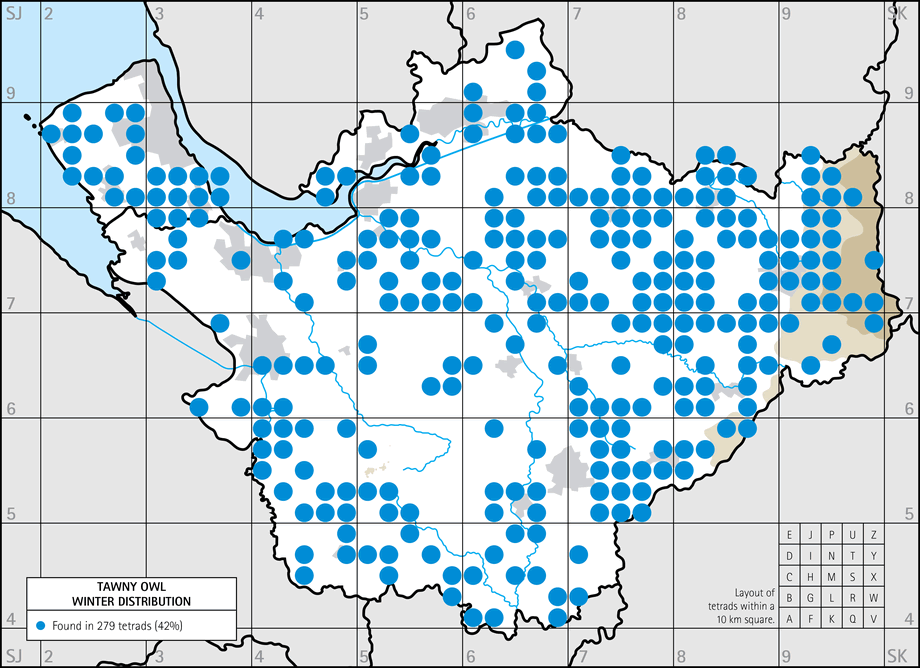
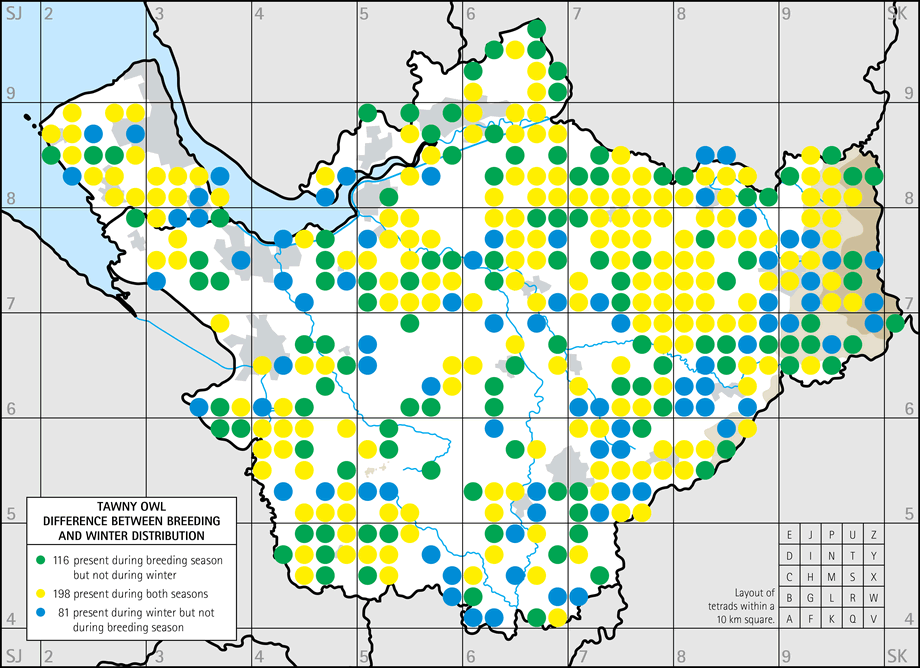
Winter
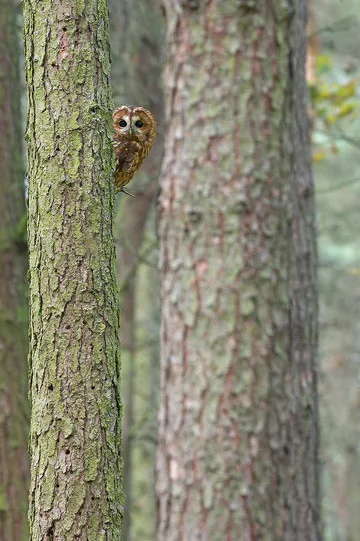
Tawny Owls were found in winter in 278 tetrads, but the distribution is puzzling, comprising 193 tetrads with breeding season and winter records, 85 tetrads with a winter record but no breeding season presence, and 111 in the breeding season where it was not found in winter. They are long-lived birds and, after their first autumn, sedentary: an adult male, at least three years old when ringed at Norton Priory, Runcorn (SJ58L) in December 1996 was retrapped in the same place five years later, and a first-year male ringed at Woolston (SJ68P) in November 1990 was retrapped there in May 1996. Some of the ‘extra’ winter tetrad records may be first-year birds, prospecting for territories after they have been noisily driven out from their parents’ territory, usually by October or November: these inexperienced birds may well occupy unusual areas that are unsuitable for breeding, although they will try to breed at one year of age if they can attract a mate.
Nevertheless, the difference between winter and breeding distribution is a surprising result for a species that is normally reputed to be one of the most sedentary of all birds, with the adult birds normally remaining in their territories all their lives, all year round. This discrepancy was obvious even from the first year’s records, and observers’ attention was drawn to it in the December 2005 Atlas newsletter, with the exhortation to ‘please try to get out and visit your tetrad, listening for owls, during this winter, especially if they bred in the area: it only needs a few minutes on a clear night, and a bit of luck, to hear one, and you might pick up some other species as well. And, in those tetrads where the species was found in winter but not in the breeding season, they are likely to be breeding somewhere close, so please try to find where!’ After a further two years of fieldwork, however, the stark seasonal differences persist and it remains an open question whether this is a real feature of the species’ biology or a recording effect of observer bias.
All but eight of the submitted counts were of one or two birds, with five records of three and three counts of four birds, near Warmingham (SJ76B) in winter 2004/ 05 and 2005/ 06, and near Lower Peover (SJ77M) in the first winter. The habitat codes show most records from woodland (58%), but surprisingly high proportions in farmland (17%), with even more in human sites than during the breeding season (68 records, 22% of the total).
Adult Tawny Owls start reinforcing their territory at the beginning of winter, calling frequently. In courtship feeding, from December to February, the male brings extra food to his much larger mate to cement the pair-bond and to build up her condition for an early start to breeding. In some ways, winter might be an easier season for the species, with long nights for their feeding, although the reduced numbers of some prey species causes some owls to shift their diet to feed more on birds, and many roosts of thrushes and finches suffer frequent attention from a Tawny Owl or two.
In autumn 2005 the BTO organised a national survey of Tawny Owls, observers re-visiting tetrads covered in the earlier 1989 survey. Publication of the results is awaited.
Atlas account sponsored by John Patterson