
Sandbach Flashes: birds and wildlife
About the Atlas
During the three breeding seasons 2004–06 and three winters 2004/05–2006/07, Cheshire and Wirral Ornithological Society (CAWOS) organised more than 350 volunteers to survey all of the county, trying to find every species of bird that was breeding or wintering
Tree Sparrow Passer montanus
Breeding
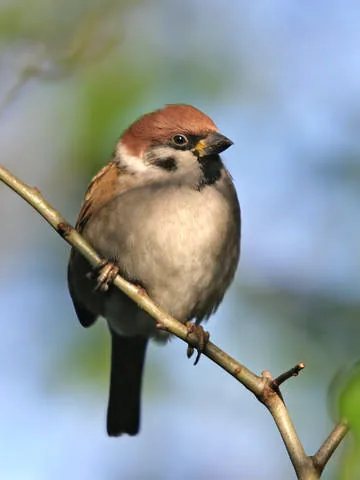
The Atlas results for this species were awaited with more trepidation than most, as its numbers have declined more steeply in the last thirty years than any other English bird. In the event, many observers commented that they found Tree Sparrows in areas where they had not known them before, their presence often given away by a series of ‘chup’ calls from deep in a hedge: the species is quite secretive and probably under-recorded in casual birdwatching, as Boyd commented 60 years ago (Boyd 1951).
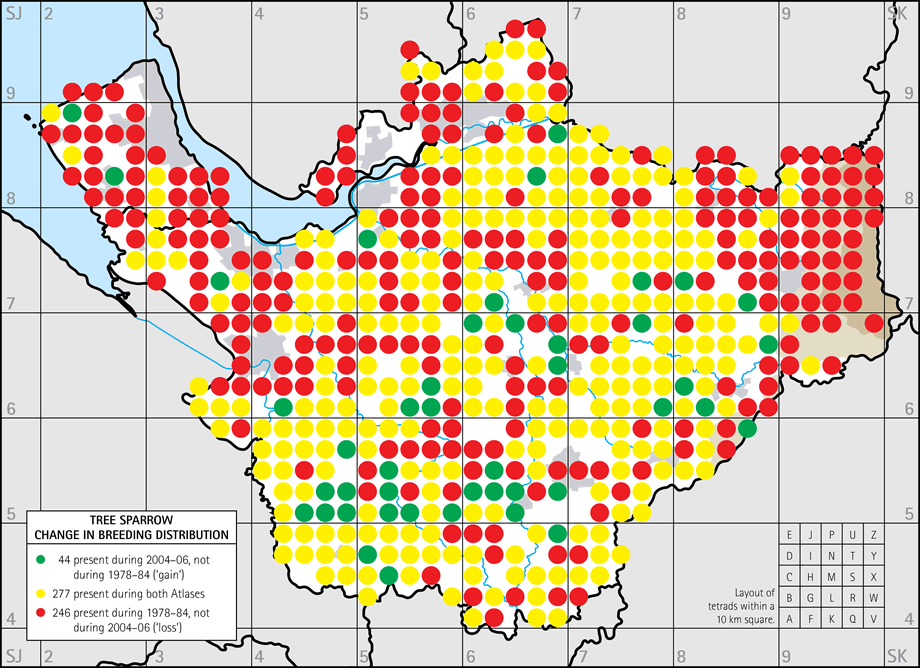
Tree Sparrow abundance dropped spectacularly in the UK between the late 1970s and the early 1990s. Most of the population crash occurred during the period of our First Atlas, so that the national index fell by three-quarters during 1978-84, and continued to decline into the mid-1990s but has risen a little since then. It appears that the low point in their Cheshire and Wirral fortunes probably occurred about half-way between our two Atlases. This species has been hit hard by agricultural intensification, especially the loss of weedy winter stubble, and it seems that Countryside Stewardship agri-environment scheme is helping to turn round their fortunes. The ‘change’ map, although showing the species lost from 246 tetrads since our First Atlas, does illustrate 44 gains, mainly in the cattle-farming areas of southern Cheshire.
Most Tree Sparrows nest in loose colonies, with some solitary pairs. Cheshire birds appear to be mainly in groups of 5-10 pairs, although 10-50 used to be the normal size (Summers-Smith 1995) and the UK BAP considers a ‘large’ colony to be one exceeding 20 pairs, possibly worthy of site safeguard measures. Colonies are not dense aggregations, and indeed a casual visitor might not realise that there is more than one or two nests. A typical colony covers an area of 5 to 20 ha, a diameter of 250-500 m, the size usually limited by the number of available holes for nesting and the amount of suitable food in the vicinity. On a local scale, they show a preference for damp areas, especially for finding copious invertebrates, although breeding adults may fly more than 1 km to suitable sources of food. Provision of nest-boxes, preferably situated with a few close together, can help in building up numbers, even starting from scratch, but studies elsewhere have shown that it might take six years or more before the birds respond and establish a colony.
[Tree Sparrows pair for life, and remain faithful to the same nest site. As they usually spend the winter not far away from the nest site, breeding activity can start promptly, although they are not particularly early nesters: their breeding season can extend from April to August, most pairs having more than one brood. Three-quarters of pairs have a second brood and about 40% have a third. They do not hang about: on average, about a week after the first chicks leaving the nest, the female has started laying the next eggs. Open nests, in hedges, can be used but in Britain more than 90% of nests of this species are in holes, in trees, and in nest-boxes. The untidy nest, a tangle of grasses, fills the cavity and usually feels very warm owing to the lining of feathers. The female typically lays 5 eggs, incubated for about 13 days by both parents. Chicks grow rapidly on their protein-rich diet of invertebrates, especially caterpillars, flies and beetles, and are in the nest for about 12-14 days (Summers-Smith 1995).]
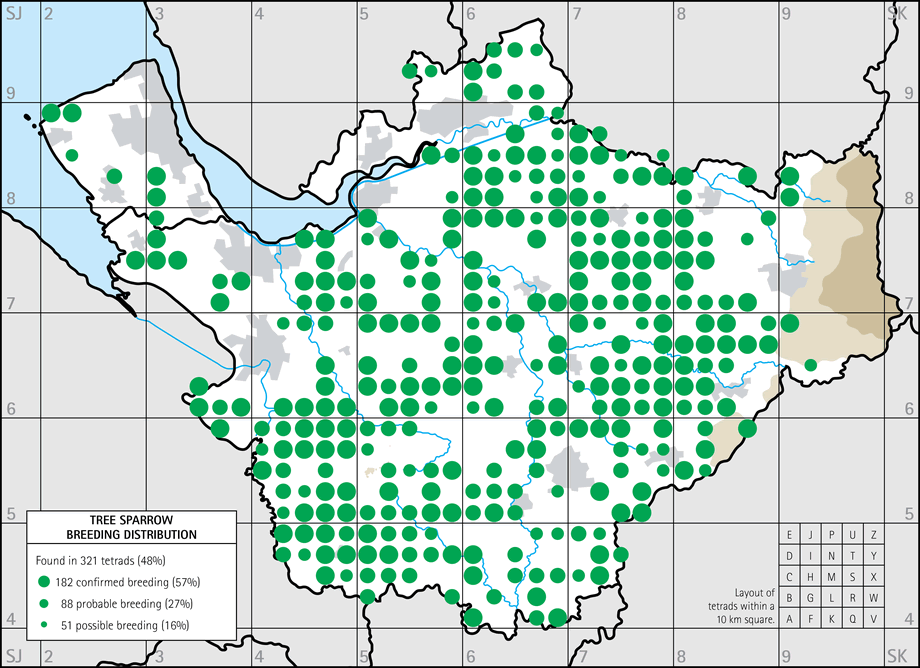
The breeding population estimate for Cheshire and Wirral in 2004-05 from the BBS analysis is 4,350 (2,100-6,600) individuals. Although probably not as scarce in the county as many observers had feared, it must be remembered that just a quarter of a century ago they were probably amongst the top ten commonest birds in Cheshire. This figure gives an average of around 7 pairs per occupied tetrad, but this is a misleading way to express the density of a colonial species with such a clumped distribution. In practice it might mean, on average, one colony per tetrad.
This is predominantly the rural sparrow, and the habitat records show that Tree Sparrows were mainly found in farmland (64% of records), with 26% in human sites, nearly all rural, and 6% woodland and 3% scrub. The map shows that its distribution in the county is now almost defined by avoidance of built-up areas and the highest ground. Our First Atlas noted that they were absent from urban areas and scarce (but present in almost all tetrads) in the eastern hills. The present survey shows that Tree Sparrows have withdrawn from suburban areas as well, with a very local distribution on Wirral, and are now missing from the hill country.
Atlas account sponsored by Alan and Judith Straw
Winter
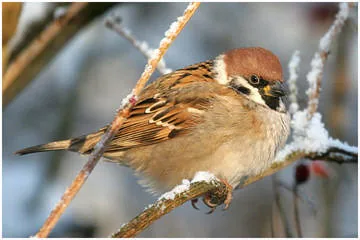
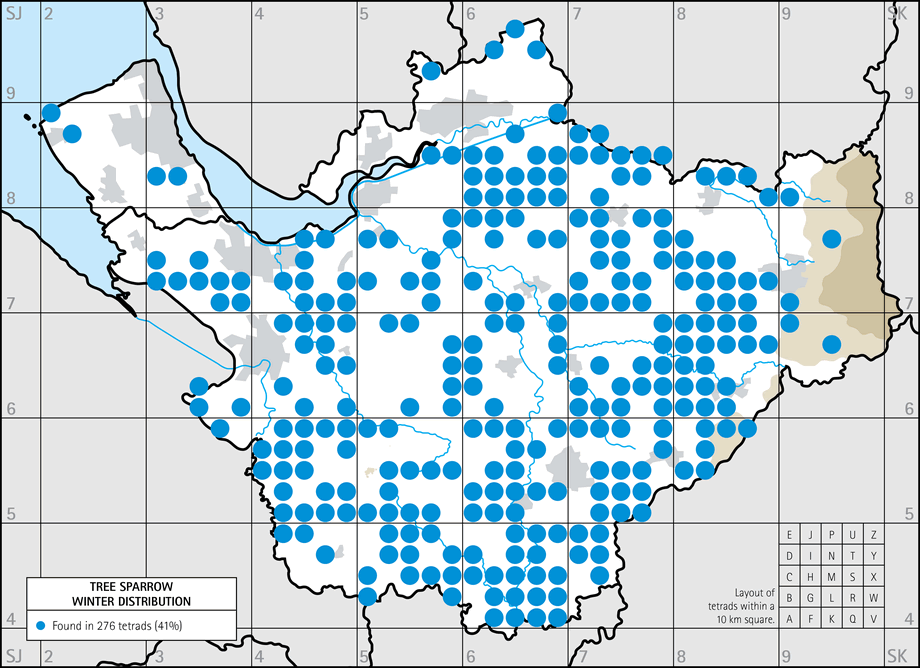
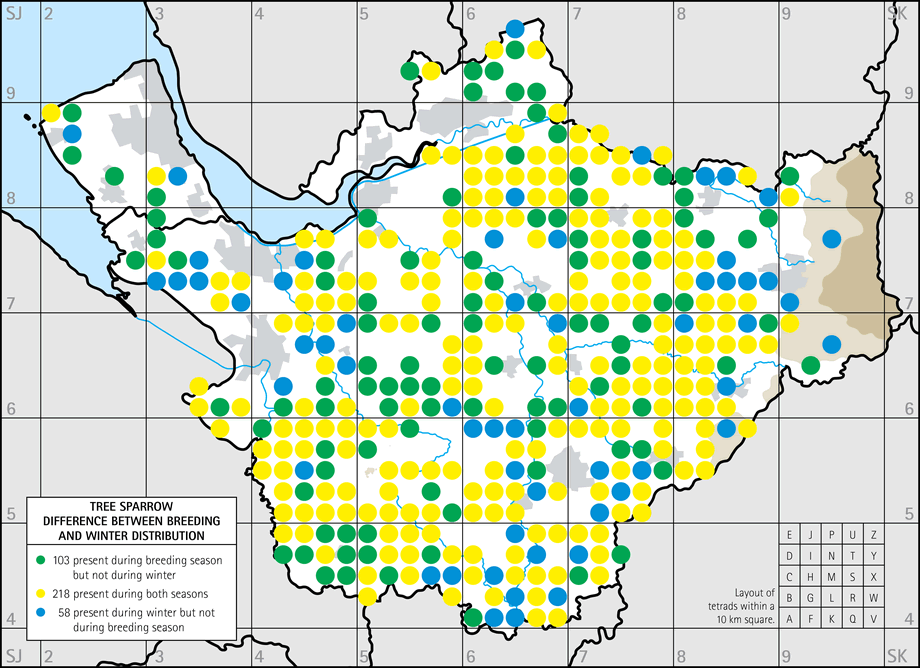
Most adult Tree Sparrows are sedentary, whilst the young birds disperse, avoiding inbreeding by moving a few km. There is a small reduction in the number of tetrads occupied from the breeding season to winter – 321 to 276 – which could be attributed to some birds deserting their breeding areas in the formation of winter flocks. 103 tetrads had birds in the breeding season but not in winter, with 58 where they were found in winter only. There is no significant change in habitat codes recorded between breeding and winter seasons, with 66% of winter records from farmland and 30% from human sites (overwhelmingly rural), and a handful from woodland and scrub.
All of them seem to join winter flocks, from a few to several hundred birds in size. Half of the reported groups in this winter Atlas were of five birds or fewer while there were seven three-figure flocks, all in the south of the county. The largest, estimated at 300 birds in 2005/ 06 and 200 birds in 2006/ 07, fed on strips of setaside and stubble in the area north of Combermere, covering four adjacent tetrads (SJ54X/ Y/ SJ64C/ D). A flock of 220 birds spent the winter of 2005/ 06 feeding on stubble and game cover including quinoa at Warmingham (SJ76A). Nationally, a major decline – a drop by a factor of three – has been noted in the sizes of winter flocks recorded in 1980-95 compared to 1965-79 (Shrubb (2003)).
It is hard to deduce their former status in Cheshire and Wirral. Previous Cheshire ornithologists wrote little about Tree Sparrows in winter, but Coward and Oldham (1910) commented that they were frequently seen in farmyards or by the roadside in company with House Sparrows, Chaffinches and Yellowhammers. Perhaps the annual county bird reports tell a story. In the 1960s the species was ignored, along with all others that were thought to be common; the reports from 1975 to 1977 list a few large flocks, up to several hundred strong; but by 1982 there were ‘few large flocks noted’ and in 1983 all flocks larger than 20 birds were listed (CWBRs).
Although Tree Sparrows join feeding flocks of other seed-eaters, they tend to stay close to hedges or other suitable cover, and hedgeless fields and the centres of large fields are left to the finches and buntings. Undisturbed flocks frequently move in waves, the birds at the back of the flock flying forward to take up position at the front. They feed in bouts, gorging themselves then retreating to cover where they preen and digest their food.
Tree Sparrows eat some farmland grain, but much less than House Sparrows do: they tend to specialise on smaller seeds such as grasses and annual weeds such as goosefoot and chickweed. They also like oil-rich seeds including sunflowers and rape. In extensive areas of planted wildbird seed crops on farmland near Broxton, I have found that Tree Sparrows ignore the areas dominated by kale and triticale and only frequent plots containing quinoa and millet: birds caught for ringing have had their crops full of these small seeds. However, observations elsewhere (Perkins et al 2007) have found different results, the authors commenting that ‘For species with a diverse diet, such as Tree Sparrow, food preference may vary between populations in different locations, due to learned behaviour and adaptation to locally abundant seed types.’
They form communal roosts, especially in thick hedgerows, but in hard weather many birds roost in holes, perhaps those that have been, or will become, their nesting site. Just four roosts were reported from Atlas fieldwork, in adjacent tetrads near Buerton (SJ64V and W), and near Weston (SJ75F and K).
Atlas account sponsored by Alan and Judith Straw