
Sandbach Flashes: birds and wildlife
About the Atlas
During the three breeding seasons 2004–06 and three winters 2004/05–2006/07, Cheshire and Wirral Ornithological Society (CAWOS) organised more than 350 volunteers to survey all of the county, trying to find every species of bird that was breeding or wintering
Twite Carduelis flavirostris
Breeding
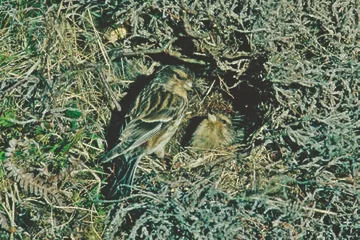
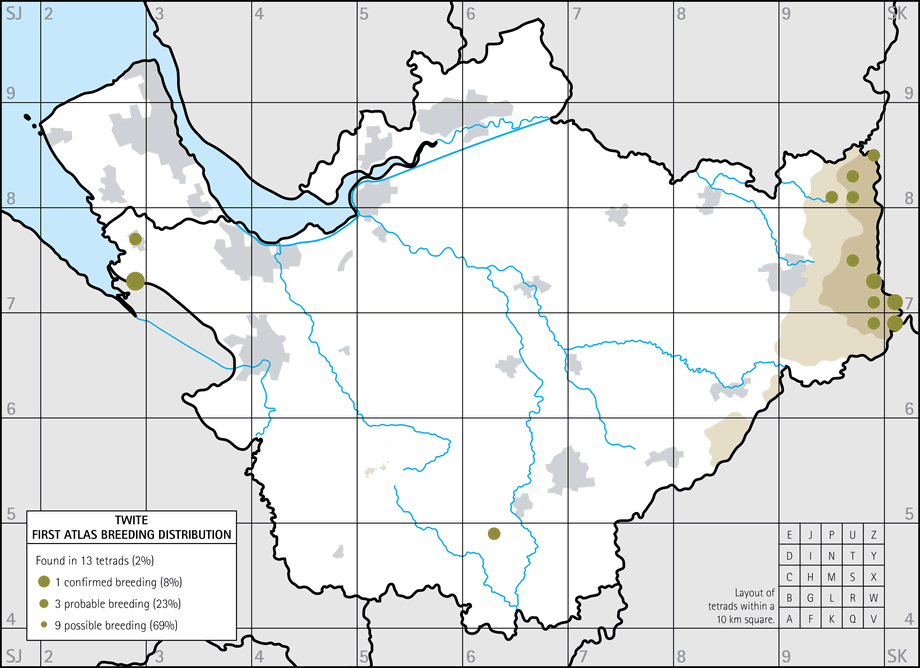
There were no records of Twite during the breeding season in this survey, but they bred during our First Atlas, in two different habitats at the lowest and highest points of the county. In 1978-84, Twites were recorded in 13 tetrads, 1 with confirmed breeding, 3 probable and 9 possible. Most of the birds were in the moorland of the eastern hills. Records from this area continued to be submitted to the annual bird reports, with the largest count in 1989 with evidence of ‘a possible ten pairs on the Cheshire side of the eastern hills’. After that year, however, only sporadic breeding season records were received, with none from 1991 to 1993, odd records in 1994 and 1995, none in 1996, and one singing bird in 1997. Following two years of absence in 1998 and 1999, it was thought that a pair at Shining Tor on 13 July 2000 ‘may have bred locally’. If they did, they were the last known breeders in the county.
Twite also used to nest alongside the estuaries. In the mid-1970s there were confirmed breeding records at New Ferry and possible breeding at Frodsham, but there has been no summer record from the Mersey for thirty years. On the Dee saltmarsh, a nest was found in 1967, then a pair seen feeding small young in 1979, the origin of the confirmed breeding record during our First Atlas. An adult was seen there on 22 June 1980, but there has been no subsequent record.
As a Red-listed species of conservation concern, the Twite’s ecology has come in for detailed study in recent years. The breeding season lasts from early May to late July, allowing up to three broods in favourable conditions. They breed at quite low densities, from 2 to 14 pairs per tetrad, in open moorland, nesting in tall heather and bracken, but get most of their food from pastures and meadows, possibly as far as 3 km away, flying to and fro on well-defined flight lines when feeding young. As with other cardueline finches, they eat small seeds such as dandelion and sorrel, storing food in their crops to be regurgitated for the chicks (Brown & Grice 2005).
Their extinction in Cheshire is just part of a wider population decline. Surveys of the South Pennines Moors SPA, including the Cheshire moors, showed an 84% drop between 1990 and 2004-05 in the breeding population of Twites (Eaton et al 2007). The reasons for their demise are not well established, however. Overgrazing by sheep and bracken removal have reduced the area of suitable nesting habitat, and their food supply has greatly diminished as many pastures are overstocked or cut early for silage, so flowers rarely set seed. Even roadside verges, potentially a rich source of seeds, are often cut in the name of ‘tidiness’ (Brown & Grice 2005). Even without these symptoms of modern countryside management, Twites are northern breeding birds of cool, wet places and climate change will make English moorlands even less hospitable for them: they are likely to be lost from England later this century (Huntley et al 2007).
Atlas account sponsored by Richard Gabb
Winter
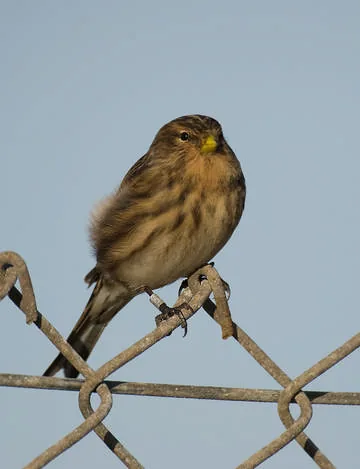
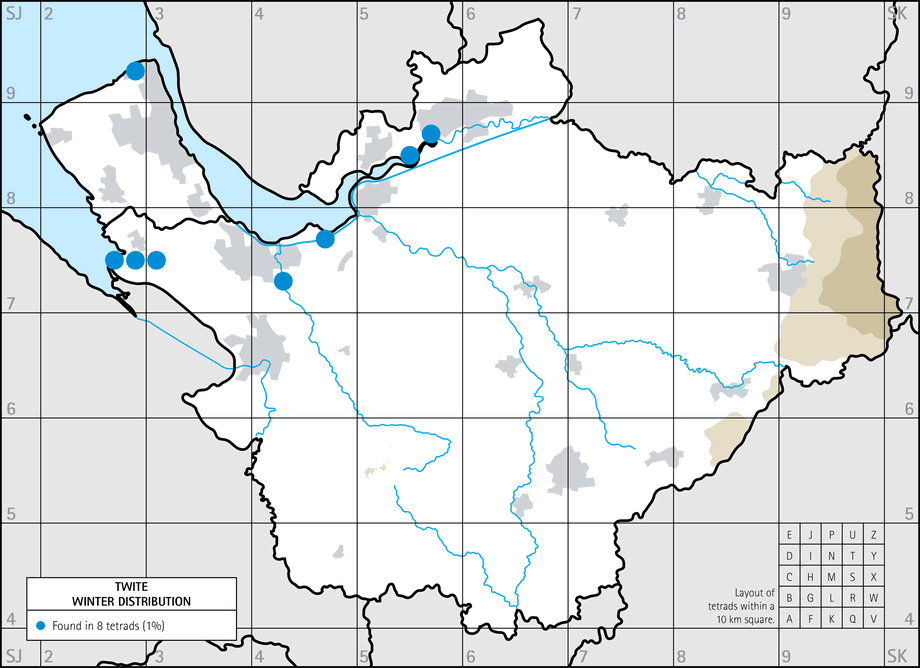
In winter, Twites flock on seed-rich estuarine saltmarshes and other weedy lowland coastal areas. Those breeding in the Pennines move south-east to winter on the English east coast, and sometimes reach the Netherlands (Migration Atlas). Contrary to the statement in the BTO Migration Atlas, the Twites wintering on the coasts of Lancashire and Cumbria are now known to have bred in the Hebrides and western Scotland. The source of the birds in Cheshire and Wirral has not been proven, but they are also likely to be of Hebridean stock. Up to half a million pairs breed in Norway, and some of them are thought to winter in Britain. Many Twites have been colour-marked in recent years, so careful observation, or a programme of ringing, could establish the origins of the county’s birds.
During the three years of this winter Atlas the Dee saltmarsh tetrads yielded counts of 10, 20 and 45; and up to 35 opportunistically fed on football fields in Wallasey after westerly gales for a few days in January 2005. A flock of 13 was counted on stubble in SJ47G and birds were recorded in all three winters in the inner Mersey tetrads, with counts up to a maximum of 30. By far the largest flock was on rough grassland on 10 December 2006 near Frodsham in SJ47T.
This is a fairly typical showing for recent years, and indeed is probably quite similar to their status to any time in the last century. Coward (1910) said that Twites were ‘… in winter occasionally to be seen in the Dee estuary’, and Boyd never mentions the species in his Country Diary or Country Parish books. Bell (1962) suggested that it was under-recorded as there had been no report at any season for twelve years up to 1949. However, on the Dee estuary since winter 1956-57 flocks up to 200 strong began to appear in each winter, with just odd birds elsewhere in the county. Since then, there have been major fluctuations in their occurrence and numbers, with the Dee being the most likely location but with some periods of several years with none or only a few present.
Atlas account sponsored by Richard Gabb