
Sandbach Flashes: birds and wildlife

About the Atlas
During the three breeding seasons 2004–06 and three winters 2004/05–2006/07, Cheshire and Wirral Ornithological Society (CAWOS) organised more than 350 volunteers to survey all of the county, trying to find every species of bird that was breeding or wintering
Water Pipit Anthus spinoletta
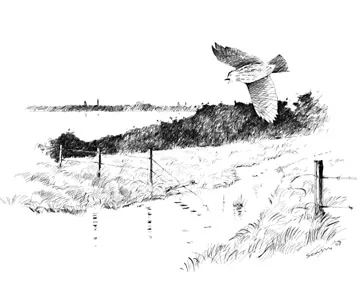
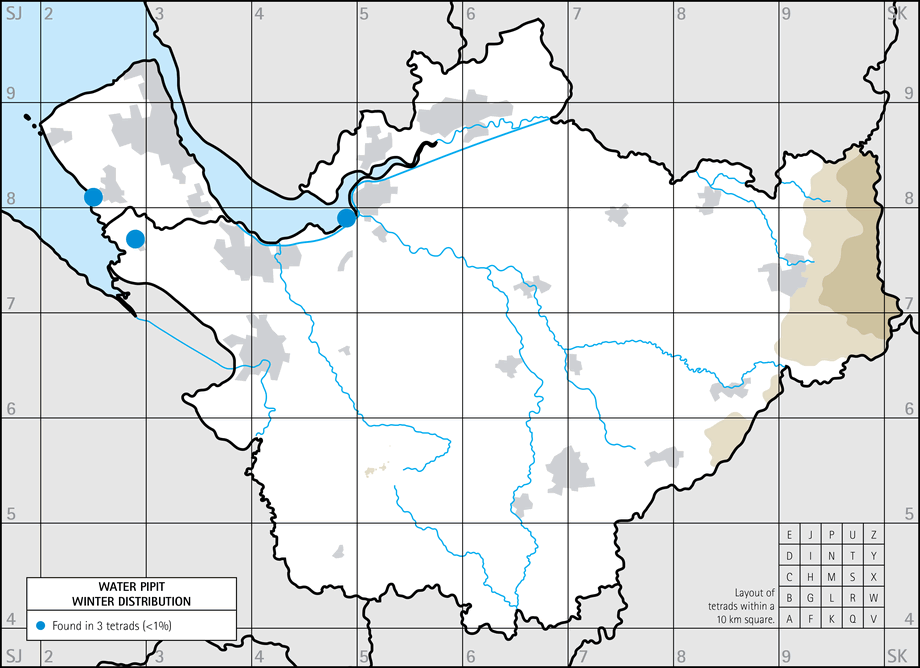
The county’s first Water Pipits were found in breeding plumage by distinguished ornithologists – H.G. Alexander on the Dee marshes near Parkgate on 21 March 1937, and A.W. Boyd at Barmere on 3 April 1939 – but winter records have been clouded by changing taxonomy and identification criteria. There were three tetrads with records in this Atlas: up to 3 birds at Neston Old Quay (SJ27Y) on three dates 3 January to 7 February 2005, and one there on 7 January 2007; one on Heswall shore (SJ28K)on 21 January 2006, and one bird at Frodsham Marsh (SJ47Z) on 12 February 2005.
It is most likely that our wintering birds come from breeding areas in the central European mountains; these are deserted in winter as Water Pipits move in all directions, including north, to low-lying land. ‘Favoured habitats include … sewage treatment works, rivers, lakes and flooded gravel pits, lowland wet grasslands and coastal fresh and brackish lagoons’ (Brown & Grice 2005) ‘Since Water Pipit is only exceptionally found in typical Rock Pipit habitat, the habitat separation between Rock Pipit and Water Pipit is almost complete’ (Alström & Mild 2003). The birds found on the Dee saltmarsh are exceptional and have not read the books.
Atlas account sponsored by Jane Turner