
Sandbach Flashes: birds and wildlife
About the Atlas
During the three breeding seasons 2004–06 and three winters 2004/05–2006/07, Cheshire and Wirral Ornithological Society (CAWOS) organised more than 350 volunteers to survey all of the county, trying to find every species of bird that was breeding or wintering
Water Rail Rallus aquaticus
Breeding
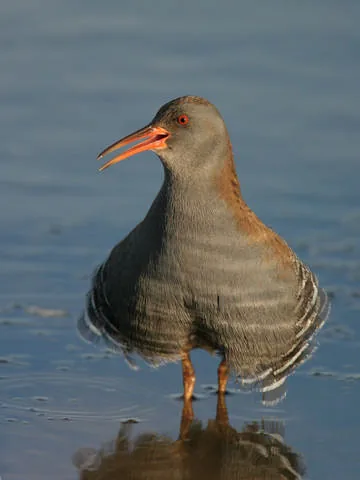
This elusive species is seldom seen and birds were most often detected by sound, especially at night when their weird collection of calls – some apparently borrowed from pigs and steam trains – can be heard from a long distance. Fieldworkers found birds in all types of standing water, from small ponds to large meres, and in all of the damp categories of semi-natural grassland, with most recorded in areas of rushes, sedges and phragmites reeds. A detailed study of the species’ habitat preferences found that they were significantly more abundant in areas of phragmites in standing water (Jenkins & Ormerod 2002),
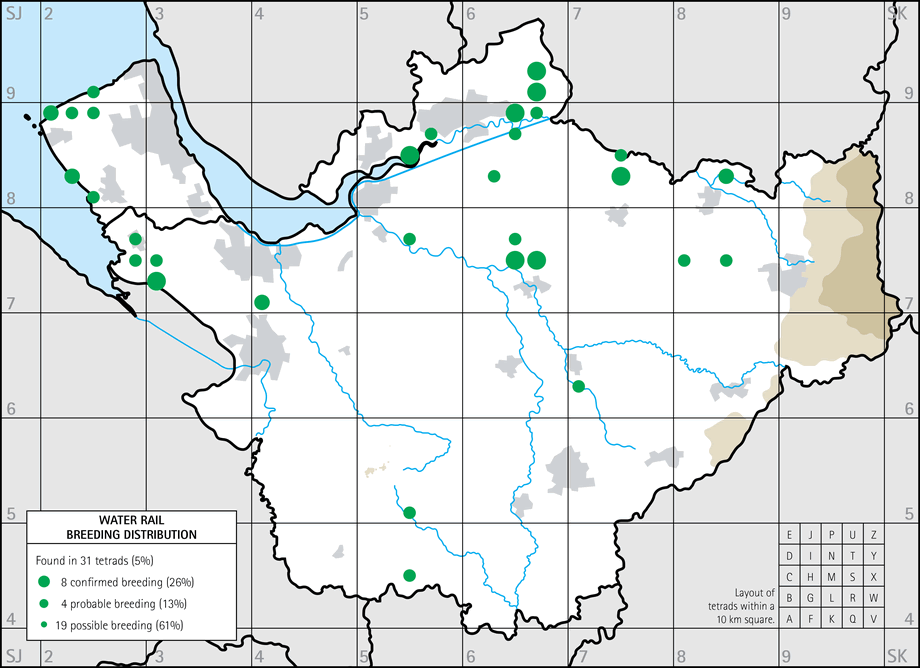
Water Rails were proven to breed in eight tetrads, more than ever before in the county. In all of these cases, observers saw adults with chicks: they have been reported from early May to August, presumably indicating two broods. All of the definite or probable breeding tetrads were towards the north of the county, and the sites at which breeding was confirmed read like a roll call of the county’s main wetlands: Woolston Eyes, Risley Moss, Rostherne Mere, Fiddler’s Ferry (the first breeding there) and Neumann’s Flash. Water Rails have colonised the north Wirral since our First Atlas, with alarm calls heard in 2004 and 2005 from birds in Red Rocks Marsh (SJ28E) where they were first proven to breed in 2001. The species has not been recorded in the east of Cheshire since they favour the eutrophic lowland waters. They mainly eat aquatic invertebrates but will also take vegetable matter and occasionally fish and amphibians.
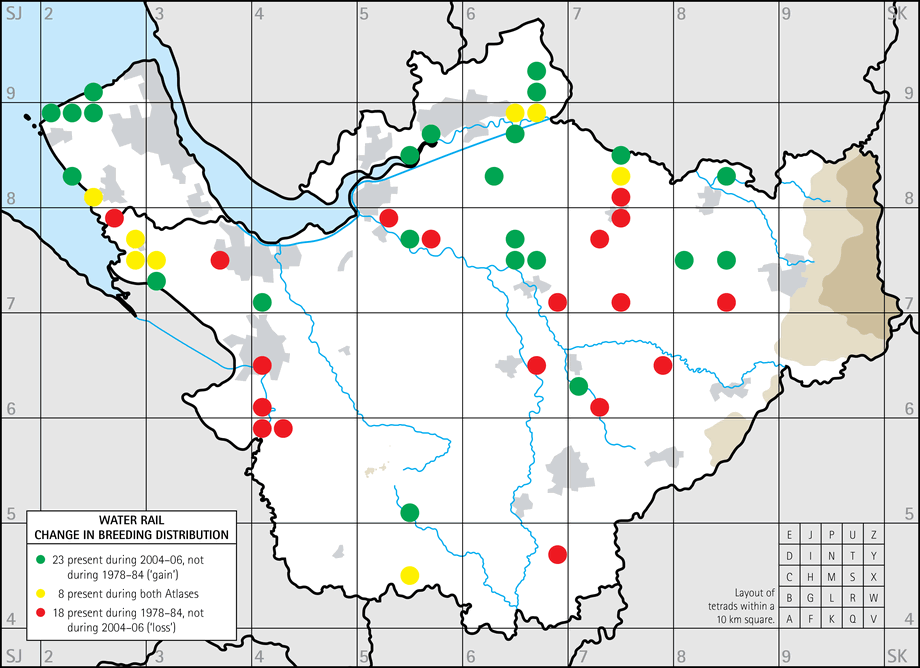
Water Rails were reported in 31 tetrads during the three years, with breeding confirmed in eight and probable, through recording of pairs, display or alarm calls, in a further four. Nineteen tetrads were logged with possible breeding through observers seeing individuals or hearing breeding calls. Eight of the tetrads had also had breeding season records during our First Atlas, with ‘gains’ in 23 tetrads and ‘losses’ from 18. Work elsewhere has shown that thorough surveying of areas of suitable habitat, including playback of the birds’ calls (Jenkins & Ormerod 2002), usually reveals many more birds than were previously suspected. At least nine pairs and two single birds were found in 2002 in an RSPB census of phragmites/ scirpus/ juncus/ typha reedbeds at Neston, Burton Point and Inner Marsh Farm (Wells 2002). The breeding population of Cheshire and Wirral is likely to be at least twenty pairs.
The national total is unknown, but Brown and Grice (2005) suggest a figure for England probably in excess of 1,000 pairs. Water Rail has now (2007) been added to the list of species monitored by the UK Rare Breeding Birds Panel because of its perceived scarcity. There has been some concern over the species’ status and conservation, causing it to be placed on the Amber List, not least because their breeding range contracted significantly between the two national atlases (1968-72 and 1988-91).
Atlas account sponsored by Marc Granville
Winter
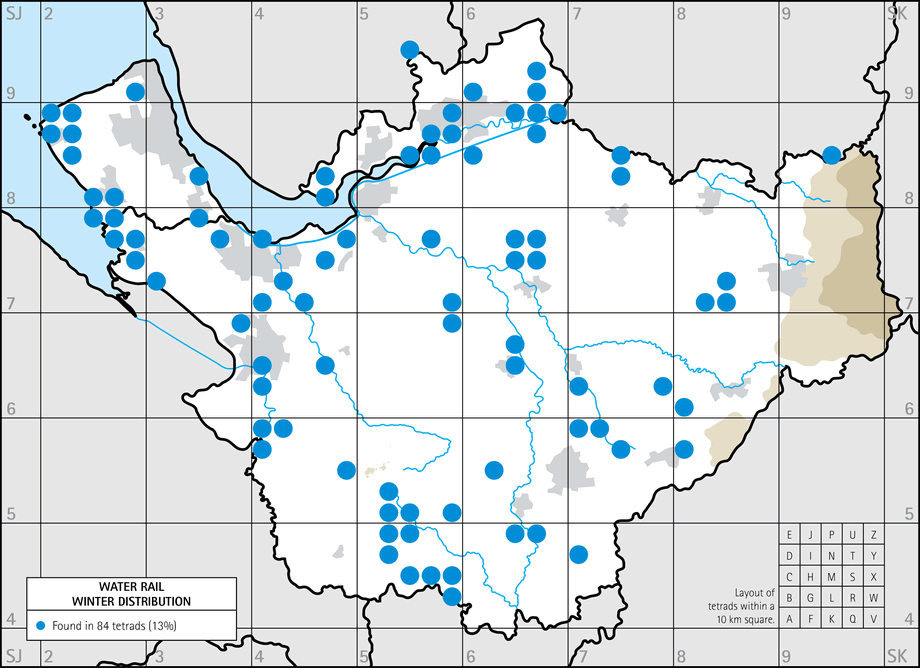
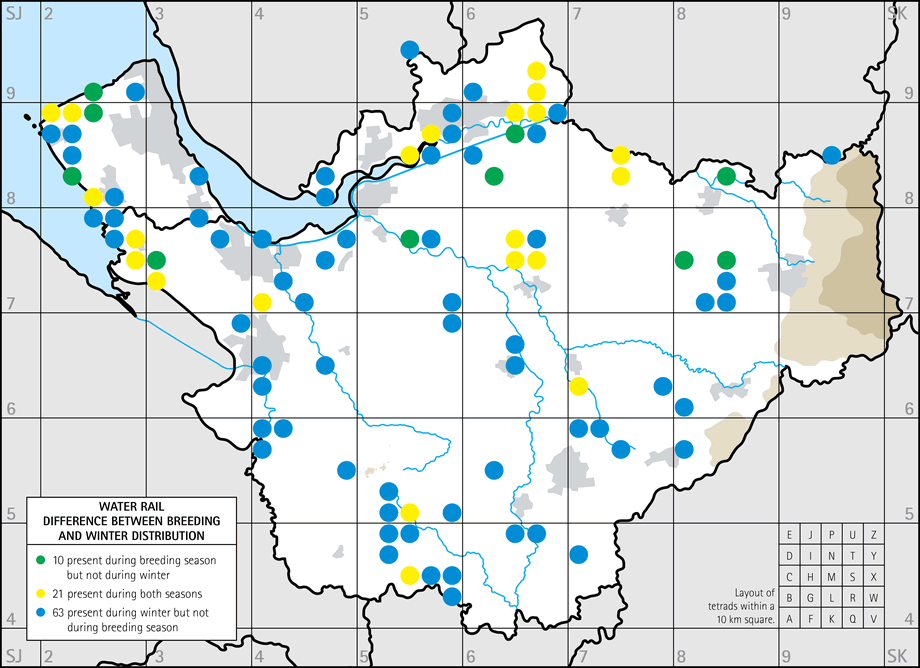
Water Rails are much more numerous in winter, when resident birds are joined by immigrants from northern and northeastern Europe, especially Germany and Denmark (Migration Atlas). As is illustrated by the preponderance of blue dots in the ‘difference’ map, showing the differences between tetrads occupied in the breeding and winter seasons, Water Rails become much more widespread in winter. The species occurred in both seasons in 21 tetrads, was found in ten during the breeding season but not in winter, but was recorded in 63 tetrads during winter only. Despite this impressive total, Water Rails may be under-recorded as they can be difficult to detect and are usually silent in winter.
Because they can be hard to find elsewhere, it has long been traditional for birdwatchers to travel to Parkgate to see Water Rails flushed from the saltmarsh by high tides, although sometimes they have to be alert if they wish to see the rails alive; for instance, eight were simultaneously being eaten by Grey Herons in February 1974, and ten were seen there on 11 January 1997, of which seven were killed and eaten by Great Black-backed Gulls. Numbers in the Dee saltmarshes have much reduced from the 140 counted in February 1974, perhaps a result of warmer winters making inland freshwaters more suitable. Sixteen has been the maximum recorded on a WeBS count there this decade, with 30 birds the highest Dee count on any winter day during this three-year Atlas, in SJ27U in 2006/ 07.
Such congregations are unusual, with the Dee flock nationally renowned, and normally Water Rails are solitary or only loosely gregarious during the winter months (BTO Winter Atlas): half of the submitted records for this Atlas were of single birds only. The total of eleven birds, counted in overgrown ditches near West Kirby (SJ28I) in 2004/ 05, was exceptional, with figures of six at Woolston and five at Rostherne the next highest inland counts. There are usually far more birds present than are seen, however, as illustrated by the total of 17 birds trapped by ringers at Woolston during winter 2001/ 02. An idea of the density attainable is shown by the finding of seven Water Rails using a small Welsh reedbed only 0.5 ha in extent, birds maintaining loose winter territories within the site (Jenkins et al 1995). Their winter diet is much the same as in the breeding season: aquatic invertebrates from insects and larvae to shrimps and molluscs; any animals that they encounter, including frogs and newts; plus some vegetable matter, especially the nutritious roots and rhizomes. When food is hard to find, they turn to carrion and killing their own prey, including small mammals and birds. Birds leave inland waters if they freeze over, but are likely to return to the site, even to the same part of the water, when it thaws (Jenkins et al 1995).
Compared to the breeding season, Water Rails were much more likely to be found on larger waters, 21 of the 46 records on freshwater being on lakes, meres and reservoirs, with only ten on small waterbodies or ponds; 15 were on the flowing water of rivers, streams and ditches and none on canals. By far the most commonly recorded habitat code was C7 – reed swamp.
Coward (1910) wrote that more were seen in winter than summer, but he wondered how much of this was due to its skulking habits rather than to any increase in numbers. Bell (1962) recognised that many wintering birds were likely to be immigrants, and said that it was seen and heard not only in the reedbeds around the meres, but was a regular visitor to suitable habitats both in the Dee and Mersey estuaries. There were just two records of single birds on the Mersey during this Atlas.
Atlas account sponsored by Marc Granville