
Sandbach Flashes: birds and wildlife
About the Atlas
During the three breeding seasons 2004–06 and three winters 2004/05–2006/07, Cheshire and Wirral Ornithological Society (CAWOS) organised more than 350 volunteers to survey all of the county, trying to find every species of bird that was breeding or wintering
Wigeon Anas penelope
Breeding
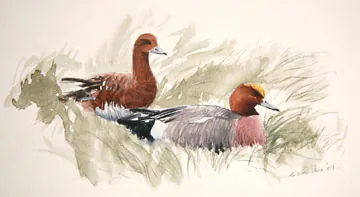
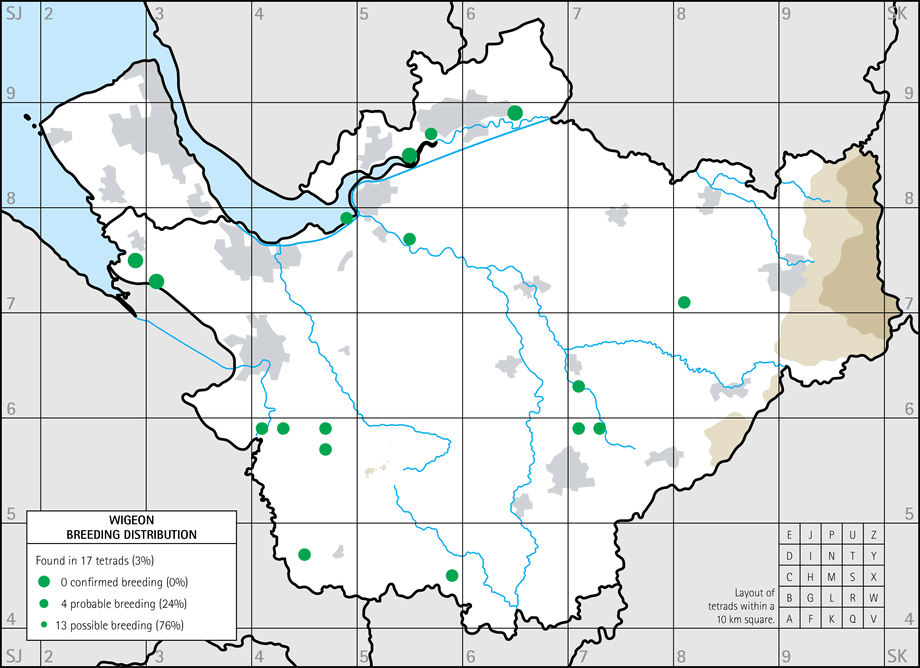
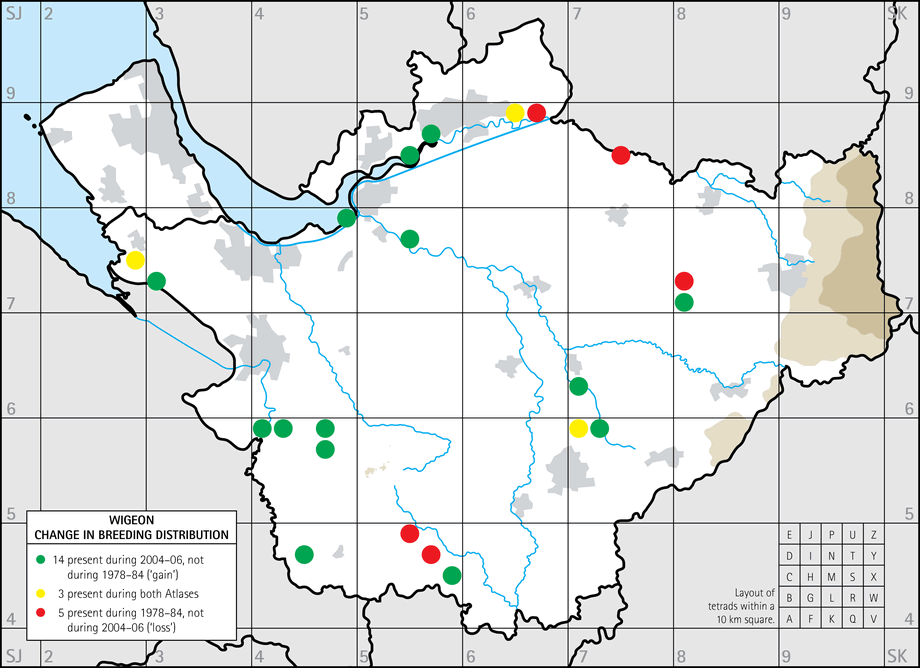
There is no evidence that Wigeon has ever bred in the wild in Cheshire and Wirral, and the records in this Atlas survey were typical of those in many other years. Single birds were present in the breeding season at a number of sites, with some waters holding several birds. Of course, any sighting of a lone male duck in the breeding season should be followed up in case he has a nesting female hidden away, but none of them gave any hint of that. This vegetarian species is the wildfowlers’ favourite, and a few summering Wigeons over the years are birds with ‘pricked’ wings, unable to fly well enough to migrate. Four tetrads had records of pairs in suitable breeding habitat, including birds displaying at Inner Marsh Farm (SJ37B), all counting as ‘probable breeding’, but nowhere has a nest ever been found or chicks seen.
This story is typical of most counties in Britain. Wigeon is a scarce enough breeding bird for its fortunes to be monitored by the Rare Breeding Birds Panel, and their report for 2004 shows that birds were summering in many counties, and pairs often present, but there were only 20 pairs confirmed breeding in England, in Essex (1 pair), Northumberland (4 pairs) and Yorkshire (15 pairs) (Holling et al 2007).
Atlas account sponsored by Dr Bill Bellamy
Winter
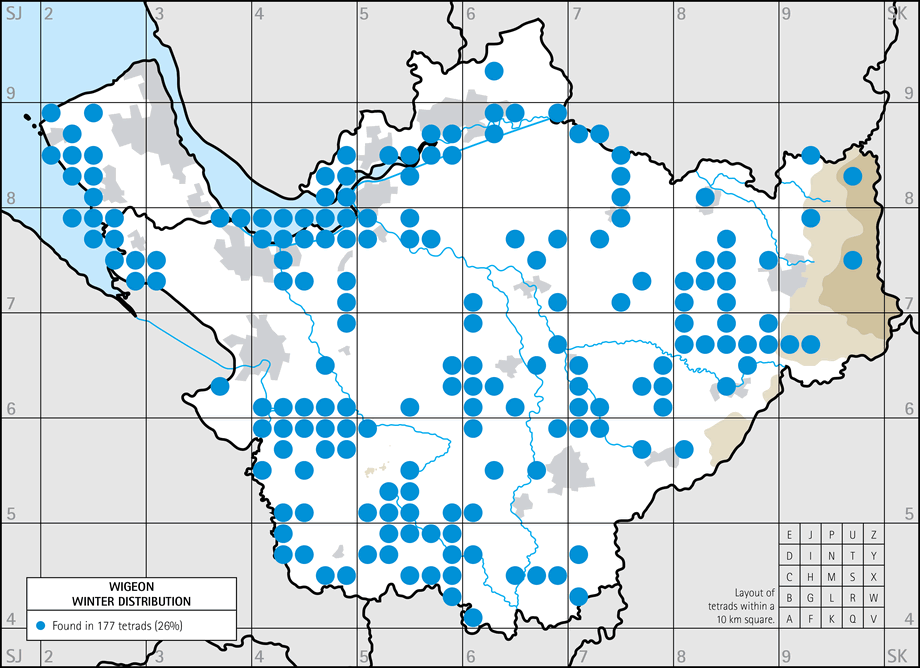
Wigeon were present in winter in 177 tetrads, just over one-quarter of the county. Coward would be surprised to see these figures, and this distribution map. Until the 1940s the great majority of the country’s Wigeon was found feeding in intertidal areas, but then switched so that they now obtain most food from freshwater habitats. In 1910, Coward noted that ‘during the winter months great numbers of Wigeon frequent the estuaries, and although the bird is less common inland it frequently visits the meres’. He gave no numbers for the estuaries but mentioned 50 to 60 birds on Rostherne Mere, 11 December 1908, implying that this is a large flock there. By Bell’s time, Wigeon preferred the Mersey to the Dee, with the peak counts over 3,000 at Ince in January 1956 and February 1957, while the highest count on the Dee was 1,400 on 22 Nov 1959. It was also a regular visitor to many inland localities, among its main haunts being Rostherne, with a maximum count in the 1950s of 200 birds, Tatton (160), Combermere (370) and Doddington (150) (Bell 1962).
Wigeon come to Britain from breeding grounds in Iceland, Fennoscandia and Russia to at least 90ºE; probably many of those in Cheshire and Wirral are from Iceland (Owen & Mitchell 1988). Overwhelmingly the most important site in Britain is the Ribble Estuary, with around 80,000 birds, and there may well be interchange with the Dee and Mersey. The Mersey estuary used to be internationally important for the species but numbers have dropped rapidly from 9,150 in winter 2001/ 02 to only around 2,000 two years later, and continuing at that level during this Atlas period. In 2005/ 06 the five-year peak mean for the Mersey dropped below the 4,060 threshold for national importance. The Dee estuary maintains its nationally important status with a long-term average of around 4,700, although numbers there have fluctuated greatly, for instance from 2,464 in 2004/ 05 to 6,695 in the following winter.
Away from the estuaries, Wigeon can be found on almost all waterbodies although they are seldom recorded on the upland waters. The largest flocks reported during this Atlas were 800 on the Dee flood meadows near Worthenbury (SJ44I); 700 at Sandbach flashes (SJ75J); 550 grazing in a field at Handley (SJ45T); and 500 loafing on Frodsham Marsh (SJ47Z). As many as 40 tetrads had flocks of 100 or more, but the median flock size across all occupied tetrads is just 35. Males usually noticeably outnumber females in these flocks, and it would be an interesting exercise to quantify that statement.
Wigeon need to forage for about 14 hours a day to maintain condition during winter, so they feed day and night (Brown & Grice 2005). They are predominantly grazers and estuarine birds feed especially on the saltmarsh, eating copious amounts of the grass Puccinellia maritima. On the Mersey estuary, in recent years they have turned to eating seeds by day, much the same as Teal, and grazing by night. At inland sites they feed on any suitable short-cropped grass in areas with an open aspect and no trees nearby, including agricultural grassland, often around marl pits and field ponds, as well as the edges of meres and other waters. As a grazing bird, Wigeons behave more like geese than other ducks, and in inland sites are often in association with flocks of Canada and Greylag Geese.
The submitted habitat codes show these preferences, although there are far more records from aquatic than grassland habitats, presumably reflecting their preference for loafing on water by day and feeding at night when fieldworkers were seldom present. The inland habitats recorded include 11 records of wet semi-natural grassland (water-meadow/ grazing marsh or reed swamp) and 14 on agricultural improved grassland, with birds on any size of standing water: 10 on ponds smaller than 50 m2, 43 on small water-bodies, 76 on lakes, reservoirs and sandpits. Only four records came from linear watercourses, with only small numbers apart from on the upper river Mersey.
Atlas account sponsored by Dr Bill Bellamy