
Sandbach Flashes: birds and wildlife

About the Atlas
During the three breeding seasons 2004–06 and three winters 2004/05–2006/07, Cheshire and Wirral Ornithological Society (CAWOS) organised more than 350 volunteers to survey all of the county, trying to find every species of bird that was breeding or wintering
Willow Warbler Phylloscopus trochilus
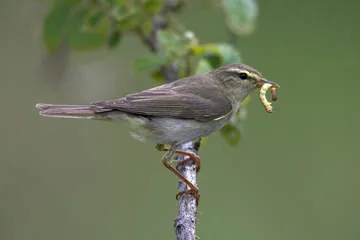
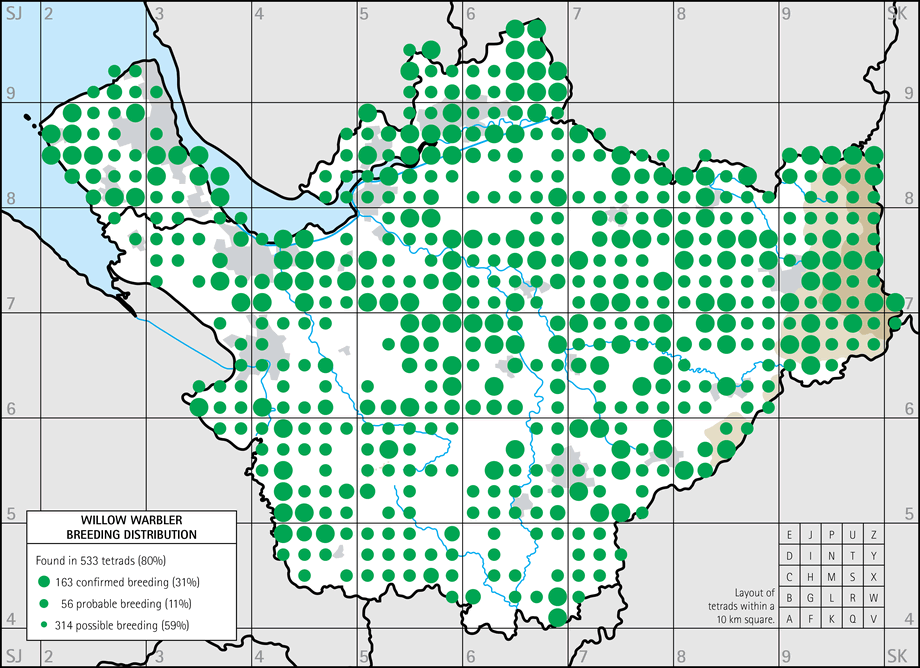
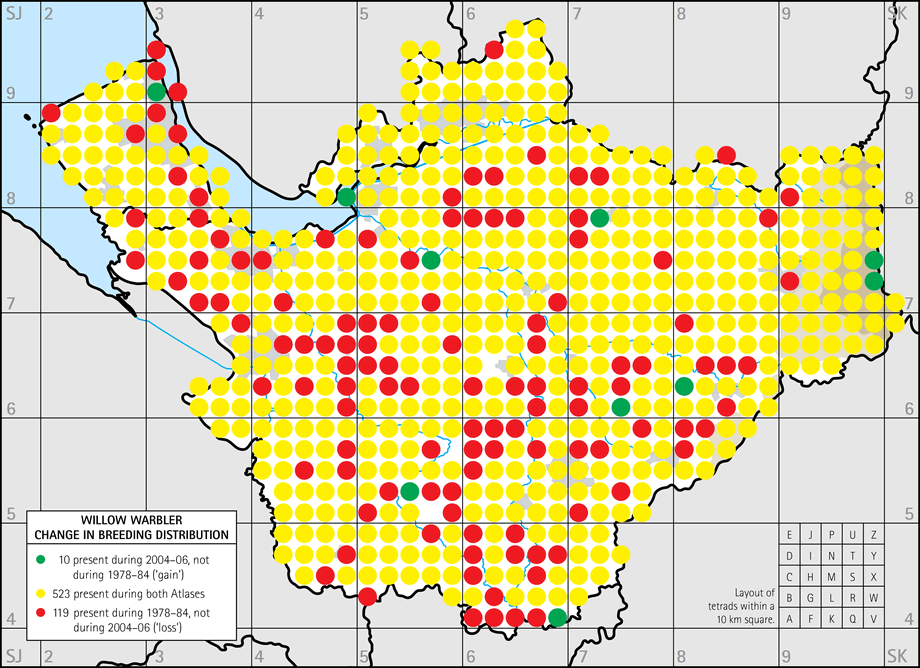
The cheering song of the Willow Warbler – sure to raise the spirits of any birdwatcher – is heard much less frequently nowadays, and the ‘change’ map is depressingly red. The species has dropped from having been the second most widespread summer visitor in the First Atlas to rank sixth now. Twenty years ago it was by a long way the most widespread warbler, found in 96% of tetrads, yet has now been overtaken in ubiquity by Chiffchaff, Blackcap and Whitethroat, having been lost from 119 tetrads, and gained in just ten. The drop in the county is probably even worse than is suggested by the ‘change’ map because so many tetrads in this Atlas recorded ‘possible’ breeding only. At many sites now it seems that a male Willow Warbler will sing for a while, fail to find a mate and then move on. In our First Atlas almost three-quarters of the tetrads in the county recorded confirmed breeding, by far the highest proportion of any warbler, and some people consider this one of the easiest species in which to get a two-letter code. The authors of the First Atlas suggested a county population, just twenty years previously, of perhaps 18,000 pairs. The BTO analysis of Cheshire and Wirral BBS gives a county breeding season population in 2005 of 4,120 (1,960-6,320) Willow Warblers.
Willow Warblers have undergone a major decline nationally. They were at their peak in England in 1984, at the end of our First Atlas, and the population indices slumped by 62% in the next twenty years, placing them on the Amber List of species of conservation concern. Their decline occurred mainly in the south of Britain, accompanied by a fall in survival rates (Peach et al. 1995a), with Scottish populations remaining unaffected. Results from a local study agree with the larger scale picture, with return rates of birds at Woolston dropping after 1984, perhaps linked to a deterioration in habitat quality such that the area continued to be occupied, but birds were not faithful to the site from year to year, and perhaps indicating a real decline in the year-to-year survival of the species, coinciding with the national drop in population from 1985 onwards (Norman 2005). With the ‘national’ decline in Willow Warblers apparently occurring mainly in the south of the UK, in this example of a ‘north-south divide’, Cheshire is definitely in the south!
This is the Phylloscopus warbler of the pioneer scrub, young woodland and sparsely wooded areas dominated by small-leaved deciduous trees like birch, alder and willow. The abundance map shows the highest densities in the scrubby unwooded areas of the eastern hills and north of the Mersey. The habitat codes recorded in this survey show 44% woodland, 32% scrub, 11% farmland and 9% human sites. The fact that there are more woodland than scrub records probably reflects just the availability of these types of habitat rather than the species’ preference; Willow Warblers clocked up more B1 (regenerating natural or semi-natural woodland) records than any other species except Whitethroat.
Atlas account sponsored by Paul Bebbington