
Sandbach Flashes: birds and wildlife

About the Atlas
During the three breeding seasons 2004–06 and three winters 2004/05–2006/07, Cheshire and Wirral Ornithological Society (CAWOS) organised more than 350 volunteers to survey all of the county, trying to find every species of bird that was breeding or wintering
Woodpigeon Columba palumbus
Breeding
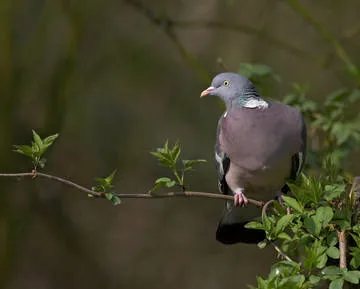
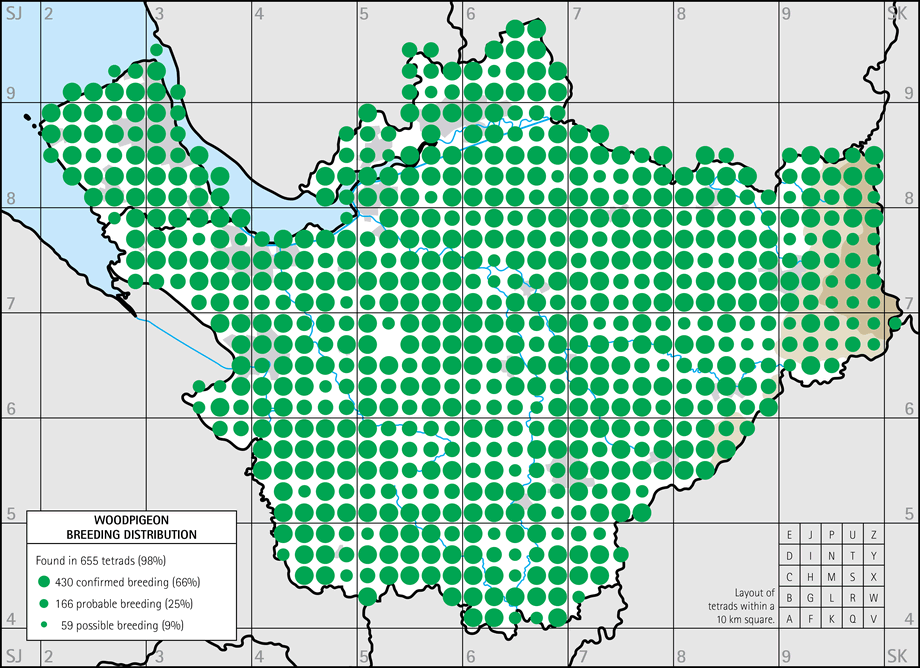
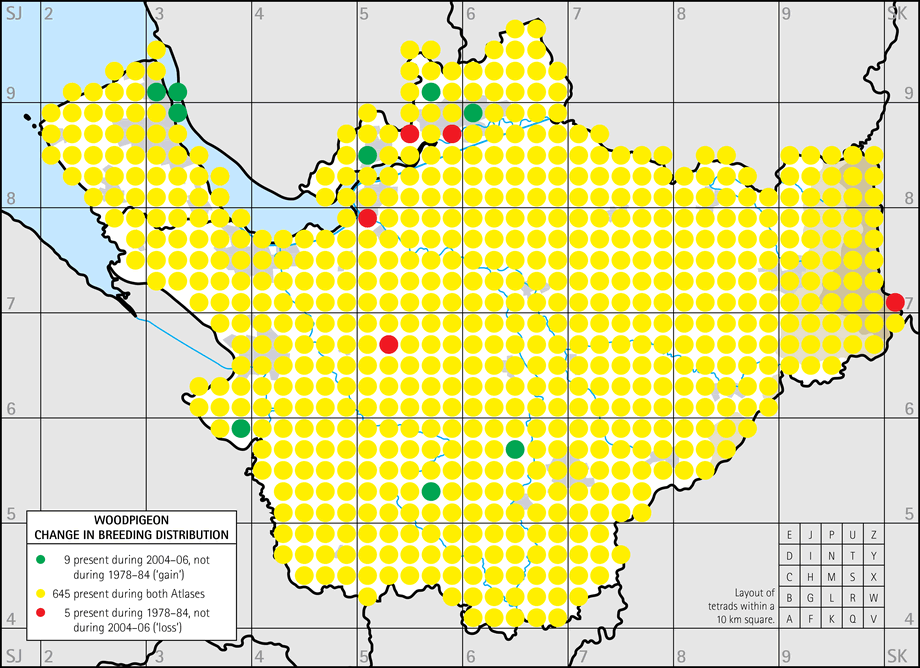
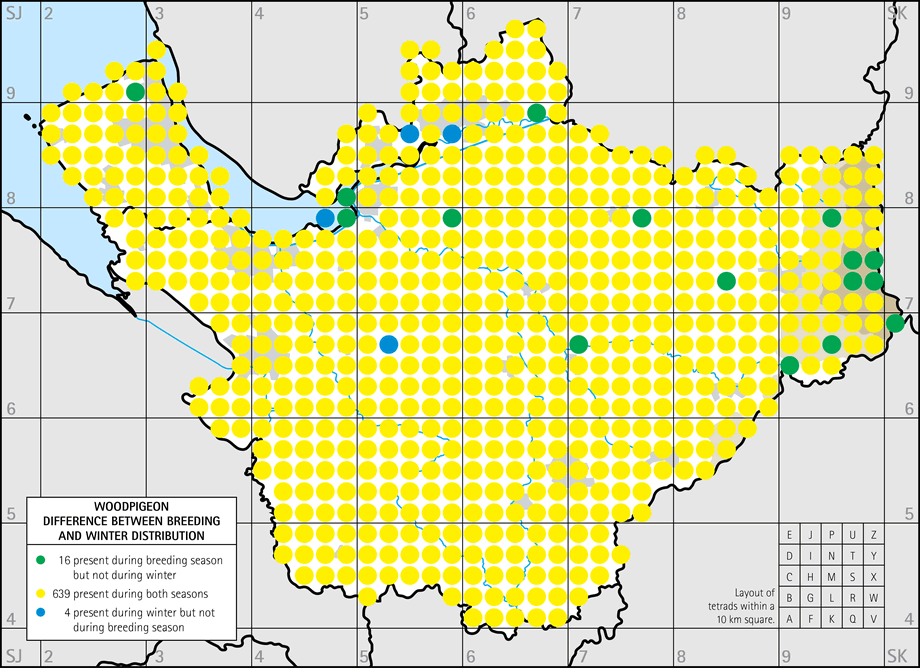
Woodpigeon is now the sixth most abundant species in Cheshire and Wirral, with a breeding population in 2004-05 of 129,890 birds (102,450-157,330), corresponding to an average of almost 200 birds per tetrad in which they were found. The abundance map shows that they were least numerous in the eastern hills and in the most wooded parts of the county, in north-east Cheshire and the centre around Delamere, with highest densities in agricultural areas. The distribution map shows that they were present almost everywhere in this Atlas, as they were twenty years ago. Their numbers are probably higher, however, as the national breeding population index has risen steadily year on year, and was up by 60% in the twenty years since 1984.
Their move into suburban and urban areas, first started in about the 1930s, is now complete and modern Woodpigeons appear to have little fear of man. The habitat codes showed 2.5% of records in urban areas and 7.5% in suburbia, with 9% in rural human sites. 37% of records were in farmland habitats, 36% in woodland and 6% in scrub.
They have an extended breeding season, at least from April to October, but most successful nests come later in the season, from July onwards, when the nests are better hidden by leaves and there are far more seeds available for the adults to eat (Murton 1965). They may well nest earlier in urban areas but the switch to autumn sowing, and thus earlier ripening, of cereals has helped them advance their breeding season in farmland (O’Connor & Shrubb 1986). The flourishing population in Sefton Park, Liverpool is more akin to farmland birds in their timing, perhaps because they feed especially on oilseed rape, flying at least 6 km away from the nest to fields outside the city (Slater 2001). This strategy obviously works because the nests of those pairs, and perhaps those of similar habit in Cheshire and Wirral, are much more successful in raising young than is found in farmland nests.
Fieldworkers proved breeding in two-thirds of tetrads, usually by finding a nest, sometimes given away by an egg shell on the ground beneath. Henry Finch, whilst surveying near Alvanley (SJ47W), had the unusual experience of recording a nest’s contents by seeing an ‘obliging’ crow remove an egg. Their nests are built of a few twigs, often so flimsy that the eggs can be seen from the ground underneath, birds often drawing attention to them by uttering a soft ‘coo’ close to the nest. Typical sites are hawthorn hedges and creepers such as ivy, but many birds build in trees, of almost any species. Perhaps a measure of their high density is that nests were found on girders in barns and in industrial sites, more typically the habitat of Feral Pigeons or Collared Doves. An urban myth says that ‘you never seen baby pigeons’ but observers in 88 tetrads found recently fledged youngsters, perhaps none as easily as Marc Granville who had them come into his Holmes Chapel garden (SJ76T) and comically try using his children’s climbing frame from which to learn to fly.
Atlas account sponsored by by David and Fran Cogger in memory of Jasper
Winter
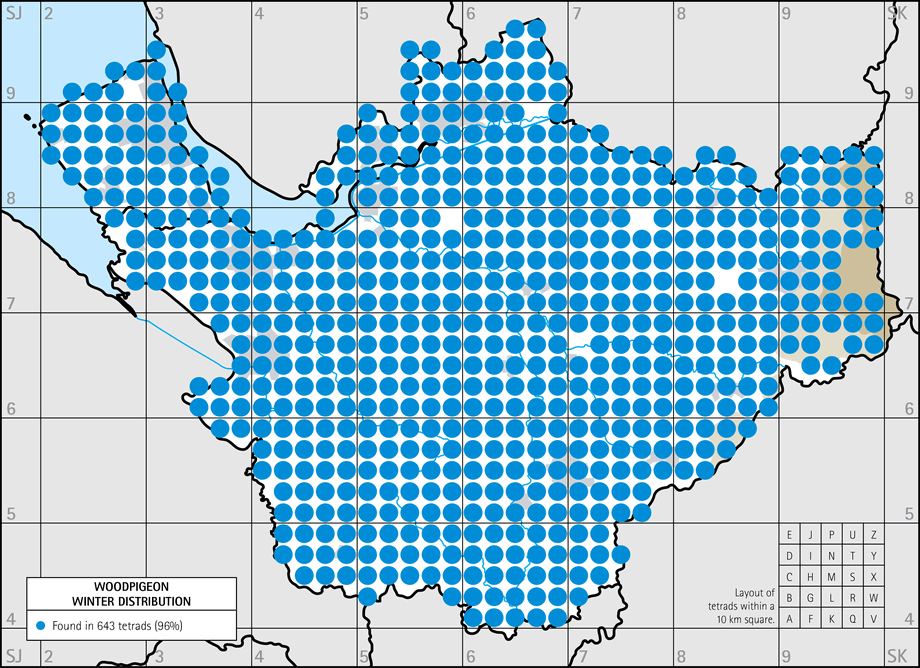
The winter survey showed Woodpigeons to be almost ubiquitous, missing only from a few of the easternmost and bleakest tetrads on the Derbyshire border and a few scattered squares elsewhere. Many Woodpigeons change habitats in winter, with more records in farmland (55% of the winter records), including 4% in stubble. Fewer (29%) were in woodland or scrub (2%), with 2% given a range of codes in the semi-natural grassland and marsh group. The changes in occupation of the ‘human site’ categories were puzzling, with half as many as in the breeding season in urban or rural areas, but much the same numbers in suburbia. They will even enter the smallest gardens if they see suitable food.
Birds were reported feeding on a wide variety of agricultural land, oilseed rape, sprouts, turnips, bare and slurried stubble, ploughed fields, horse paddocks, and improved grassland with sheep grazing. Boyd (1951) undertook a very informative analysis of the number of Woodpigeons he had recorded feeding in different agricultural crops. Their preferred order, judging from the size of the flocks, started with clover, then kale and similar brassicas, grain, newly-sown fields, pasture, and finally, least favoured, stubble, ploughed land and old potato ground. We do not know how much of each crop was available, or the extent of shooting or scaring, but the main change from today is that little clover is grown now, and oilseed rape is usually their favoured food. However, although oilseed provides Woodpigeons with a more than ample food supply, its nutritional value is low and birds have to consume vast amounts of it and spend long hours each day feeding. Higher quality food such as grain, beechmast or acorns is preferred, if available.
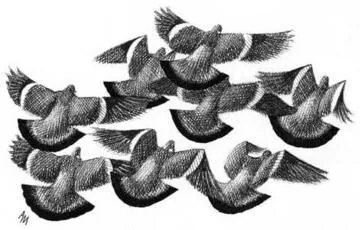
Woodpigeons tend to forage in groups, fieldworkers submitting 726 counts of flocks. The median size was 30 birds, with 184 over 100 and four flocks over 1,000 strong, with a maximum of 2,000 at Caldy (SJ28H) in 2004/ 05. They also gather to spend the night communally, and 96 records were submitted of flocks going to roost, with half of the counts of 100 birds or more, with seven over 1,000, topped by the gathering of 2,500 noted by Pete Hall at Toft (SJ77N) in 2004/ 05.
All previous authors have commented on winter immigration of Woodpigeons, although there is no evidence for their origins. Coward (1910) wrote that these winter influxes vary from year to year. In keeping with the norm for the time, he gave no numbers, but the winter of 1893/ 94 saw ‘an exceptional invasion’, with ‘hordes’ of the species in Cheshire, correlated with an unusual abundance of acorns. Hardy (1941) described the species as an abundant winter visitor, ‘about three times the nesting population’, with immense winter flocks roosting in woods, especially pines. Boyd (1951) recorded influxes in November and December, with winter flocks numbering many hundreds and even thousands. Bell (1962) wrote that winter immigration varies from year to year, sometime in hundreds or even thousands.
Most British adult Woodpigeons are sedentary, but first-year birds disperse up to a median distance of 30 km in midwinter, returning towards their natal area to breed. Since about 1980, the growing of oilseed rape has influenced their behaviour, with few birds moving away from areas where it is available (Migration Atlas). The large flocks that are seen moving south in some years, usually in October, might be from the highly migratory northern European populations, drifted over on their journey to Iberia to feed on the copious acorns there.
Atlas account sponsored by David and Fran Cogger in memory of Jasper