
Sandbach Flashes: birds and wildlife

About the Atlas
During the three breeding seasons 2004–06 and three winters 2004/05–2006/07, Cheshire and Wirral Ornithological Society (CAWOS) organised more than 350 volunteers to survey all of the county, trying to find every species of bird that was breeding or wintering
Woodcock Scolopax rusticola
Breeding

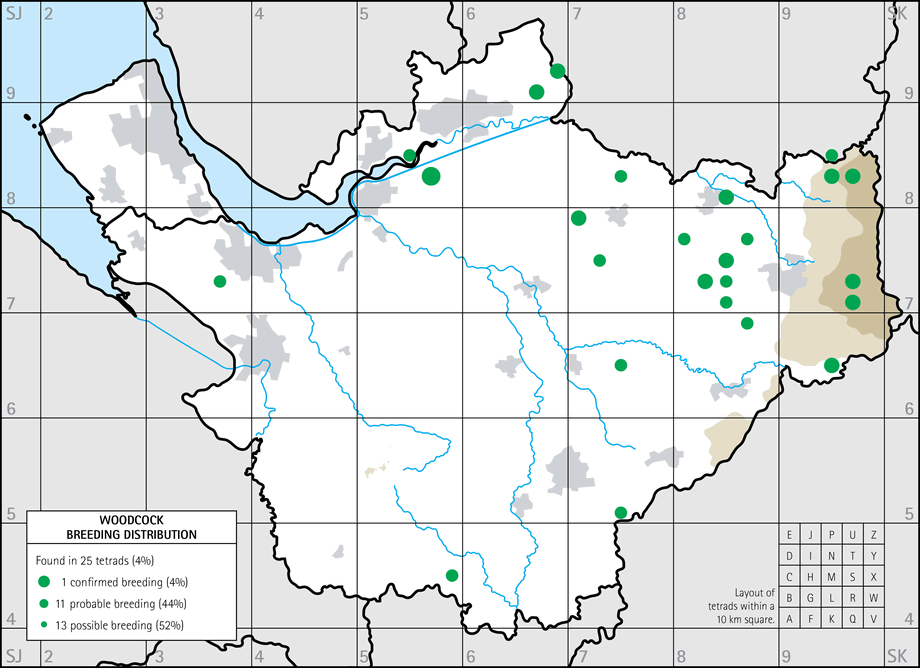
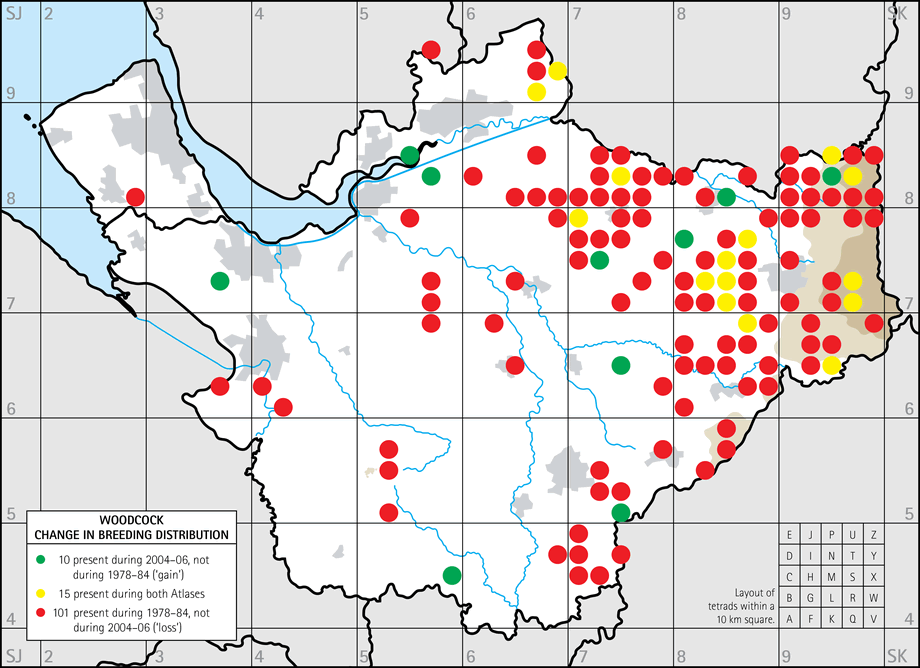
Woodcocks have declined substantially as a breeding bird in the last twenty years. The map showing change from our First Atlas reveals that they were present in just 15 tetrads in both surveys, with birds in ten new tetrads now, and lost from 101 occupied during 1978-84. This is not an easy bird to census. BTO CBC results show decreases every year from its peak in 1974 until the end of the CBC in 1999, with a 76% drop in that quarter-century. From the end of our First Atlas fieldwork period in 1984 there has been at least a 60% fall in the national population, so it is not surprising that this Atlas shows a substantial contraction in range, and Woodcocks are now almost entirely a bird of eastern Cheshire.
Most of the Atlas records were of birds in May or June roding, their peculiar display flight in which males fly in circuits just above the woodland canopy in the half-light of dawn or dusk, emitting low pitched grunting noises and loud shrill disyllabic whistles. The sounds can carry up to 300 m and probably attract the attention of a female, which in turn entices the male to the ground. Woodcocks are polygynous, with a few older, dominant males roding for the longest each day and obtaining most of the matings with females, whereas first-year males only rode for short periods. Birds were recorded for this Atlas roding in eight tetrads, with a bird visiting a possible nest site in another and one observer reported pairs in another two tetrads. The only confirmed breeding record came from Daresbury Firs (SJ58R) where a bird was inadvertently flushed off eggs at the base of a fir tree in a heathland regeneration area. According to the annual county bird reports, this appears to be the first proven breeding since 1984. Although they are probably under-recorded, it seems unlikely that the county population will be more than 20 or 30 breeding females, a substantial drop from the estimate of 150 just twenty years ago.
Birds were recorded for this Atlas in a range of woodland types: broadleaved (9 tetrads), coniferous (2), mixed (6), waterlogged (carr) broadleaved (2) and waterlogged coniferous (2). Their preferred breeding habitat is deciduous or mixed woodland, with conifer plantations used up until they become too dense; at least some understorey and damp earthworm-rich soils are important, as are wide rides and small clearings (2-4 ha) in larger woods. Their current breeding distribution corresponds roughly with the most wooded parts of the county.
Woodocks probably merit a place on the Red List of species of conservation concern, but are currently Amber Listed until specialised surveys have ascertained their true status as a British breeding bird. The reasons for the species’ decline are not well established, but the hypotheses include recreational disturbance, the drying out of natural woodlands, overgrazing by deer, and the maturation of new plantations (Fuller et al 2005).
Atlas account sponsored by John E. Ashworth
Winter

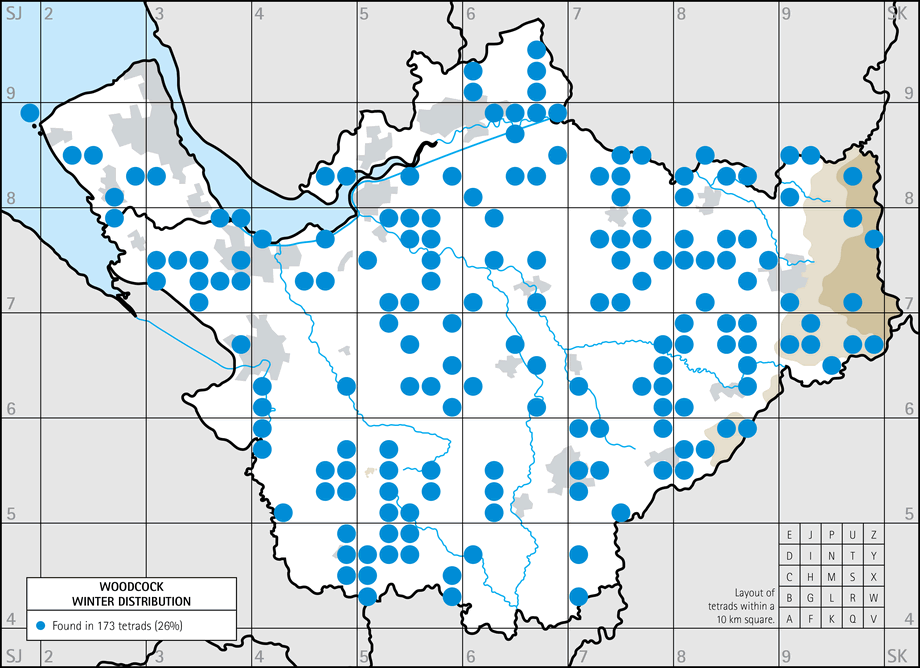
Most British Woodcocks are sedentary, but their numbers are dwarfed in winter by those of birds from the northeast, with migrants outnumbering residents by about 13:1 in midwinter (Migration Atlas). Birds generally arrive on the November full moon, mainly from Fennoscandia and the Baltic states, with a few from Russia; one ringed in Lithuania was shot at Thurstaston (SJ28M) on 24 November 2003. When they first come in overnight, Woodcocks are prone to turning up in odd places including, in foggy weather, flying into tall buildings. Amongst those recorded in this survey were birds brought into a veterinary surgery in Birkenhead and caught by a cat in Tarporley, both released unharmed. The Atlas map shows them widely distributed across Cheshire, at all altitudes, although avoiding urban areas and sparse on Wirral.
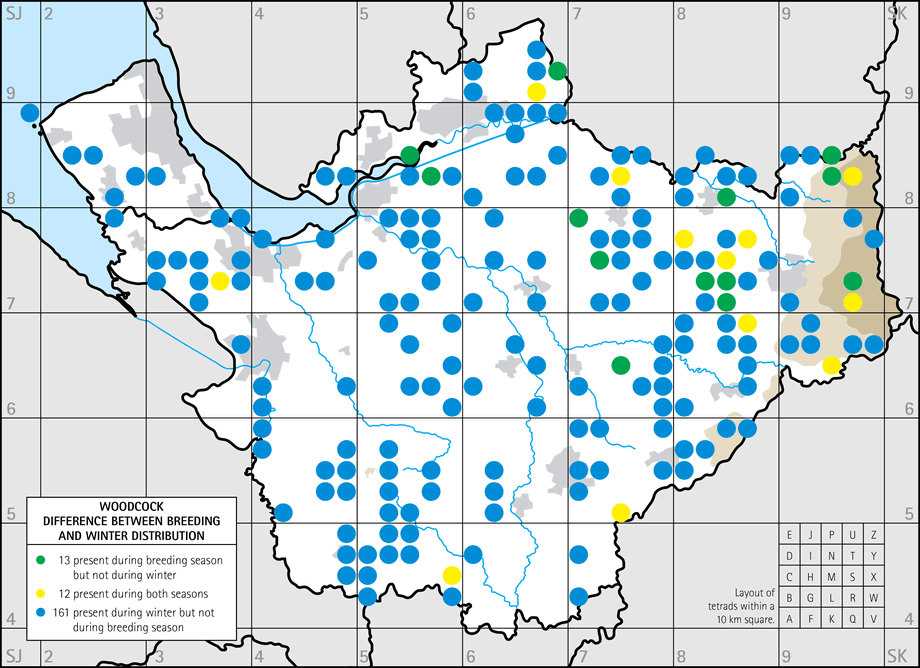
In winter, Woodcocks mostly feed in fields at night, mainly eating earthworms and preferring areas with permanent, frost-free pasture or long-rotation grass leys because these offer the highest density of invertebrate foods. During the day they rest within woodland or scrub within about 1 km of the feeding sites, and their winter distribution is determined mainly by the availability of suitable nocturnal feeding areas rather than diurnal cover; these relaxed habitat requirements mean that they are found in a much wider range of woodland than in the breeding season, with even some quite small patches of scrub often holding Woodcock during the day.
Because they leave the woods after sunset and return before sunrise, most birds are recorded in their daytime loafing areas rather than where they feed, and the submitted habitat codes reflect this bias. 59% of the records were in woodland, including 12% in waterlogged carr, with 10% in scrub, mostly regenerating natural or semi-natural woodland. There were odd records from wet pastures and rushy fields, with 5% in bogs, 7% on farmland, mostly grassland or stubble, and 6% in freshwater sites, mostly narrow watercourses. Woodcocks are susceptible to cold winters when the ground freezes, and then tend to seek unfrozen areas in ditches or alongside small streams.
Most birds were found singly, accounting for two-thirds of the Atlas records, and they spread out in separate areas when feeding although several can share a favoured daytime site: there were three records of four birds, three of five and two of six, all eclipsed by the figures of up to twenty counted in Moss Wood on the Cholmondeley estate (SJ55K). Some large totals are occasionally reported from shooting estates. Figures from the Game and Wildlife Conservation Trust show an average of about 1.5 birds shot annually per km2 of estate area, with little change in this number from the beginning of the 20th century.
Coward (1910) knew the species as a winter resident in varying numbers, occurring in all parts of Cheshire, and Bell (1962) suspected that it was under-recorded and wrote that ‘as a winter visitor it must be much commoner than the records indicate’. That comment probably still applies nowadays, and an element of luck is needed to find Woodcocks, but this Atlas map shows them to be widespread and is probably the most comprehensive ever assessment of their winter distribution in the county.
Atlas account sponsored by John E. Ashworth