
Sandbach Flashes: birds and wildlife

About the Atlas
During the three breeding seasons 2004–06 and three winters 2004/05–2006/07, Cheshire and Wirral Ornithological Society (CAWOS) organised more than 350 volunteers to survey all of the county, trying to find every species of bird that was breeding or wintering
Wren Troglodytes troglodytes
Breeding
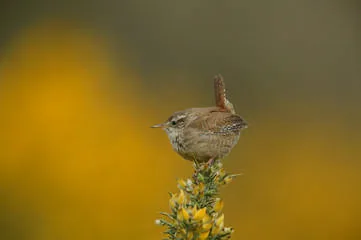
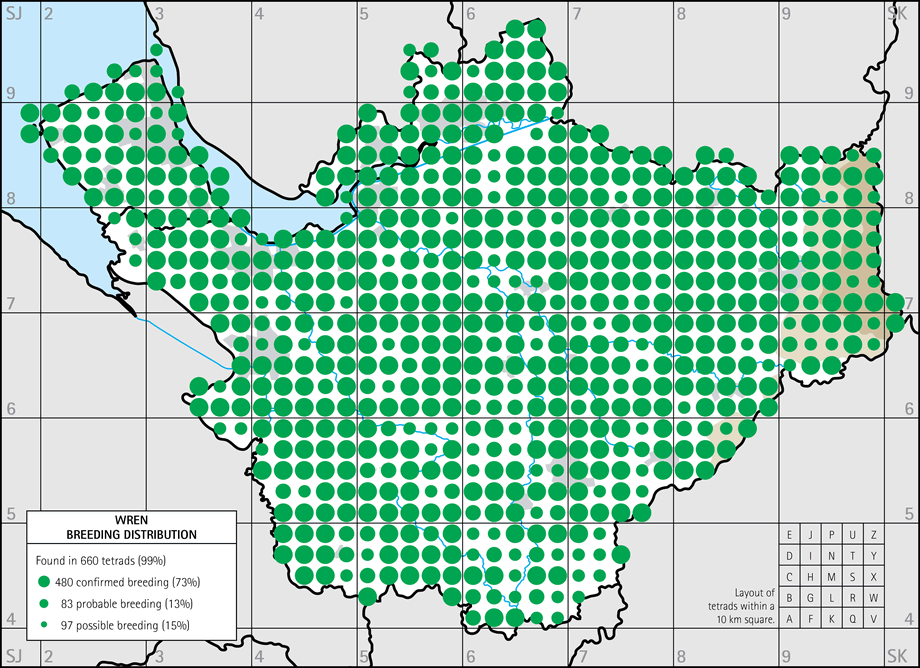
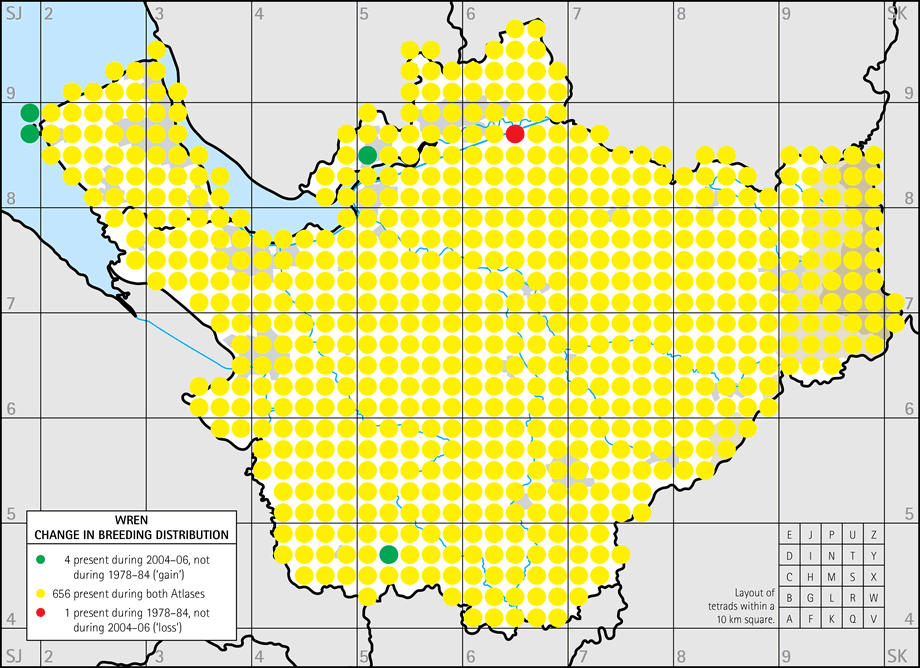
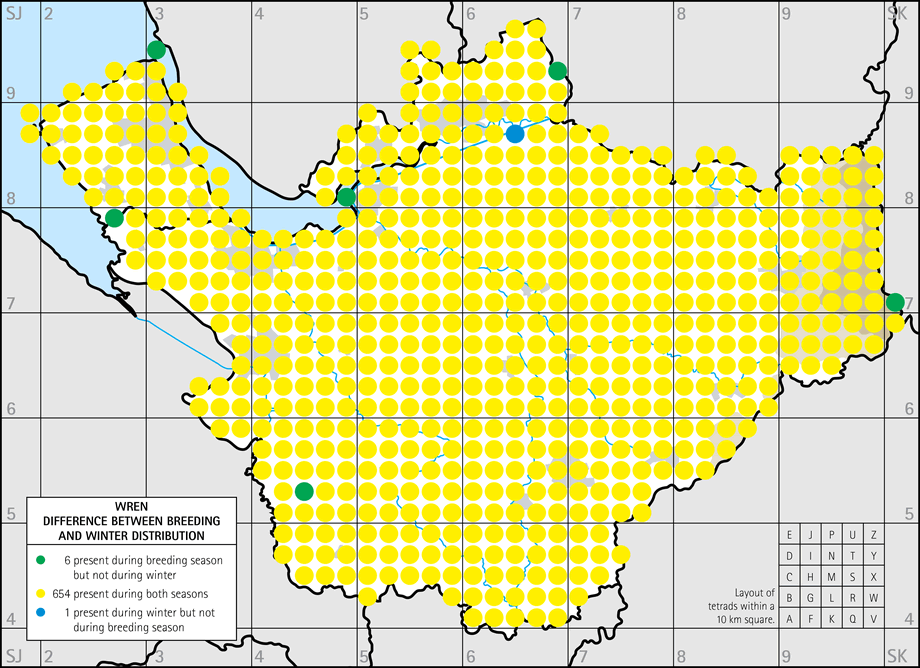
This Atlas survey showed that Wren is now the county’s most widespread breeding species, present in 660 tetrads and only missing from the estuarine saltmarshes. The only change since our First Atlas is that Wrens have bred on Hilbre since the mid-1990s, last known in the 1930s (Hardy 1941).
The key to the Wren’s success is its ability to thrive in a variety of habitats. Fieldworkers recorded Wrens in farmland (32% of records), woodland (29%), human sites (27%) and scrub (10%). The species’ habitat preferences run in the order: first, small woods and clumps of trees with underlying scrub; next, rough vegetation along rivers, streams and ditches; followed by gardens and the edges of farmland ponds, with field hedgerows the least favoured (Williamson 1969). Now, with their population at a high level, it is not surprising that every habitat is occupied.
Wrens were confirmed breeding in 73% of their tetrads, with observers in 163 tetrads recording adults carrying food or a faecal sac, in 206 tetrads seeing recently fledged chicks and finding nests with young or eggs in 111. Male Wrens build several ‘cocks’ nests’, domed balls of moss, leaves and grasses, from which his mate chooses one and lines it with feathers. The same procedure is followed for the almost customary second brood in July. Most nests are in hedges or creeping plants or in holes such as rock crevices, amongst tree roots or, especially in the hills, drystone walls and stunted hedges provide numerous nest-sites. In farm buildings they often build on an old Swallow’s nest, and several observers reported Wrens using nests in artificial sites including under a bridge, in a car port, in honeysuckle against a pole in a garden centre, on the timber frame of a hide at Woolston Eyes, and one found by Tony Coatsworth in Little Bollington (SJ78I), where an adult was feeding chicks in a hanging basket outside a pub.
The BTO analysis of Breeding Bird Survey transects shows that this is our seventh most numerous species, with a breeding population of Cheshire and Wirral in 2004-05 of 129,370 birds (108,620-150,110), an average of almost 200 Wrens per tetrad across the county. In the best habitats there are up to 320 birds per tetrad, as the abundance maps shows in scrubby areas along the Mersey valley and south Wirral, and in south-east Cheshire.
There is no long-term trend in the national or local Wren populations but their numbers can fluctuate enormously, dropping to less than one-quarter of their maximum level following the severe winter weather of 1962/ 63, with other large drops in 1978/ 79 and 1985/ 86. In exposed sites, almost every Wren might die, with the population restocked from birds surviving in sheltered farmsteads and villages (Peach et al 1995). In recent years, the limit on their population has been competition from other Wrens as they reach the carrying capacity of the environment.
Atlas account sponsored by Andy Harmer
Winter
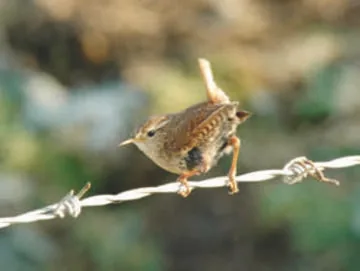
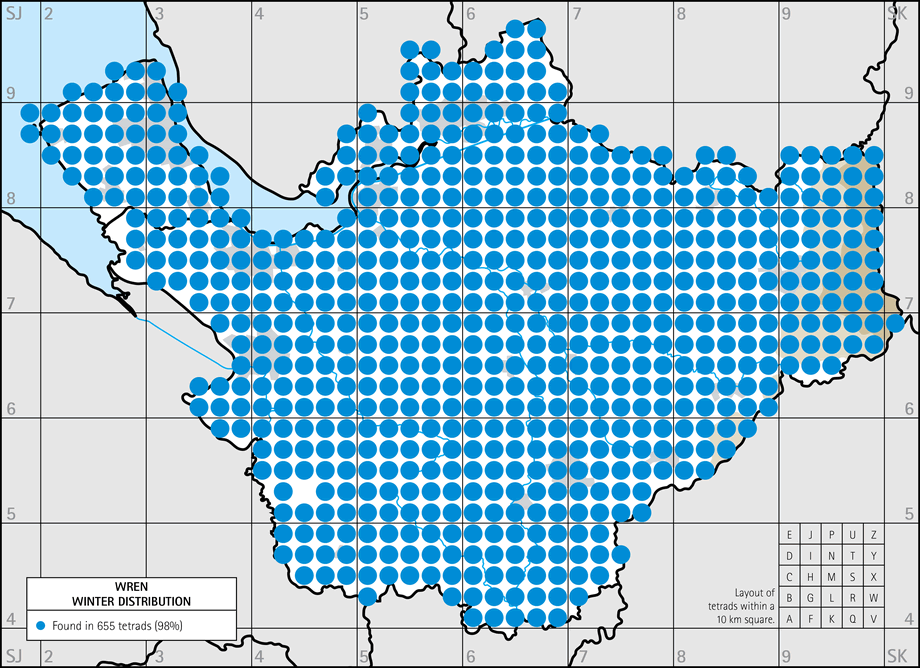
Some Wrens undertake altitudinal migration (Migration Atlas), leaving the highest ground, but surveyors for this Atlas found some birds in virtually every tetrad apart from the highest of all in the county (SK07A), lying above 500 m. Otherwise, many birds stay on or near their breeding areas. Typically of insectivores, many Wrens establish winter territories. Indeed, ensuring over-winter survival is so important to them that competition for territories may start in July (BTO Winter Atlas). There is little aggression during winter and many birds are unobtrusive. The odd bursts of winter song seem to be unrelated to declarations of territorial possession. As might be expected from a territorial species, half of the counts submitted by Atlas surveyors were of single birds. Some Wrens do gather into groups, especially in reedbeds and other habitats not used for breeding; these birds contain a majority of females, somewhat smaller than males, that have probably lost out in a contest for a territory.
As in the breeding season, Wrens find most of their winter food close to the ground, in ditches, hedges, crevices in walls and the like, which they search assiduously for insects, spiders and some seeds.
Habitat occupation in winter is determined partly by availability of food but especially by shelter from cold and winds. Atlas fieldworkers registered significant drops in almost every category of habitat code except for urban and suburban areas, but with substantial increases in the totals in hedgerows. To some extent birds flitting about in hedges might be more noticeable, with silent birds in woodland or scrub being quite inconspicuous, but there are some real differences in the type of hedges used: in the breeding season, the two categories of hedge (more or less than 2 metres in height) were equally occupied, but in winter there were significantly more Wrens recorded in short hedges. The BTO Winter Atlas noted that farmland hedgerows were commonly empty in winter, but that certainly is not the experience during this survey. The explanation for the disagreement may be winter temperatures, with the first national winter atlas collecting data during the relatively cold winters of 1981/ 82 to 1983/ 84, when the first winter had two ten-day spells of sub-zero temperatures, much colder than during this Cheshire and Wirral Atlas.
As a small resident insectivore the Wren is always vulnerable to hard weather. One way in which they try to keep warm overnight is by sharing roost sites, birds huddling together to minimise loss of heat. One such roost was reported during this Atlas, in house ivy near Mow Cop (SJ85U) where Alan Straw counted ten birds; the maximum at the same site had been 17 in 2003/ 04.
Atlas account sponsored by Andy Harmer