Review of Bird News (CAWOS) March 2025
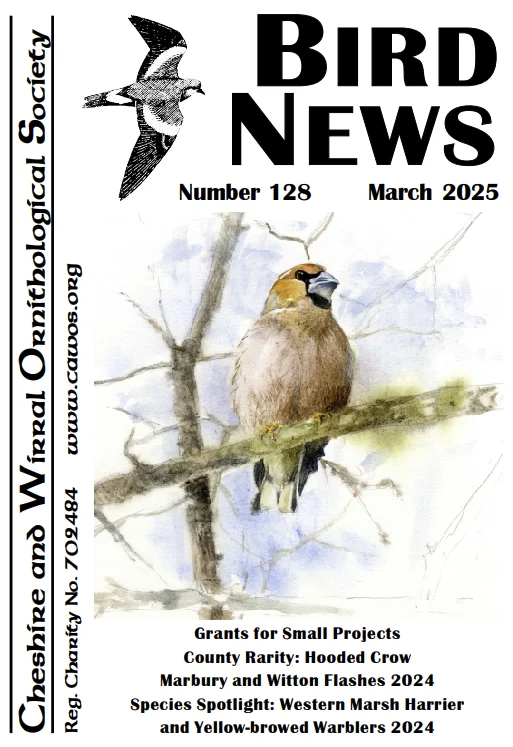
Review of Bird News (CAWOS) March 2025
Our own flashes feature strongly in Bird News 128, the March 2025 newsletter of the Cheshire and Wirral Ornithological Society (CAWOS). The county round-up lists Caspian Gull, Hen Harrier and Yellow-browed Warbler on the patch. The wider issue also brings big news: ten Marsh Harrier nests in the county in 2024, a record autumn for Yellow-browed Warblers, and a stark ringing year at Woolston.
Here is a summary of what the issue found, with the bits that matter most for anyone watching the Sandbach Flashes. All credit goes to the writers named below and to CAWOS, whose newsletter is well worth joining for.
Our patch in the county round-up
The Crewe and Nantwich section of Tony Parker’s county round-up reads like a highlights reel of autumn and early winter 2024 on the flashes:
- Caspian Gull on Elton Hall Flash on 1–2 September, 21–28 October and 30 November.
- Hen Harrier at Maw Green Tip on 27 September.
- Nine Whinchats at Maw Green Tip on 12 September.
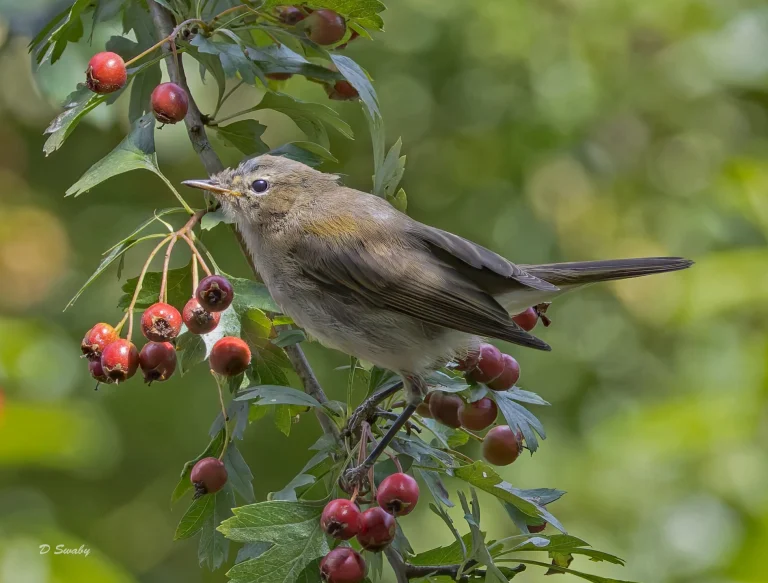
- Yellow-browed Warbler at Elton Hall Flash on 9 October, part of the big national influx described below.
- Garganey at Railway Flash on several dates through October.
- Green-winged Teal at Pump House Flash on several dates in November and December.
- Eight Whooper Swans at Watch Lane Flash on 13 November.
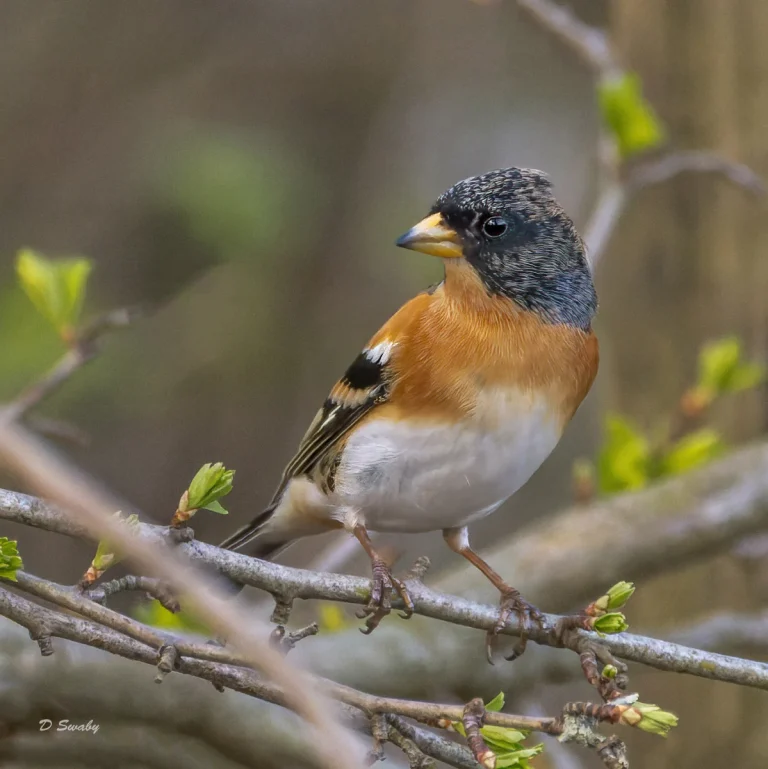
Nearby there were three Black Terns at Hurleston on 8 September, a Black-necked Grebe at Doddington on 22 September, and up to seven Bramblings at Bickerton on 10 October. The round-up thanks SECOS and the Sandbach WhatsApp group among its sources, so local records are clearly reaching the county picture.
The round-up notes that some records may not yet have been checked by the CAWOS Rarities Panel or the BBRC.
Marsh Harriers: ten nests in a year
Ten Marsh Harrier nests were found in Cheshire and Wirral in 2024, nearly 15 years after the county’s first breeding record in 2010. Andy Harmer found them with a thermal-imaging drone, flown under licence and at heights that don’t disturb the birds.
The nests lay in a triangle from Neston to Woolston to Northwich, and half were around Frodsham. In two areas a single male seemed to be feeding two females. Despite a cold, wet spring that held back local Buzzards, the harriers laid on time from mid-April.
The drone footage turned up some surprises:
- A male was seen snipping reeds in a gap where, ten days later, a female was sitting on a new nest.
- Males brought in most of the nest material, but females arranged it. Some males simply dropped reeds onto the chicks.
- One male brooded a chick while the female was away, which is unusual.
- Another male took to perching on a camera mount placed two metres from the nest. That hardly fits the species’ reputation for being wary of new objects.
- Successful nests were rebuilt within 5 to 10 metres the next year. Failed sites were never reused.
Twelve chicks from four nests were colour-ringed, with green rings carrying a white code. A pair also tried to nest at Ashton’s Flash near Northwich, which Greg Baker covers in his Marbury review. The young hatched but none survived. With reedbeds filling up, Andy expects harriers to spread to new habitat, perhaps tall biofuel crops such as miscanthus. That makes any Marsh Harrier lingering around our own reedbeds worth noting.
The full illustrated version of Andy’s article is at Cheshire & Wirral Raptor Study Group.
Yellow-browed Warblers: a record-breaking autumn
Autumn 2024 brought one of the biggest Yellow-browed Warbler influxes ever into north-west Europe, matching the famous 2016 arrival. Richard Smith counted 32 records on the Dee Estuary and North Wirral, just short of the 35 there in 2016.
Nationally, the birds arrived in force from 19 September, mostly in Shetland, Orkney and down the east coast. By mid-October they were everywhere, with over 540 national reports in just three days, 14 to 16 October. Locally, Jane Turner’s Hoylake garden produced at least 10. One bird she caught on 10 October was 20% heavier when re-caught three days later, so these tiny warblers were finding plenty to eat.
Inland they turned up too. Besides our Elton Hall bird, there were at least six at Woolston Eyes on 8 October, and five were ringed at Rostherne. That was only the reserve’s second record and its first since 1996.
The puzzle remains why they come at all. The species breeds across Siberia and winters in south-east Asia. Birds reaching Britain seem to fly the opposite way to the rest of the population, and few are seen in winter or on the return trip in spring. Whether this is a new migration route forming, or thousands of lost birds every year, nobody yet knows. For us the lesson is simple: check every tit flock and willow in October.
Hooded Crow: a lost winter visitor
The Hooded Crow has gone from a near-annual winter visitor to almost absent in the county. Since 2003 there have been records on only seven dates, all on the north Wirral coast between 2017 and 2020.
Jane Turner explains that the ‘Hoodie’ is a close relative of our Carrion Crow, and may yet be lumped back with it. The two are almost identical genetically, and hybrids can be hard to spot. A grey-and-black bird in flight may just be recorded as “Hooded Crow or hybrid”.
Steve Barber traced the county record back to 1854, when it was known as the Royston Crow. Wirral birders watched for its winter arrival, and it fed on mussels at Hilbre Point. Into the 20th century it turned up most winters, from Rostherne, where up to four fed on dead birds on the frozen mere, to the east Cheshire hills. The biggest count was 50 over Claughton in Birkenhead on Christmas Eve 1959.
Steve’s best guess at why they stopped coming is that northern and eastern European birds now tend to stay put in winter. The county also lost ground in the national winter atlas while neighbouring coasts gained. A Hoodie at the flashes would now be a real find.
Ringing news: a hard summer at Woolston
Woolston ringed 1,922 birds between April and September 2024, down 56% on 4,386 the summer before. Michael Miles expects 2024 to be the site’s worst ringing year since at least 1993. Bad weather cut sessions from 90 to 70, but that alone can’t explain a fall that size.
- Over 1,200 fewer warblers were caught. More Cetti’s Warblers were ringed than Sedge Warblers.
- Few warblers had laid down fat before migrating, which suggests they were short of insects.
- Greenfinch summer totals fell from 201 in 2022 to 146, then 54. Bullfinch dropped from 79 to 65, then 46.
- Only 7 young Willow Tits were ringed, against 17 the year before.
- Breeding ran about two weeks late for most warblers. The first young Bullfinch wasn’t caught until 27 July.
On Hilbre, 38 birds were caught in November, twice the usual number. They included a Blackbird ringed in Sweden, Scandinavian Blackcaps, and a Siberian Chiffchaff. The Dee colour-ring group logged over 900 sightings of ringed Knots in four months. They also saw Great White Egrets from the new Somerset breeding colony, and a Curlew released from a German zoo’s head-starting project.
The Mid-Cheshire Barn Owl Group reports a below-average 2024 and a wet, cold start to 2025. They ask for any Barn Owl sightings through cheshirebarnowls.co.uk.
Elsewhere in the county
Marbury and Witton Flashes had a quiet 2024 with 143 species, says Greg Baker, but two were new for the site: Little Tern and Ring-necked Parakeet. Like our flashes, they suffered from high water and a poor wader passage. Even Avocet numbers fell. Visible-migration watches produced site records of 315 Meadow Pipits and 9,051 Woodpigeons, and four Hawfinches stayed from November.
Rostherne Mere recorded 127 species, its best year since 2012, says Bill Bellamy. Its ringers caught three Bearded Reedlings, the first there since 1978, and Ring-necked Parakeets were seen almost daily from mid-October.
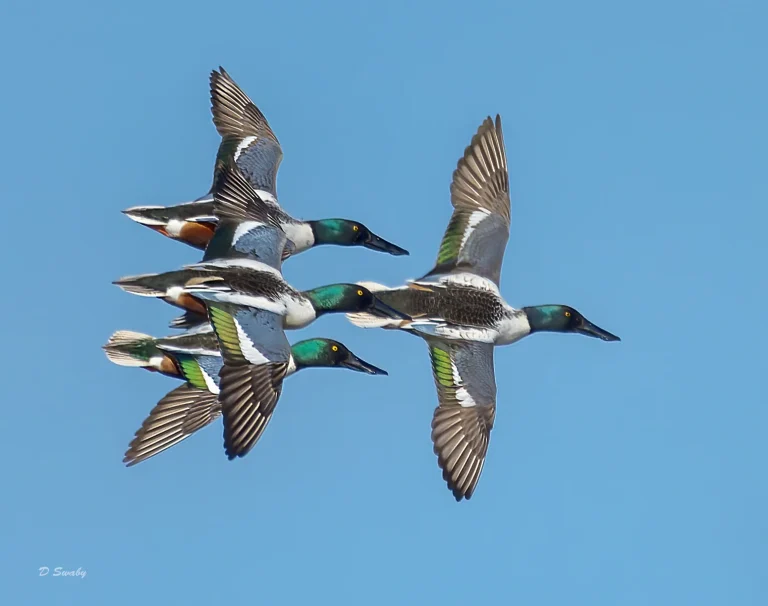
The Dee Estuary has changed hugely in 24 years, as Richard Smith shows by comparing the 1999/2000 and 2023/24 WeBS reports:
| Species | 1999/2000 peak | 2023/24 peak |
|---|---|---|
| Pink-footed Goose | 66 | 23,816 |
| Black-tailed Godwit | 2,543 | 10,422 |
| Little Egret | 5 | 399 |
| Shoveler | 77 | 426 |
| Bewick’s Swan | 56 | 0 |
| Purple Sandpiper | 45 | 20 |
Oystercatchers have recovered to over 27,000 since controls on cockling came in in 2008. Goldeneye have almost disappeared.
How you can help
In his guest editorial, CAWOS President David Norman urges birders to record more than ticks. Many site and year listers stop noting a species once they’ve seen it. As a result, the county knows little about its breeding songbirds, such as the Willow Warbler. You don’t need to find a nest to prove breeding: alarm calls or a bird carrying food will do, noted from the path before you move on.
- Send in your records. Sandbach sightings reach the county report through SECOS and the county recorder, so every sighting counts.
- Note breeding evidence, not just first sightings, especially for declining species.
- Get ready for the next national atlas. The BTO plans to start it in autumn 2027, and CAWOS may run a county atlas alongside it.
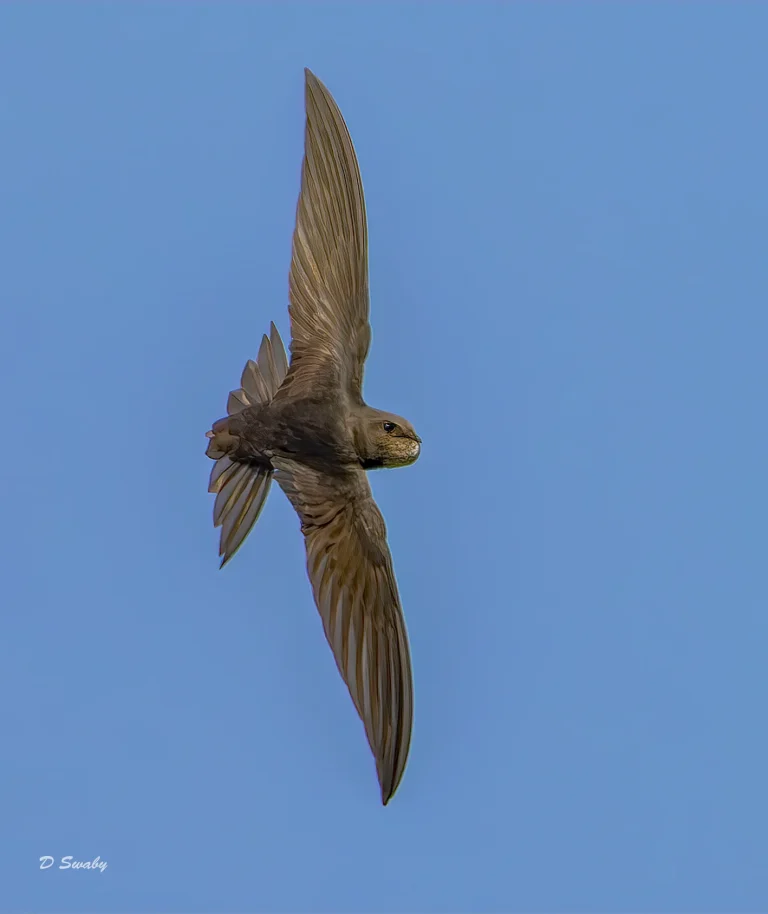
- Join CAWOS surveys. In 2025, the society restarted its own surveys, starting with Marsh Tit, Willow Tit and Swift.
- Apply for a grant. CAWOS launched grants of up to £500 for clubs and community projects that help wild birds. Check cawos.org for the current details.
CAWOS is also short of volunteers to edit and compile the annual Bird Report. If you can help, the society would love to hear from you.
Summarised from Bird News 128 (March 2025), with thanks to the Cheshire and Wirral Ornithological Society and its contributors: David Norman, Jane Turner, Steve Barber, Tony Parker, Andy Harmer, Richard Smith, Michael Miles, John Elliott, Greg Baker, Bill Bellamy and John Mycock. To read the full newsletter, join CAWOS at cawos.org.